
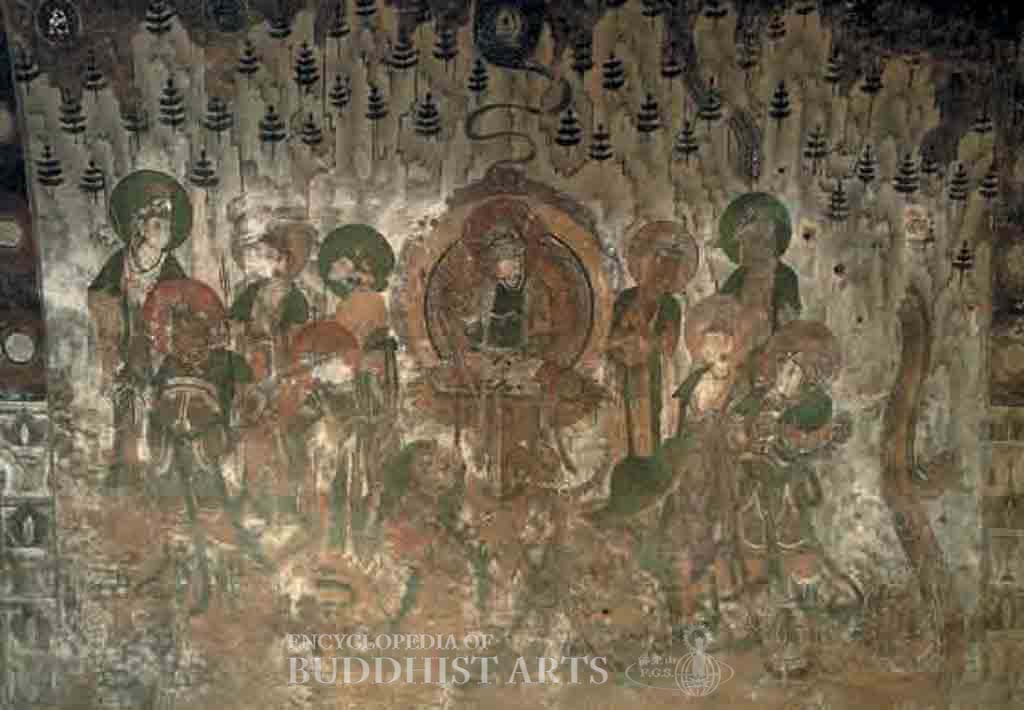
Yulin Cave 29: Manjusri Bodhisattva and Attendants (east wall)
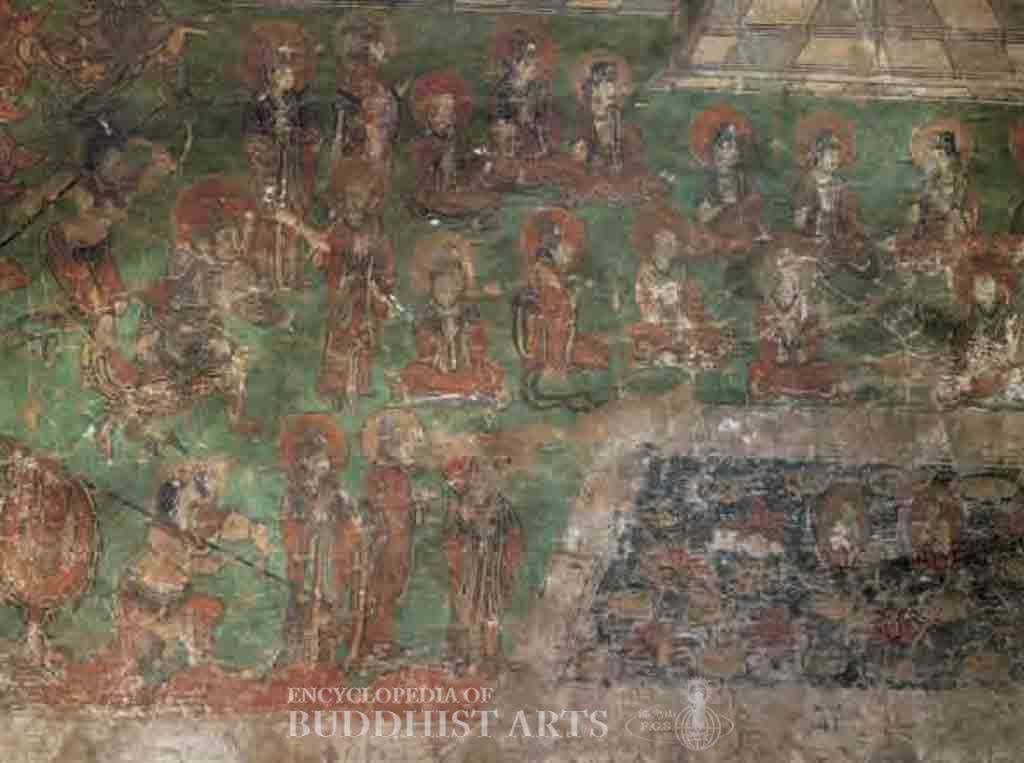
Yulin Cave 29: Illustration of the Amitabha Sutra (detail) (west wall)
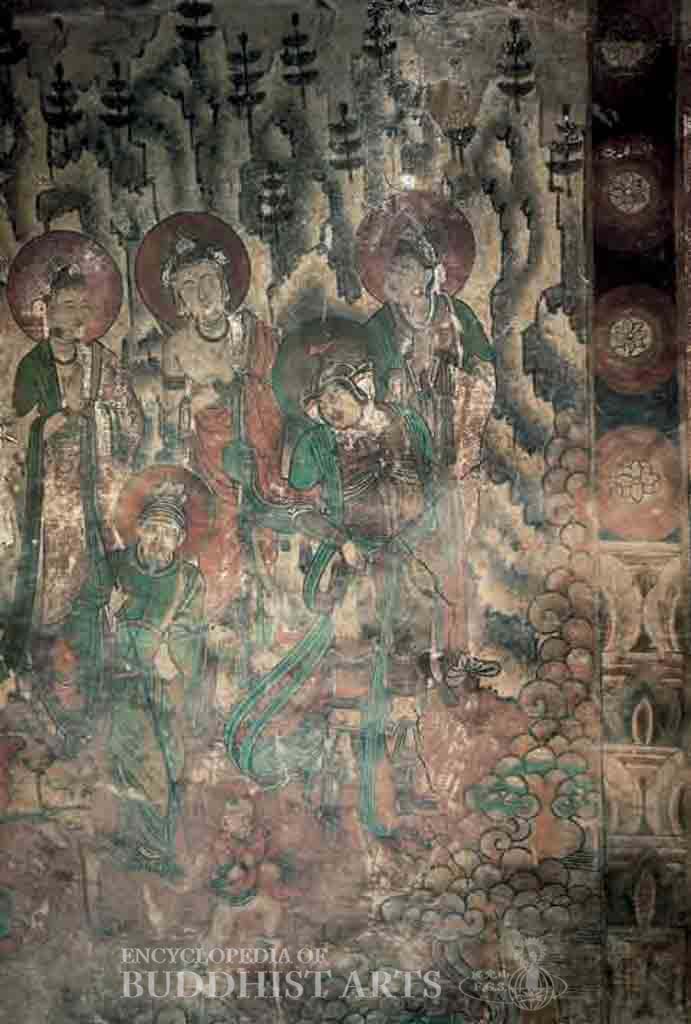
Yulin Cave 29: Samantabhadra Bodhisattva and Attendants (detail) (west wall)
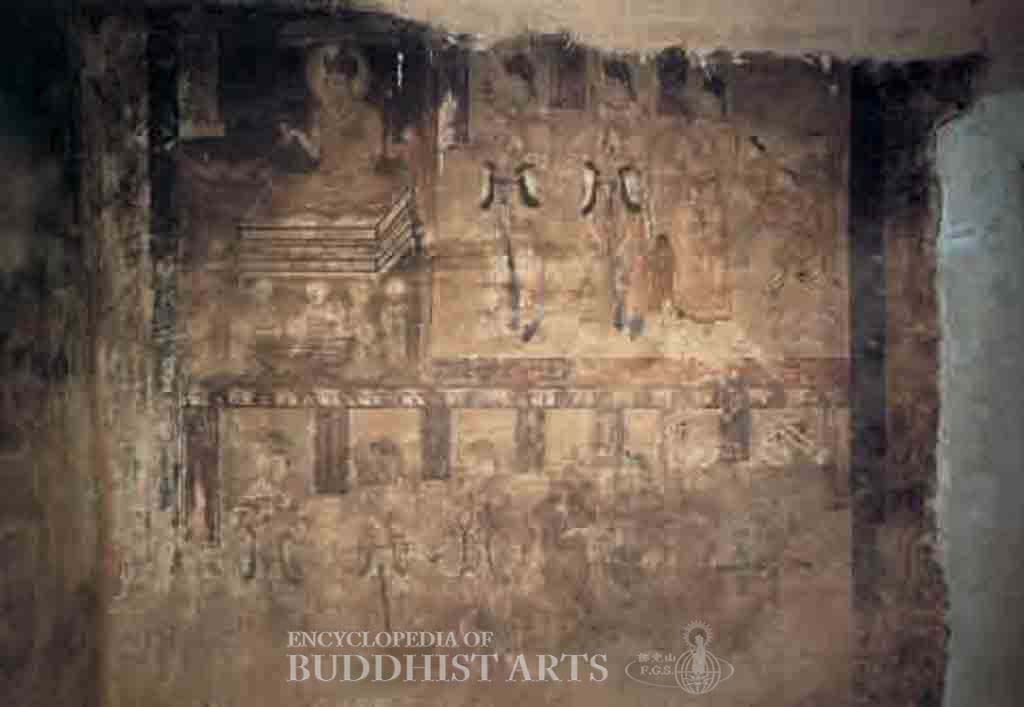
Yulin Cave 29: Front Wall (left side)
Yulin Cave 29
CHINA, Gansu, Guazhou
This is located at the north end of the east cliff facing south. The cave has a square layout with a truncated pyramidal ceiling. It was created during the Western Xia period (1032–1227), and repaired during the Yuan (1271–1368) and Qing (1644–1911) dynasties. Different parts of the cave have been damaged by smoke to varying degrees.
The decorations on the cave ceiling consist of ink inscriptions, the Thousand Buddhas, and draperies. A round, five-tier altar in the center of the cave was made during the Yuan dynasty. On the altar are a number of colorful Qing dynasty statues.
An illustration of the Buddha teaching the Dharma is depicted in the center of the back (north) wall, and murals of Water-Moon Avalokitesvara on both sides. Unfortunately, these murals are no longer discernible. Rows of donor figures are found on both sides of the doorway on the front (south) wall, and an illustration of a National Master is painted in an area on the upper left corner. An image of an eminent monk, which has been blackened by smoke, can be seen on the upper right corner of the front wall.
Along the east wall are illustrations of the Medicine Buddha Sutra as well as Manjusri Bodhisattva and Attendants. The lower section was painted with male donor figures, but these have largely worn away. Illustrations on the west wall are of the Amitabha Sutra as well as Samantabhadra Bodhisattva and Attendants, while along the bottom are female donor figures. The layout of the illustration of the Amitabha Sutra is similar to that of the illustration of the Medicine Buddha Sutra. Strong colors, such as bright red and dark green, give a vivid depiction of the Western Pure Land.
Of the caves created during the Western Xia period, this particular cave contains perhaps the greatest amount of local content. The subject matter and style of the murals possess maturity and demonstrate the masterful artistic skills of the Western Xia period.
For more details, go to the Encyclopedia of Buddhist Arts: Caves T-Z, page 1614.
Cite this article:
author = Hsingyun and Youheng and Johnson, Peter and Mankuang and Huntington, Susan and Edson, Gary and Neather, Robert,
booktitle = {Encyclopedia of Buddhist Arts: Caves T-Z},
pages = 1614,
title = {{Yulin Cave 29}},
volume = 9,
year = {2016}}