
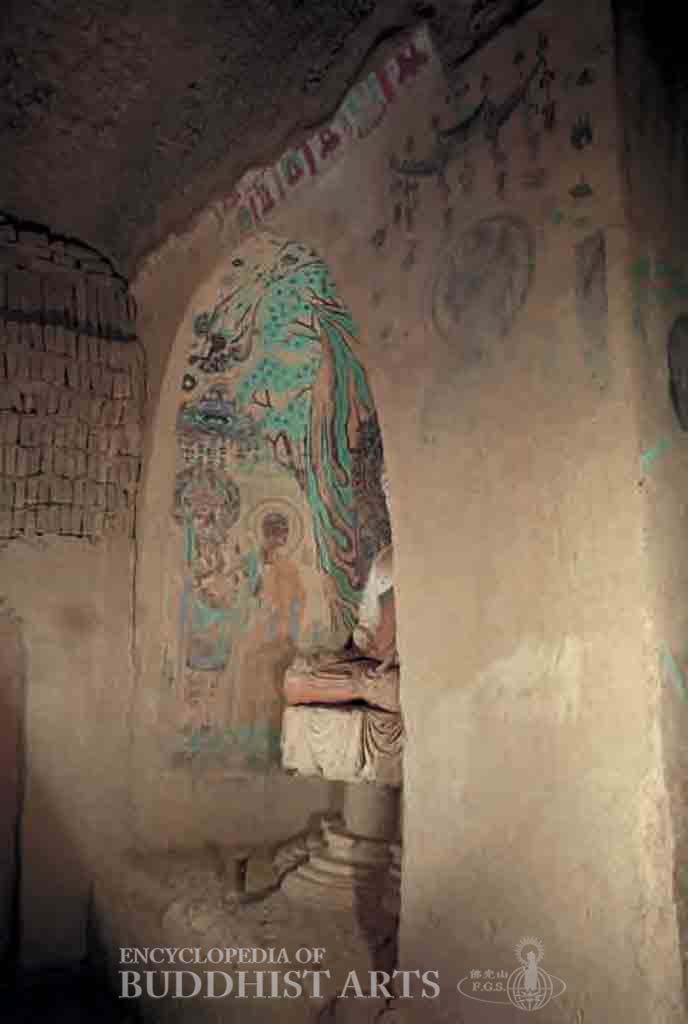
Yulin Cave 28: Central Pillar (east side niche)
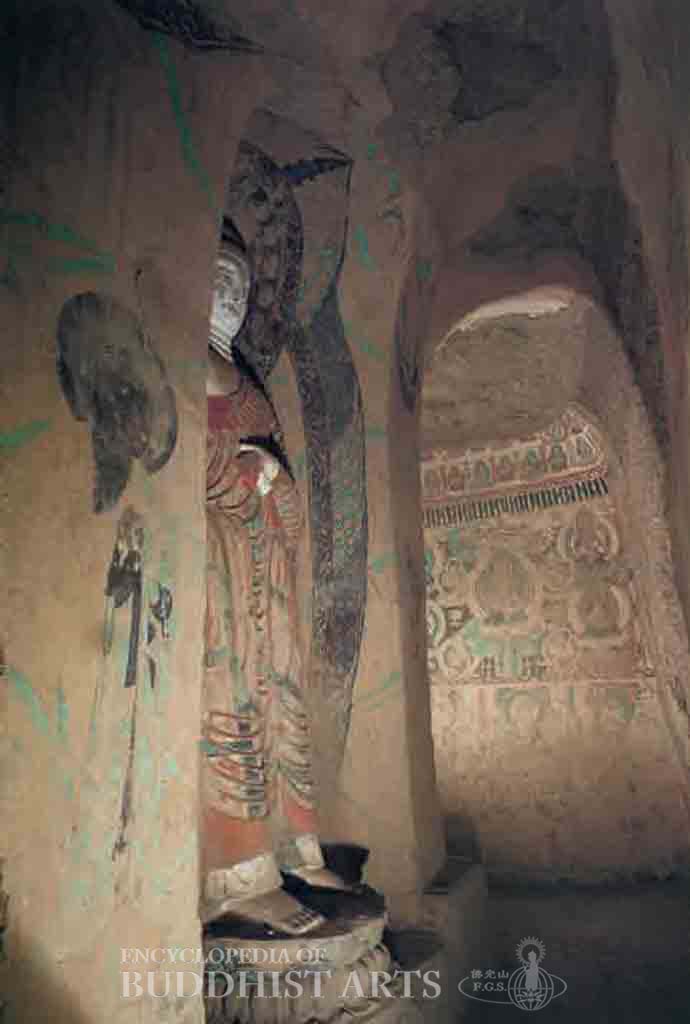
Yulin Cave 28: Rear Corridor and Central Pillar (north side niche)
Yulin Cave 28
CHINA, Gansu, Guazhou
This central pillar cave is located on the lower level of the east cliff and is believed to have been created during the Early Tang period (618–712) with repairs made during the Song (960–1279), Western Xia (1032–1227), and Qing (1644–1911) dynasties. According to archaeological evidence, Cave 28 may be the oldest cave at the Yulin site. The central pillar originally had niches on all four sides; however, the niche on the south side no longer exists. Although the front section of the cave is damaged, the rear corridor and its barrel-vaulted ceiling are relatively well preserved.
The niche on the east side of the pillar contains a sculpture of a seated Buddha with a painted flame-patterned nimbus, as well as an aureole. A Bodhisattva and a disciple are painted on each of the side walls of the niche. The disciple on the left side has been identified as Ananda. Wearing a green and yellow monastic robe, he holds a ruyi (wish-fulfilling talisman) and stands facing the Buddha as if in reverence. The Bodhisattva beside Ananda stands with palms joined, wearing a headdress and a dhoti tied at the waist. There is a nimbus behind the Bodhisattva’s head and an ornate canopy painted above it. A Bodhi tree and an apsara scattering flowers among multi-colored clouds are depicted above. Painted on the niche lintel are remnants of the Thousand Buddhas. The faint remnant of a Bodhisattva painted during the Tang dynasty can be found on the left wall outside the niche, but the details of this image are no longer discernible.
The niche on the north side of the central pillar contains a carving of a standing Buddha. The Buddha wears a monastic robe over both shoulders, with one hand grasping the robes in front of the chest. A nimbus and mountains are depicted on the wall behind the Buddha. The walls on the exterior of the niche are decorated with attending disciples, while above them are apsaras and mountain range. The niche on the west side of the pillar contains a Buddha seated with legs pendent, dated to the Tang dynasty. The remnants of the murals around this niche are a faded Tang dynasty Bodhisattva located on the left side of the niche lintel, and a line drawing of a figure created during the late Western Xia period.
All four walls of the cave have been painted with murals. The left side of the back (east) wall contains an illustration of the Buddha teaching the Dharma, while the right side is painted with an image of Avalokitesvara Bodhisattva. Six Bodhisattvas that have gathered to listen to the Dharma are depicted at the bottom of the wall. A standing Buddha, an illustration of the Buddha teaching the Dharma, and remnants of a Bodhisattva are all found on the north wall. The front (west) wall still contains parts of three seated Buddhas and four faded Bodhisattvas at the bottom right corner. The murals on the ceiling include images of the Thousand Buddhas on the north, east, and west slopes, as well as a ring of draperies beneath them. The date of these ceiling murals is unknown. Although the cave was repaired by later dynasties, it still retains its original Tang dynasty style, and has been a valuable resource for early cave mural research.
For more details, go to the Encyclopedia of Buddhist Arts: Caves T-Z, page 1612.
Cite this article:
author = Hsingyun and Youheng and Johnson, Peter and Mankuang and Huntington, Susan and Edson, Gary and Neather, Robert,
booktitle = {Encyclopedia of Buddhist Arts: Caves T-Z},
pages = 1612,
title = {{Yulin Cave 28}},
volume = 9,
year = {2016}}