
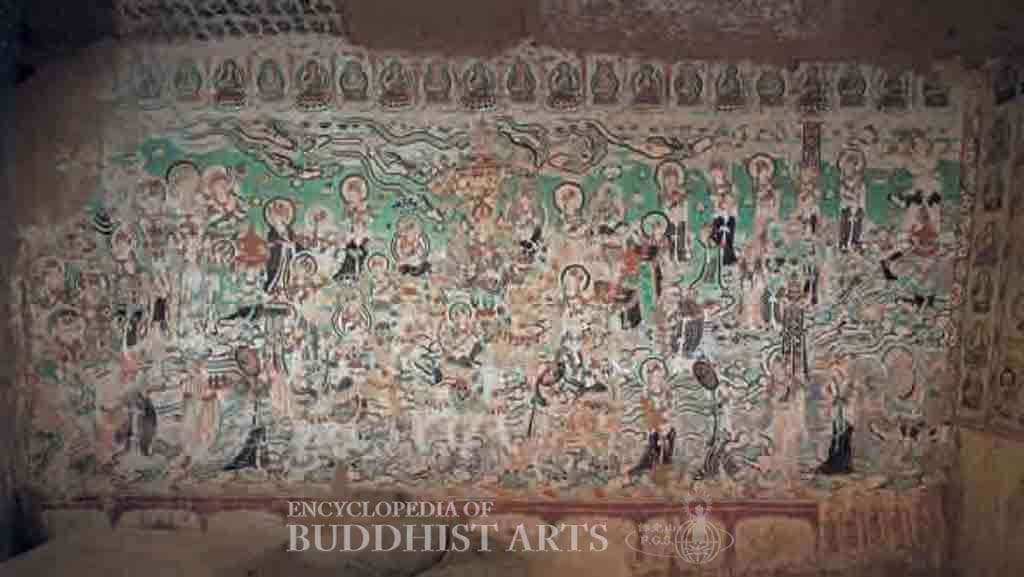
Yulin Cave 35: Manjusri, Samantabhadra, and Attendants - Manjusri Bodhisattva and Attendants (north wall)
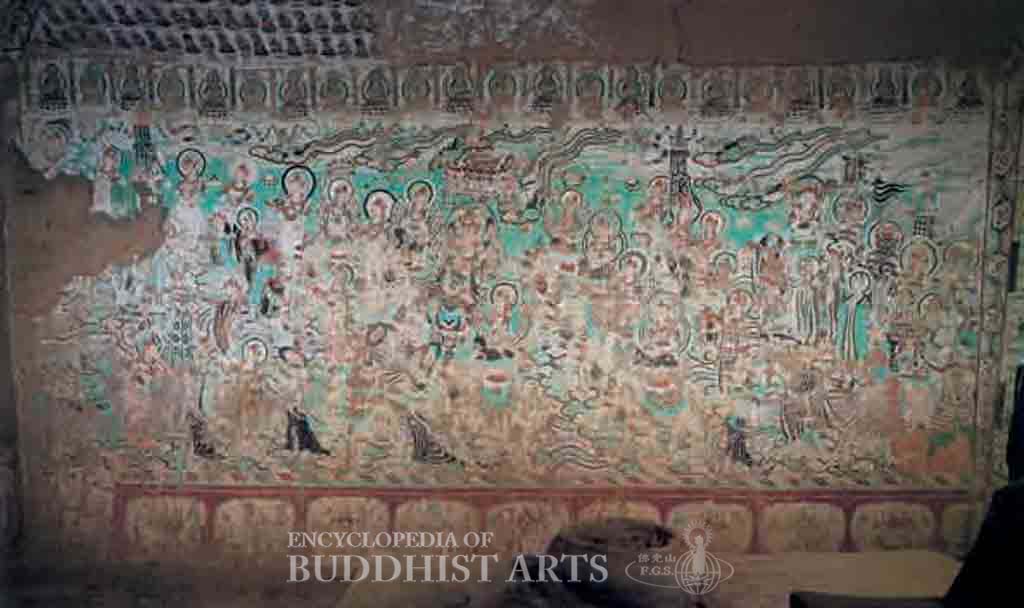
Yulin Cave 35: Manjusri, Samantabhadra, and Attendants - Samantabhadra Bodhisattva and Attendants (south wall)
Yulin Cave 35: Manjusri, Samantabhadra, and Attendants
CHINA, Gansu, Guazhou; Five Dynasties
These murals are located within the main chamber. The cave was built during the Tang dynasty (618–907) and repairs were made in the Five Dynasties (907–960). While most illustrations of Manjusri and Samantabhadra Bodhisattvas in the Yulin Caves are located on either side of the doorway within the main chamber, these two are situated on the north and south walls. They are also the largest in the Dunhuang area. Their scroll-like layouts depict the Bodhisattvas leading their respective processions toward a great gathering. Both are significant pieces among the Vajrayana Buddhist artworks found in Dunhuang.
In the illustration of Manjusri Bodhisattva and Attendants on the north wall, a lion keeper leads the procession with a large incense burner balanced on his head. Two guardian warriors who clear the way are depicted on either side of him. Immediately behind them is a band of heavenly musicians, with rows of banners and Bodhisattvas on each side. An altar table is behind the band, followed by Manjusri and his eight manifestations, all of whom ride upon lions. Manjusri himself is larger than his eight manifestations. Heavenly beings are found at the back. Brahma and Sakra can be seen in the center, flanked by the Eight Classes of Dharma Protectors: heavenly beings, nagas, yaksas, gandharvas, asuras, garudas, kinnaras, and mahoragas. Also within the procession are children who make offerings. In the sky apsaras play musical instruments and scatter flowers. Altogether, there are about 70 figures within the mural, all proceeding forth upon the clouds.
The illustration of Samantabhadra Bodhisattva and Attendants on the south wall is similar in layout, with this procession depicted crossing the sea. Samantabhadra and his manifestations ride upon white elephants, although damage and wear has rendered them indistinct.
For more details, go to the Encyclopedia of Buddhist Arts: Caves T-Z, page 1629.
Cite this article:
author = Hsingyun and Youheng and Johnson, Peter and Mankuang and Huntington, Susan and Edson, Gary and Neather, Robert,
booktitle = {Encyclopedia of Buddhist Arts: Caves T-Z},
pages = 1629,
title = {{Yulin Cave 35: Manjusri, Samantabhadra, and Attendants}},
volume = 9,
year = {2016}}