
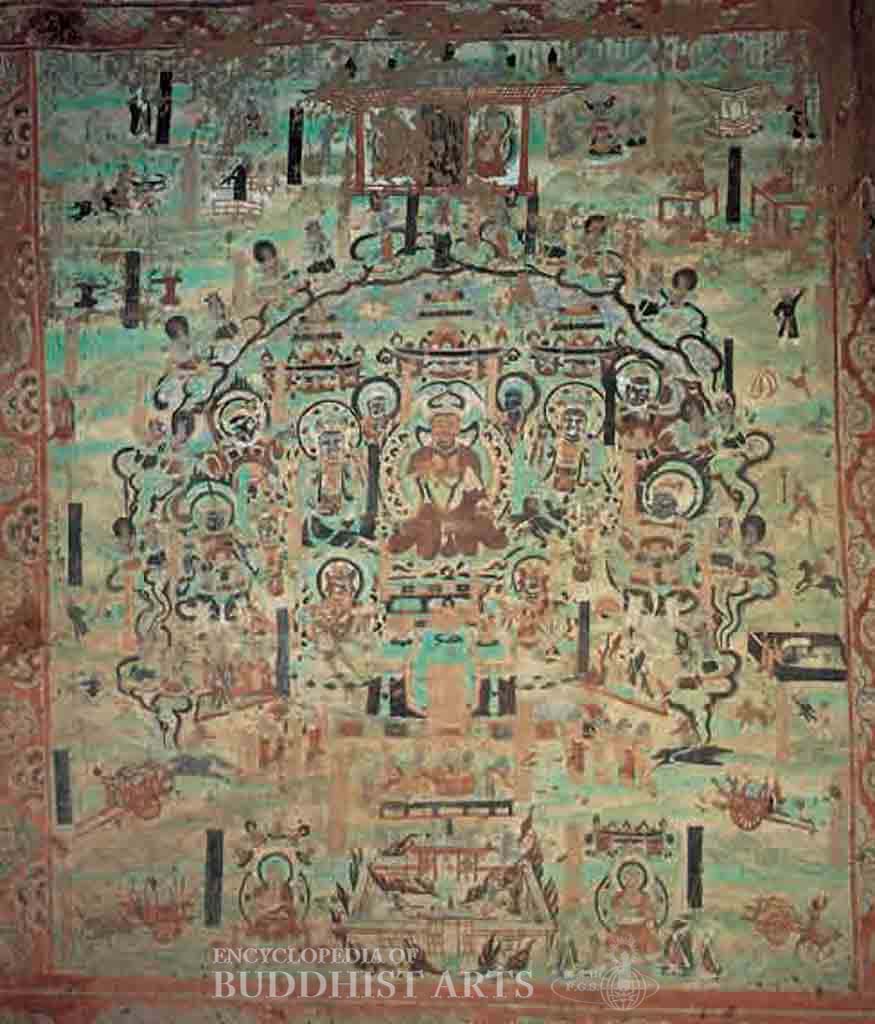
Yulin Cave 36: Illustration of the Lotus Sutra
Yulin Cave 36: Illustration of the Lotus Sutra
CHINA, Gansu, Guazhou; Tang dynasty
This mural is located on the right side of the front (east) wall within the antechamber. The cave consists of an antechamber and a main chamber with a truncated pyramidal ceiling. The walls of the main chamber were repainted during the Five Dynasties (907–960), while some Tang dynasty (618–907) murals remain on the walls of the antechamber.
The back (west) wall of the antechamber is painted with a sun, a moon, Buddhas on clouds, figures making offerings, and cartouches of vows. All of these images were repainted during the Five Dynasties. The north and south walls depict Heavenly Kings, also created during the Five Dynasties. Murals dating to the Tang dynasty can be found on the front wall, on both sides of the doorway. The mural on the left side of the doorway is an illustration of the Sutra on the Descent of Maitreya, while the illustration on the right side depicts the Lotus Sutra, shown here. This is the only depiction of the Lotus Sutra within the Yulin Caves.
An assembly is found in the center of the mural. Bodhisattvas, disciples and representative beings from the Eight Classes of Dharma Protectors encircle the Buddha, while additional Bodhisattvas spring out from the earth and gather in the background before the Prabhutaratna Pagoda. A depiction of the Buddha’s parinirvana is seen in the lower register of the illustration. Below this are two images derived from the Lotus Sutra: a depiction of the Burning House parable is located in the center, and an image of the sixteen princes who became enlightened after hearing their father teach the Lotus Sutra is on the right. The image on the left depicts the Buddha teaching the Dharma at Deer Park. Images drawn from various chapters of the Lotus Sutra are found on either side of the assembly, including: the “Universal Gateway Chapter,” the “Chapter on Peaceful Practices,” the “Chapter on Sadaparibhuta Bodhisattva,” and the “Chapter on Belief and Understanding.” The style of this illustration places particular focus on its symmetrical layout and the clarity and conciseness of the images and figures, a stylistic characteristic of the Late Tang period (846–907).
For more details, go to the Encyclopedia of Buddhist Arts: Caves T-Z, page 1630.
Cite this article:
author = Hsingyun and Youheng and Johnson, Peter and Mankuang and Huntington, Susan and Edson, Gary and Neather, Robert,
booktitle = {Encyclopedia of Buddhist Arts: Caves T-Z},
pages = 1630,
title = {{Yulin Cave 36: Illustration of the Lotus Sutra}},
volume = 9,
year = {2016}}