
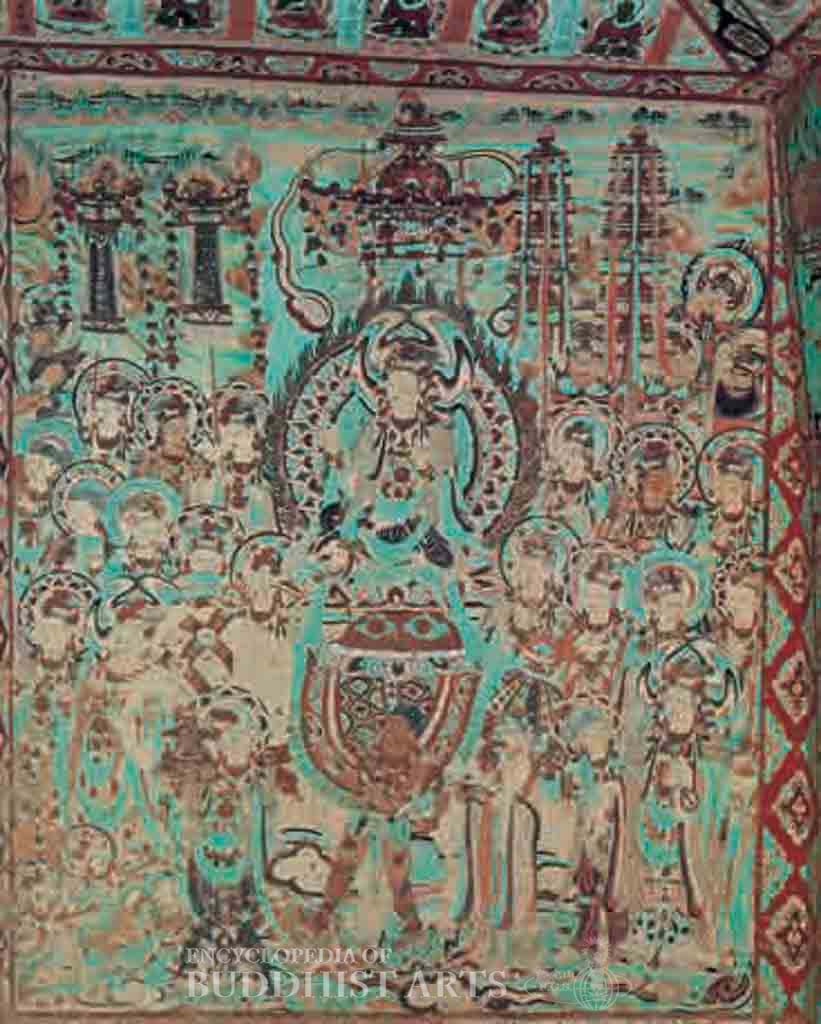
Yulin Cave 12: Samantabhadra Bodhisattva and Attendants
Yulin Cave 12: Samantabhadra Bodhisattva and Attendants
CHINA, Gansu, Guazhou; Five Dynasties
This cave was created during the Five Dynasties (907–960) and repaired during the Qing dynasty (1644–1911). It consists of an antechamber and a main chamber. Within the antechamber, part of the ceiling is sloped, and there are U-shaped platforms in front of the north and south walls. The ceiling of the main chamber is pyramidal. A platform that supports the nine Medicine Buddhas, which date to the Qing dynasty, extends along the north, south, and back (east) walls.
The illustration of Samantabhadra Bodhisattva and Attendants is located to the right of the doorway on the front (west) wall of the main chamber. A passage of written vows is found above the doorway and on the left is an illustration of Manjusri Bodhisattva. The Samantabhadra image is one of 19 painted depictions of the Bodhisattva found within the Yulin Caves. Samantabhadra rides upon a white elephant, attended by Bodhisattvas and heavenly beings. A mahout leads the elephant. Apsaras play musical instruments and lead the procession, while others raise banners and canopies high above the crowd. The layout of the mural is one of the more commonly seen arrangements passed down from the Mid-Tang period (756–846).
For more details, go to the Encyclopedia of Buddhist Arts: Caves T-Z, page 1585.
Cite this article:
author = Hsingyun and Youheng and Johnson, Peter and Mankuang and Huntington, Susan and Edson, Gary and Neather, Robert,
booktitle = {Encyclopedia of Buddhist Arts: Caves T-Z},
pages = 1585,
title = {{Yulin Cave 12: Samantabhadra Bodhisattva and Attendants}},
volume = 9,
year = {2016}}