
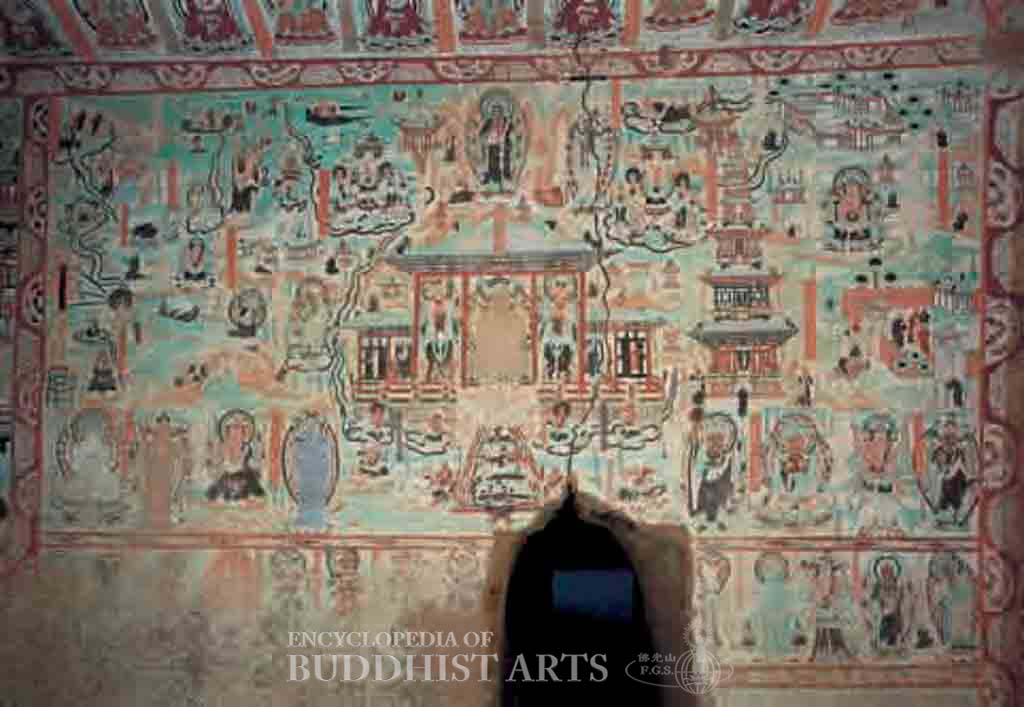
Yulin Cave 33: Sacred Sites of Buddhism
Yulin Cave 33: Sacred Sites of Buddhism
CHINA, Gansu, Guazhou; Five Dynasties
This mural is located on the right side of the south wall within the main chamber. It contains references to a number of Buddhist legends, figures, and auspicious symbols. Gosrnga (Ox Head Mountain) of Khotan is found at the center of the mural. Within the temple are a Buddha and two Bodhisattvas, as well as numerous disciples and monastics. A bull’s head is depicted over the entrance stairs in front of the main temple. Around the stairway are four Bodhisattvas seated upon clouds. Yaksas, lions, and Heavenly Kings are found beside the stairway.
Images of Manjusri and Samantabhadra Bodhisattvas accompanied by a retinue of attendants, all traveling upon fluffy clouds can be seen in the background of the mural. A seven-tier Chinese-style wooden pagoda is to the right. Two weeping willows grow from the sides of the pagoda, while four monks stand beneath the trees in reverence.
Directly above the central temple is a Buddha standing on top of a rocky mountain. A small figure on a raft, to the left of the Buddha, represents the story of Liu Sahe, a monk who went on a pilgrimage to the sacred sites. Another standing Buddha is depicted to the right of the central Buddha, and between these two figures is a well with a small figure stooped over it. This image represents the story of a blacksmith, Cunda, who dug the well as an offering to the Buddha. The lower register of this mural is painted with two rows of eight figures.
This rare mural contains the most complete composition of Buddhist sacred sites from the Tang dynasty (618–907) and the Five Dynasties (907–960). Though there are other murals of a similar style which were created during the Late Tang period (846–907), they are mostly small compositions, at least in comparison to the detail and complexity of this piece.
For more details, go to the Encyclopedia of Buddhist Arts: Caves T-Z, page 1627.
Cite this article:
author = Hsingyun and Youheng and Johnson, Peter and Mankuang and Huntington, Susan and Edson, Gary and Neather, Robert,
booktitle = {Encyclopedia of Buddhist Arts: Caves T-Z},
pages = 1627,
title = {{Yulin Cave 33: Sacred Sites of Buddhism}},
volume = 9,
year = {2016}}