
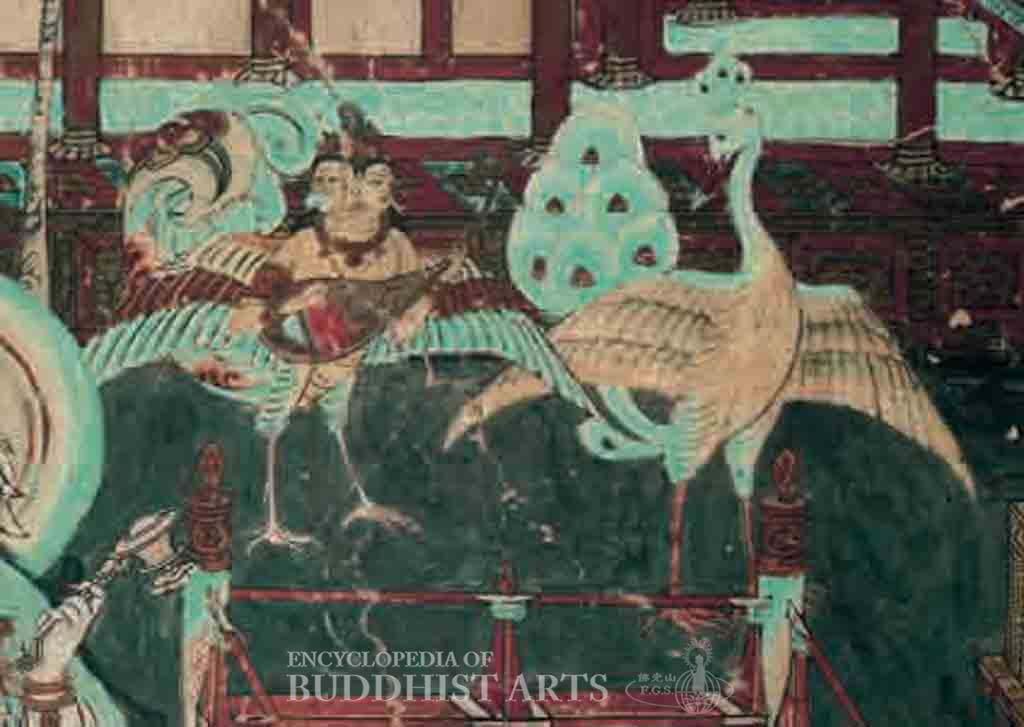
Yulin Cave 25: Illustration of the Amitayurdhyana Sutra - Western Pure Land - Jivajiva and Peacock
Yulin Cave 25: Illustration of the Amitayurdhyana Sutra - Western Pure Land - Jivajiva and Peacock
CHINA, Gansu, Guazhou; Tang dynasty
This painting is located on the right side of the central panel of the illustration of the Amitayurdhyana Sutra found on the south wall of the main chamber. The jivajiva is described in the Samyukta Ratna Pitaka Sutra, which states, “Living in the snowy mountains, there is a bird called the jivajiva which has a body and two heads.”
The jivajiva has the lower body of a bird, while the upper body and the two heads are portrayed with almost entirely human features, except one head that is beaked. The jivajiva plays the pipa and is accompanied by a peacock, which flares its wings and appears to dance. The image reflects the depiction of the Western Pure Land within the Amitayurdhyana Sutra, which states that, “The Pure Land always has various fantastic colorful birds such as a white crane, peacock, parrot, sari, kalavinka, and jivajiva. The birds sing harmonious and delightful songs day and night.”
For more details, go to the Encyclopedia of Buddhist Arts: Caves T-Z, page 1599.
Cite this article:
author = Hsingyun and Youheng and Johnson, Peter and Mankuang and Huntington, Susan and Edson, Gary and Neather, Robert,
booktitle = {Encyclopedia of Buddhist Arts: Caves T-Z},
pages = 1599,
title = {{Yulin Cave 25: Illustration of the Amitayurdhyana Sutra - Western Pure Land - Jivajiva and Peacock}},
volume = 9,
year = {2016}}