
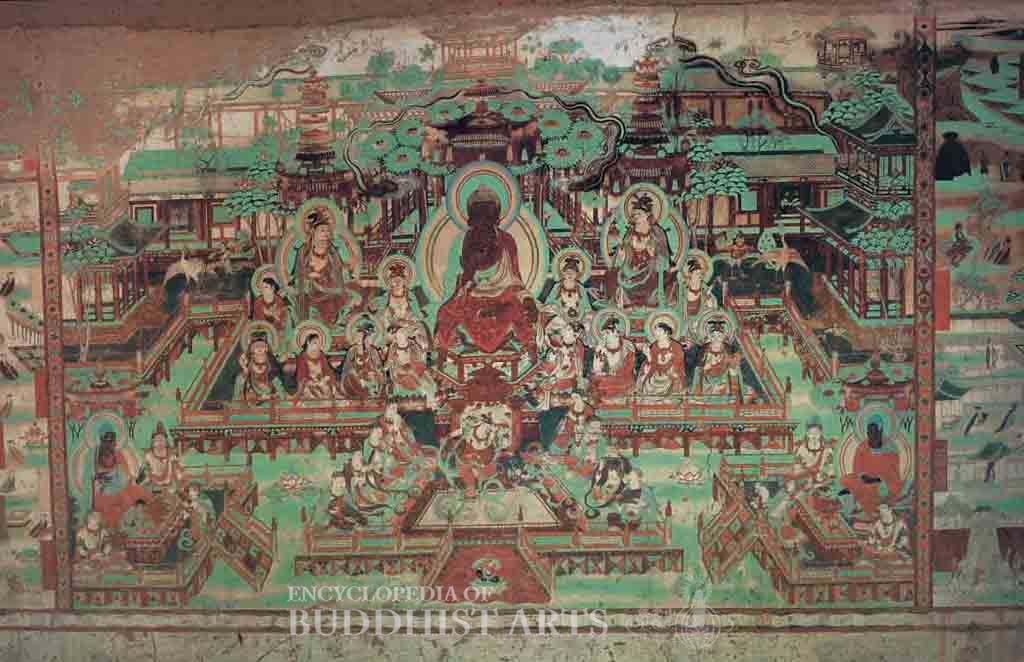
Yulin Cave 25: Illustration of the Amitayurdhyana Sutra - Western Pure Land
Yulin Cave 25: Illustration of the Amitayurdhyana Sutra - Western Pure Land
CHINA, Gansu, Guazhou; Tang dynasty
This painting from the Mid-Tang period (756–846) is located in the central panel of the illustration of the Amitayurdhyana Sutra on the south wall of the main chamber. It illustrates the Western Pure Land, which was a popular subject of cave murals painted during the High Tang period (712–756). The mural shares some similarities with the illustration of the Amitabha Sutra, with the exception of the two narrative panels of the Sixteen Contemplations and the Ajatasatru story shown on the two sides of this Western Pure Land depiction.
This illustration depicts a lotus pond with palace buildings rising above it, consisting of verandas, balustrades, and stairways. Amitabha Buddha, at the center, is seated in full lotus position upon a lotus throne. Avalokitesvara and Mahasthamaprapta Bodhisattvas are located on Amitabha’s right and left sides, respectively. Other heavenly beings are gathered around the Buddha and on nearby verandas, listening to Amitabha’s teachings. A group of musicians surrounding a dynamic dancing figure sit on a platform in the foreground of the image. Some of the elements of the illustration reflect the description of the Western Pure Land given in the Amitabha Sutra, including the pond of seven treasures, the waters with eight virtues, the trees laden with gems, and birds singing in chorus. The layout of the mural has been carefully designed to give it a sense of depth. In addition, the architectural elements depicted in the image are precisely depicted, exhibiting the high level of proficiency of the artist in architectural composition.
For more details, go to the Encyclopedia of Buddhist Arts: Caves T-Z, page 1598.
Cite this article:
author = Hsingyun and Youheng and Johnson, Peter and Mankuang and Huntington, Susan and Edson, Gary and Neather, Robert,
booktitle = {Encyclopedia of Buddhist Arts: Caves T-Z},
pages = 1598,
title = {{Yulin Cave 25: Illustration of the Amitayurdhyana Sutra - Western Pure Land}},
volume = 9,
year = {2016}}