

Yulin Caves: East Cliff
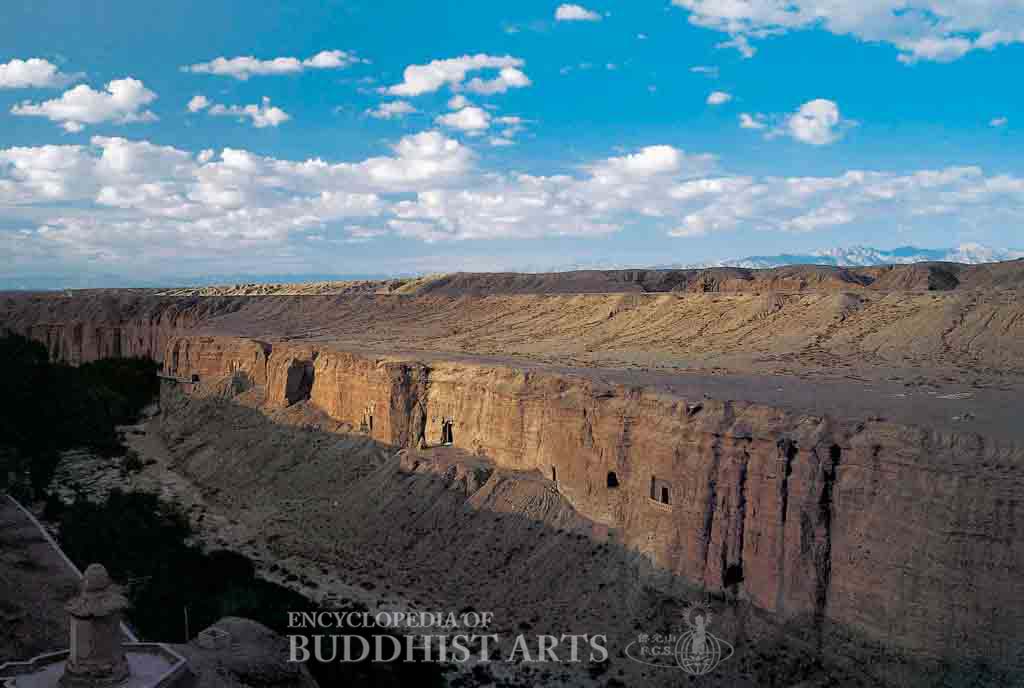
Yulin Caves: West Cliff

Yulin Caves: East Cliff (site layout)
Yulin Caves
CHINA, Gansu, Guazhou
The Yulin Caves, also known as Yulin Temple or the Thousand Buddha Gorge, are located along the east and west banks of the Yulin River, 75 km southwest of Guazhou. There are 42 surviving caves at the site, with 31 on the east cliff and 11 on the west cliff. The creation and development of the caves took place over a period spanning from the Tang (618–907) to the Qing (1644–1911) dynasty, There are more than 5,200 sq m of wall paintings and over 200 statues within the cave system. In addition, outside the caves are 21 structures including stupas and a paper-burning tower. The area was listed as a National Cultural Heritage Site in 1996.
The major types of caves at Yulin include: central pillar cave with niches on four sides; square or rectangular cave with a Sumeru throne or round platform and a truncated pyramidal ceiling; and great Buddha cave with an oval layout and a barrel-vaulted ceiling. The caves are generally carved between 7 m to 8 m into the cliff face and are consequently sheltered from weathering leaving much of the artwork in remarkably good condition. Although the exact dating of the caves has not been determined, scholars believe that Cave 28 was the earliest and created during the Early Tang period (618–712). The majority of the extant murals date from the Tang and Song dynasties.
The Tibetans gained control of the Guazhou area in 776. During the 108 years of Tibetan rule, the truncated pyramidal ceilings were constructed with the addition of various important artworks. Cave 25, located on the east cliff, contains murals dating to this period. The murals feature themes such as Manjusri and Samantabhadra Bodhisattvas, illustration of the Amitayurdhyana Sutra and the Sutra on the Descent of Maitreya, and the Mandala of the Eight Great Bodhisattvas. In addition, the antechamber features images of Vaisravana and Virudhaka.
Cao Yijin took control of the region in the year 914, and the Cao family regime continued to rule the area for over 100 years. During this time, an art academy was organized by the Caos, specializing in the creation of artwork at the Dunhuang Caves. The extant artwork from this period within the Yulin Caves includes numerous architectural pieces and murals created or repaired by the art academy. The murals have the consistent, cohesive style of the Tang dynasty and display highly developed artistic techniques.
There are 28 caves from this period. These caves are generally larger in scale and feature a central Buddha platform. Unlike the early artwork in the region, which is characterized by the deification of Buddhist figures, the themes from this period generally reflect the more mundane human realm.
Several caves contain life-like depictions of patrons, which include the Cao family, regional minorities, and artisans from the art academy. Normally, rulers and their vassals are arranged in order of rank and seniority, and often occupy large and prominent areas on the walls of the caves.
Cave 32, which dates to the Cao reign, features an illustration of the Brahmajala Sutra that encompasses the entire back wall. In the middle of the illustration is Vairocana Buddha, while at the bottom are numerous figures of various types that listen to the Dharma. This mural is particularly characteristic of the period in terms of its rich and novel subject matter, when compared to earlier illustrations of the Brahmajala Sutra. Examples of the innovation in artistic themes and content are the large illustrations of Manjusri and Samantabhadra Bodhisttvas in Cave 35. Additional figures, including Candraprabha Buddha, Suryaprabha Buddha, and Vaisvarana, were never depicted at Yulin Caves before this period.
The year 1030 marked the collapse of the Cao regime and the beginning of Uighur control in Shazhou. Although the caves created during the Uighur period generally have layouts and styles consistent with those of the Tang dynasty, the large sutra illustrations from this period feature different themes. Popular themes include the Buddha Teaching the Dharma, the Western Pure Land, the Medicine Buddha, and the Seven Buddhas of the Past. New subject matter introduced during this period includes the Prophecy of Dipamkara Buddha, the Sixteen Arhats, and murals of traveling monks. An important characteristic of the Uighur caves is the images of patrons dressed in Uighur clothing.
Some of the more unique and valuable works of the Yulin Caves are within the caves dating to the Western Xia (1032–1227) and Yuan (1271–1368) dynasties. Emperor Jingzong (reigned 1032–1048) of the Western Xia period defeated the Uighurs in 1036 in Shazhou, which was subsequently combined with the adjacent Guazhou area to create the Western Xia region. The Western Xia contributions to the site include Caves 2, 3, 10, and 29, as well as repairs to earlier extant caves. The artwork created during this period features a combination of Mahayana and Vajrayana Buddhist themes, and introduced new subject matter to the region including Water-Moon Avalokitesvara Bodhisattva and Master Xuanzang’s Journey to Obtain the Sutras.
Murals which are particularly representative of artworks from the Western Xia period can be found in Cave 3. The cave features well-preserved illustrations of mandalas on the north and south walls. These are of great historical value as mandalas from this period created in accordance with strict specifications are extremely rare in China. Also of historical significance are the images in Cave 29, which depict a Western Xia National Master and a division official of Guazhou and his family. These figures have distinctive Tangut characteristics and provide an important source of information for research into the culture of the Western Xia.
In 1227, the Mongolians brought an end to the Western Xia period, but the blend of Mahayana and Vajrayana Buddhist art were adopted and continued to be employed throughout the Yuan dynasty. Tibetan Buddhist themes were particularly common. One example can be found in Cave 4, which contains a mandala and images of Green and White Taras.
The caves underwent major repairs between the years 1796 and 1820. All the statues within the caves, apart from the Great Buddha in Cave 6, had also undergone some type of repair during previous dynasties, yet most managed to retain a distinct Tang style. Statues which were created during the Qing dynasty are distinguishable from the original Tang pieces as they are notably coarser and generally display a lower level of artistic skill.
For more details, go to the Encyclopedia of Buddhist Arts: Caves T-Z, page 1554.
Cite this article:
author = Hsingyun and Youheng and Johnson, Peter and Mankuang and Huntington, Susan and Edson, Gary and Neather, Robert,
booktitle = {Encyclopedia of Buddhist Arts: Caves T-Z},
pages = 1554,
title = {{Yulin Caves}},
volume = 9,
year = {2016}}