
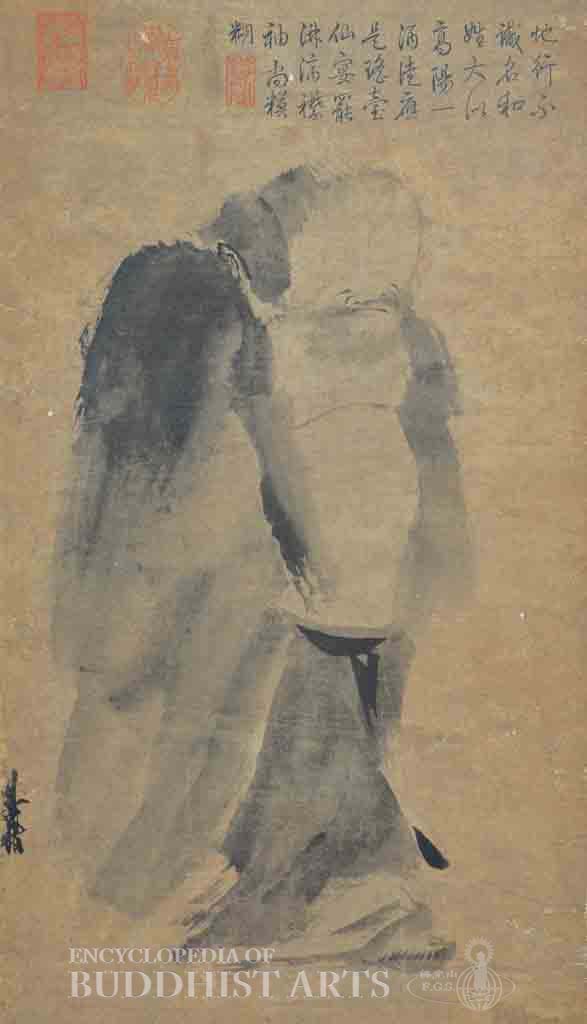
Drunken Celestial by Liang Kai; Southern Song dynasty
Ink on paper
Liang Kai
CHINA, Shandong, Tai'an; Southern Song dynasty
Liang Kai, originally named Bai Liang, was a painter-in-attendance in the Imperial Painting Academy. Born in Dongping county of Tai’an, when he was young he studied alongside Jia Shigu, another well-known painter. Liang had an easy-going personality and was unfettered with worldly honors. Fed up with regulations in the academy, he gave up the Golden Belt that was awarded to him and left his position. Liang was known for his acquaintances with Chan monks such as Miaofeng, and he was highly-regarded for his incorporation of Chan into his paintings.
Liang was considered a master painter of figures, Buddhist and Daoist imagery, and landscapes. His figures are often depicted in splash-ink to express a state of transcendence. He painted in two very distinct styles. The first, known as “xibi,” is composed of fine yet thorough strokes, which was influenced by Wu Daozi and Li Gonglin, both of whom employed the slender tip of the brush to create powerful curves and detail. This effect can be seen in Liang’s work entitled Ascetic Sakyamuni. The second style is known as “jianbi” which was inherited from Shi Ke. This technique emphasizes the use of minimal terse strokes to create a sense of fluidity, as can be seen in Drunken Celestial, where thick patches of black ink appear smeared, and a few strokes are swept across the composition to evoke a serene atmosphere.
Many valuable works by Liang still exist, including Drunken Celestial, which is kept at the National Palace Museum in Taipei, Taiwan; Eight Eminent Masters, kept at the Shanghai Museum; and Sixth Patriarch Cutting Bamboo, Poet Li Bai Reciting While Strolling, and Ascetic Sakyamuni Emerging from the Mountains, among several others that are now kept at the Tokyo National Museum in Japan.
For more details, go to the Encyclopedia of Buddhist Arts: People, page 169.
Cite this article:
author = Hsingyun and Youheng and Youlu and Pokorski, Stefanie and Yichao and Mankuang and Miaohsi,
booktitle = {Encyclopedia of Buddhist Arts: People },
pages = 169,
title = {{Liang Kai}},
volume = 19,
year = {2016}}