
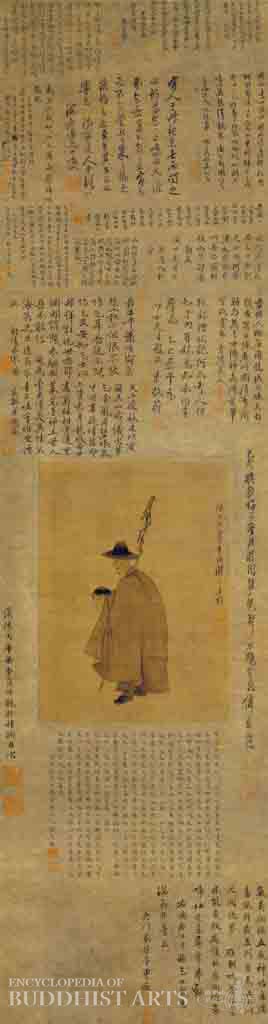
Mendicant by Chen Hongshou; Ming dynasty, dated 1639
Ink on silk
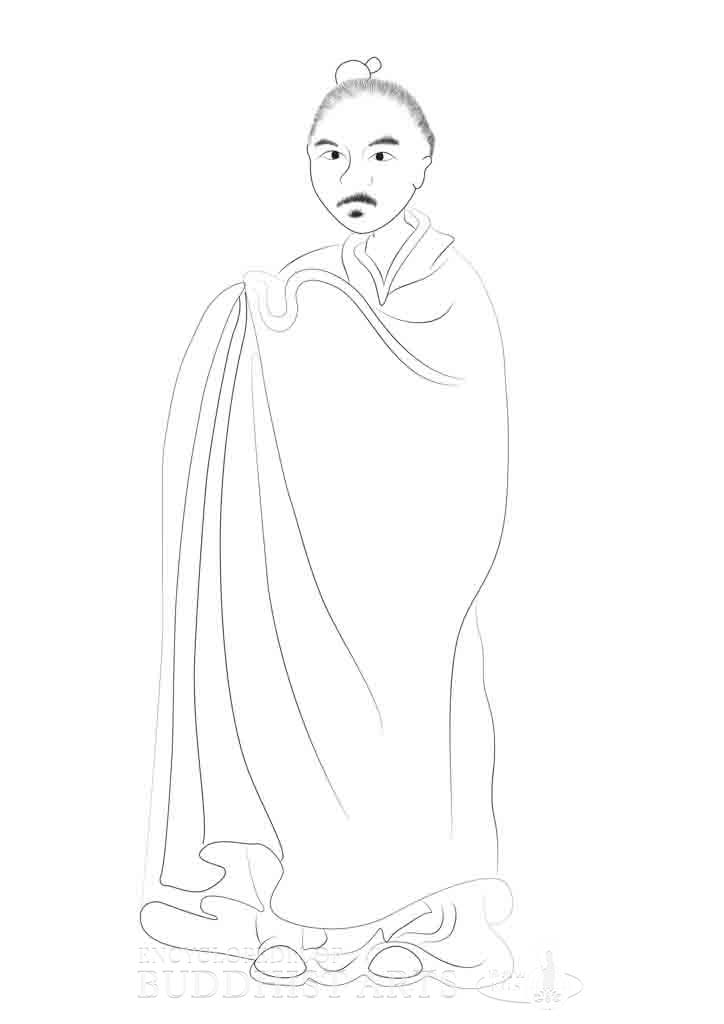
Chen Hongshou
CHINA, Zhejiang, Shaoxing; Ming to Qing dynasty
Chen Hongshou was a painter from Zhuji, Shaoxing. At a young age, he replicated the stone carving of the Seventy-Two Disciples of Confucius written by Li Gonglin. His works were much appreciated by Emperor Yizong (reigned 1628–1644) of the Qing dynasty, who later summoned him to work in Beijing as a court official. The emperor requested that Chen reproduce images of previous emperors. As a result of his exceptional work, he became well-known in the capital and enjoyed the same reputation as Cui Zizhong, another notable painter of the Ming dynasty (1368–1644). They were referred to as the Southern Chen and Northern Cui. In 1646 when the Qing army entered eastern Zhejiang, he took refuge in Buddhism and renounced at Yunmen Temple in Guangdong, taking the Dharma name Senghui.
His strengths were in figure painting in which he incorporated the essence of the works of Li Gonglin and Zhao Mengfu. Additionally, he could paint rapidly in the same manner as Lu Tanwei. Chen also excelled in painting landscapes, flowers, and birds that were delicate and colorful. He introduced iron-wire drawing and orchid leaf tracing into his landscapes to portray clouds and flowing water against backgrounds of trees and rocks. The works he produced in his old age were more hyperbolic and broke many rules set by ancient painters.
His extensive collection of extant works include Children Paying Respect to the Buddha and Mendicant, kept at the Palace Museum in Beijing; Avalokitesvara Bodhisattva, retained at the Jilin Provincial Museum in Changchun; Cundi, kept at the Metropolitan Museum of Art in New York, USA; and Five-Character Quatrain, kept at the Nanjing Museum in Jiangsu.
For more details, go to the Encyclopedia of Buddhist Arts: People, page 18.
Cite this article:
author = Hsingyun and Youheng and Youlu and Pokorski, Stefanie and Yichao and Mankuang and Miaohsi,
booktitle = {Encyclopedia of Buddhist Arts: People },
pages = 18,
title = {{Chen Hongshou}},
volume = 19,
year = {2016}}