
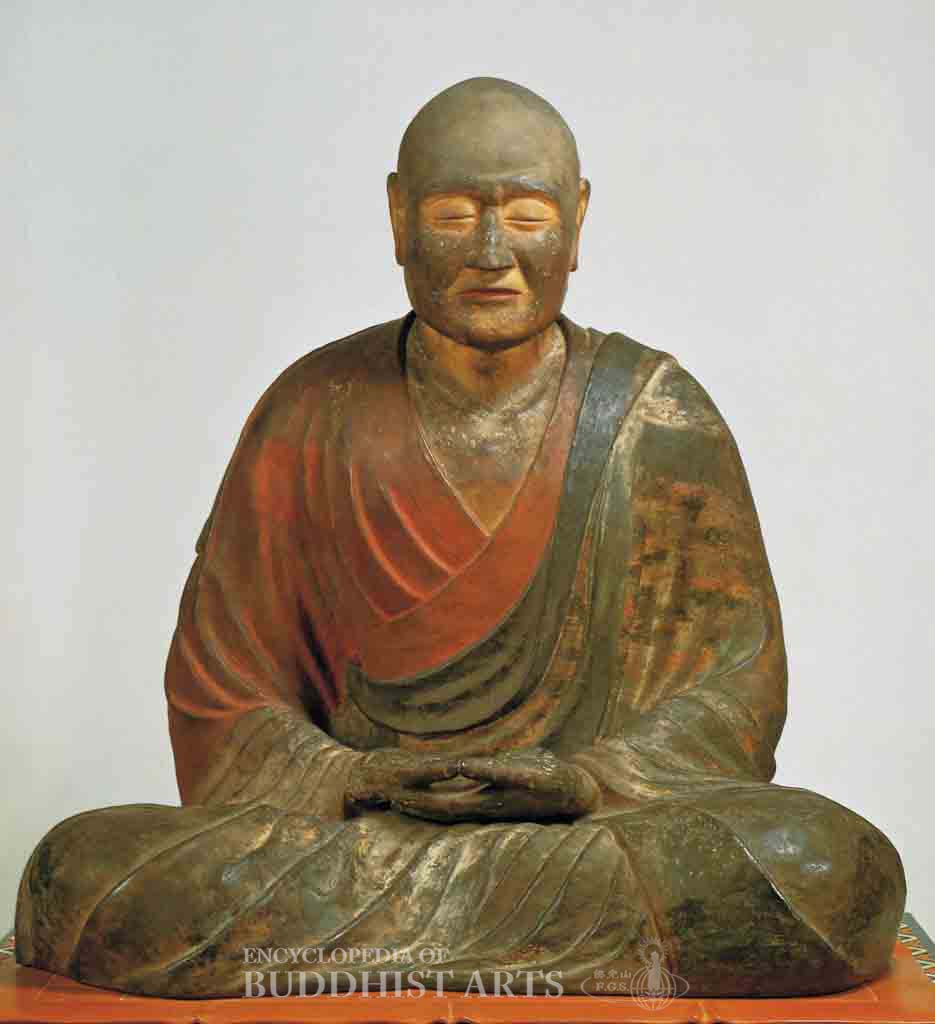
Master Jianzhen; Nara period
Dry lacquer
Jianzhen
CHINA, Jiangsu, Yangzhou; Tang dynasty
Born in Jiangyang, Guangling (present day Yangzhou, Jiangsu), Jianzhen was also known as Ganjin in Japanese. He joined the monastic order at the age of 14 under Chan Master Zhiman. He traveled to the ancient capital cities of Chang’an and Luoyang to study before returning to Daming Temple in Jiangsu to teach the vinaya and transmit the Dharma. Invited to Japan to impart the precepts, he made several attempts to travel to the country, encountering many difficulties along the way, including the loss of his vision. It was not until his sixth attempt in 752 that he finally made a successful voyage. The numerous sutras, artworks, and medicines that he brought to Japan contributed tremendously to Sino-Japanese cultural exchange.
Jianzhen was proficient in architectural and sculptural skills. It was recorded in Eastern Expedition of the Great Tang Monk that during his vinaya teaching in Huainan, he built several temples and statues. After his arrival in Japan, he led his disciples, including Situo and Rubao, in the construction of Toshodaiji Temple in Nara between 757 and 759.
Upon establishing a precept hall in Todaiji Temple in Nara, Jianzhen conferred the Bodhisattva Precepts on the Japanese royalty as well as the public. He also transmitted ordination precepts to several Japanese monks; this was the first of such ordination in the history in Japan. Jianzhen is known for having founded the Ritsu school of Buddhism in Japan, which was known as one of the six schools in Nara.
In the main hall of Toshodaiji Temple still today, there is a statue of Master Jianzhen enshrined within a niche. The statue, made with a dry lacquer technique, is the earliest of its kind and is listed as a National Treasure.
For more details, go to the Encyclopedia of Buddhist Arts: People, page 116.
Cite this article:
author = Hsingyun and Youheng and Youlu and Pokorski, Stefanie and Yichao and Mankuang and Miaohsi,
booktitle = {Encyclopedia of Buddhist Arts: People },
pages = 116,
title = {{Jianzhen}},
volume = 19,
year = {2016}}