
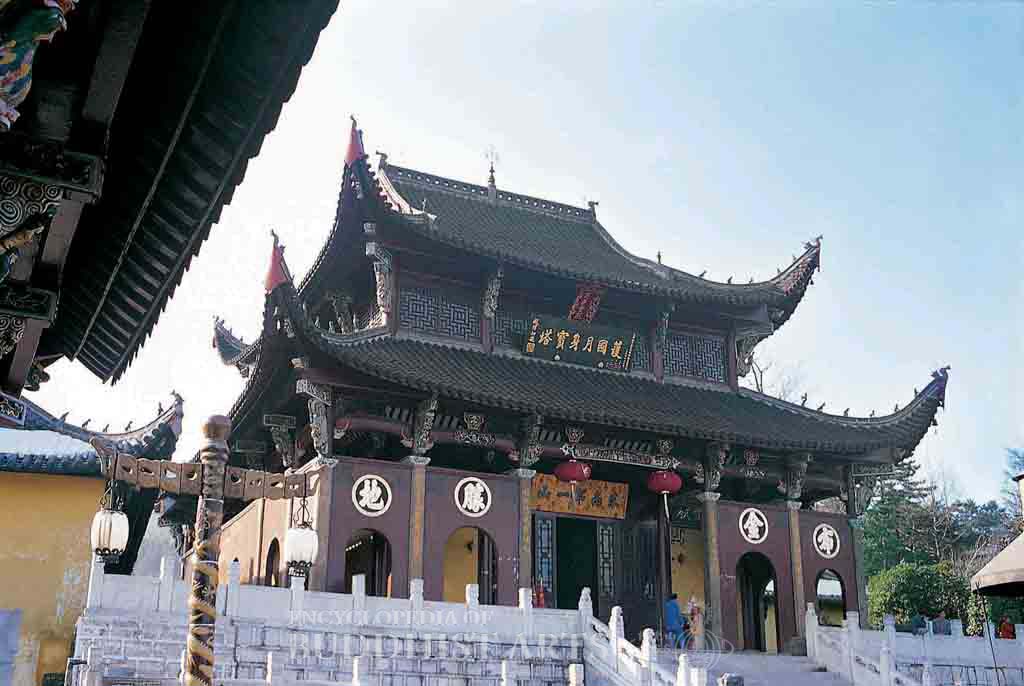
Jiuhuashan Corporeal Relic Hall
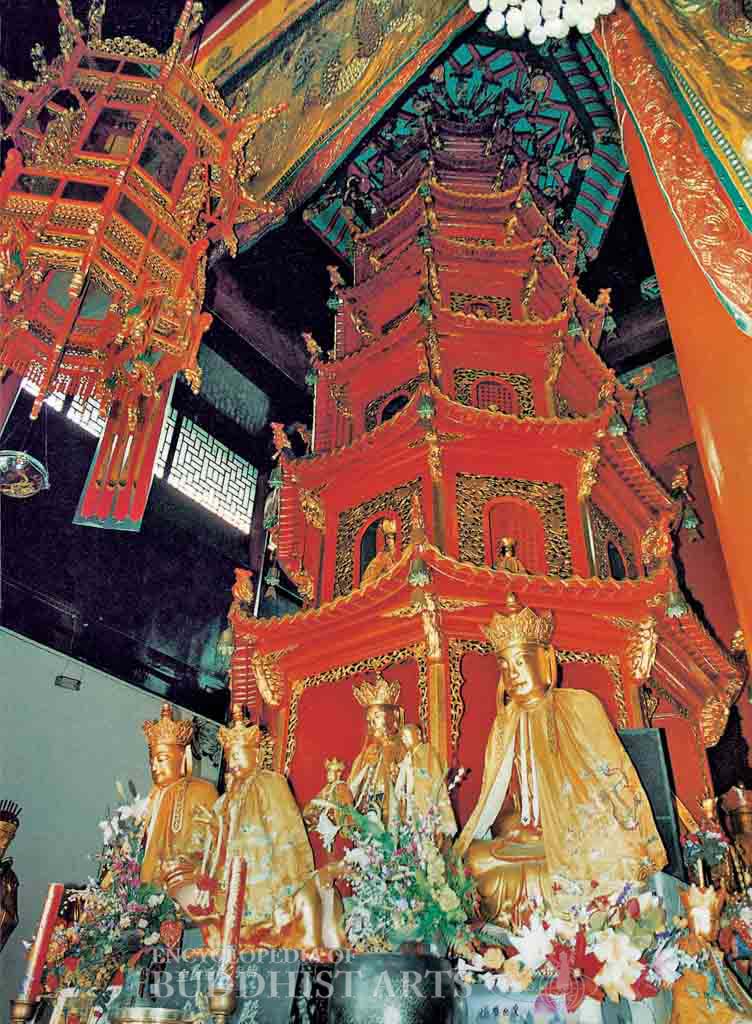
Jiuhuashan Corporeal Relic Hall: Pagoda (interior)
Jiuhuashan Corporeal Relic Hall
CHINA, Anhui, Chizhou
The hall is situated on the summit of Shenguang Peak, to the west of Huacheng Temple. When the monk Kim Gyo Gak passed away in 794 during the Tang dynasty, his body was kept in a stone coffin. After three years, his body was described as being in a lifelike state, with color, soft skin and “joints that clink like golden locks,” as described in the sutras. Thus, his followers believed he was the manifestation of Ksitigarbha Bodhisattva. He then became known as the Golden Ksitigarbha and a stone pagoda was built for him, followed by the Corporeal Relic Hall. The building was repaired in 1684, but in 1857 the hall was looted and destroyed, along with Huacheng Temple. It was rebuilt between 1862 and 1874 and was renovated three times during the 20th century. The building was listed as a key Buddhist temple in the Han region of China in 1983.
The three-by-three bay Corporeal Relic Hall has a double-eave hip-and-gable roof covered in iron tiles. There is a veranda surrounding the whole building. In front of the building are steep stone steps leading up to the platform on which the hall stands. Within the hall there is a seven-tier octagonal wooden pagoda standing on a white marble base. Statues of Ksitigarbha are located around the pagoda. There are niches on every tier, each with a golden Ksitigarbha enshrined inside. Altogether there are 56 statues. Within the wooden pagoda, there is a second three-tier stone pagoda containing the body relic of the Golden Ksitigarbha.
For more details, go to the Encyclopedia of Buddhist Arts: Architecture G-L, page 540.
Cite this article:
author = Hsingyun and Youheng and Johnson, Peter and Mankuang and Lancaster, Lewis,
booktitle = {Encyclopedia of Buddhist Arts: Architecture G-L},
pages = 540,
title = {{Jiuhuashan Corporeal Relic Hall}},
volume = 2,
year = {2016}}