
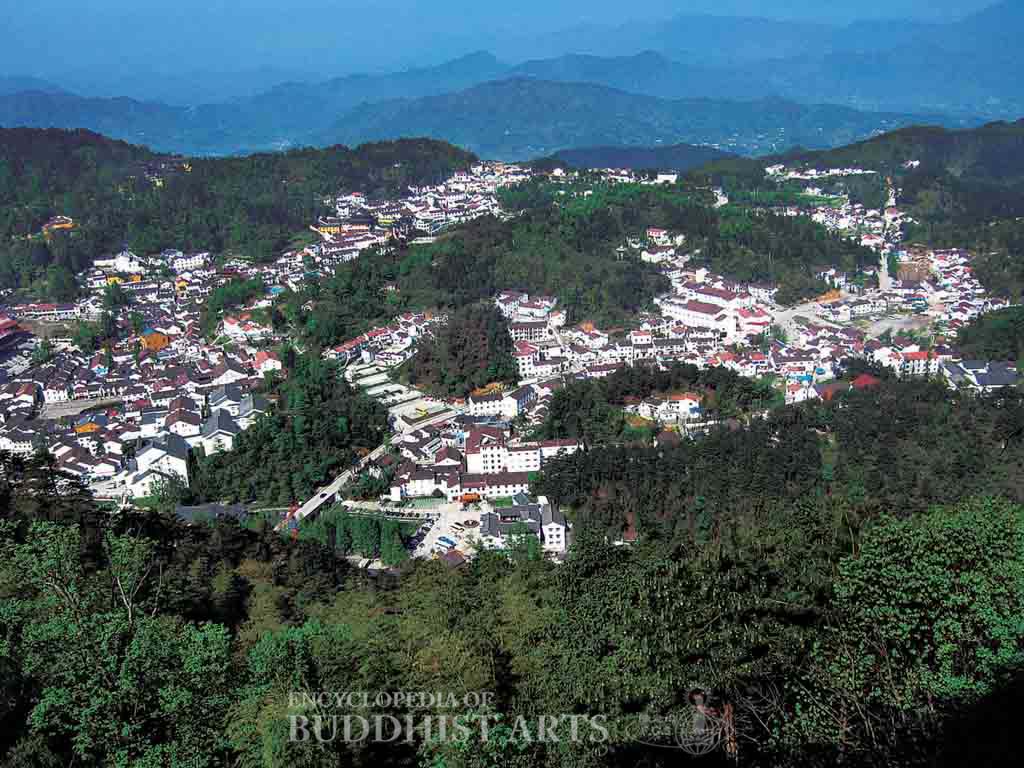
Jiuhuashan (aerial view)
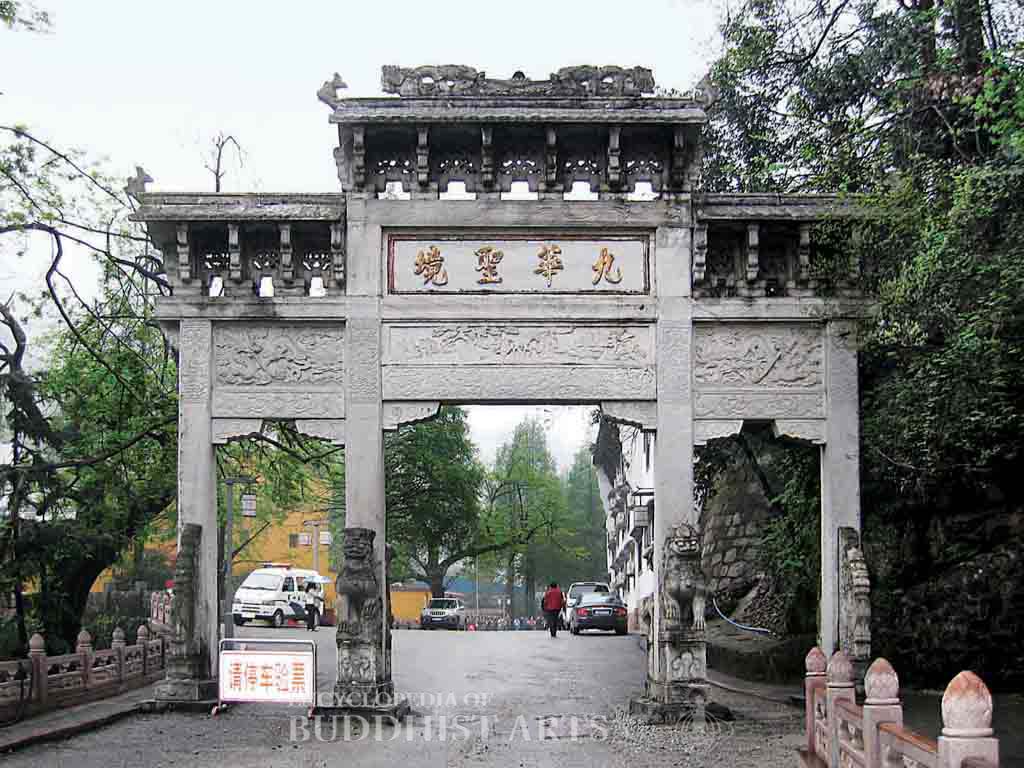
Jiuhuashan: Gateway
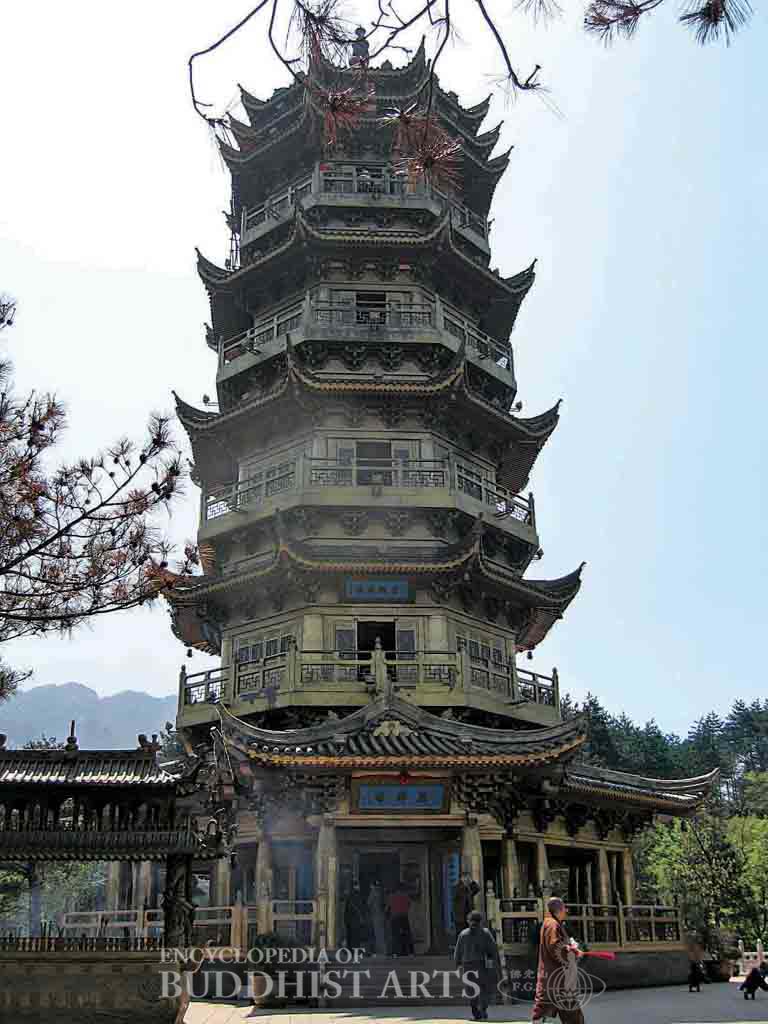
Jiuhuashan: Huixiang Pavilion - Ten Thousand Buddha Pagoda
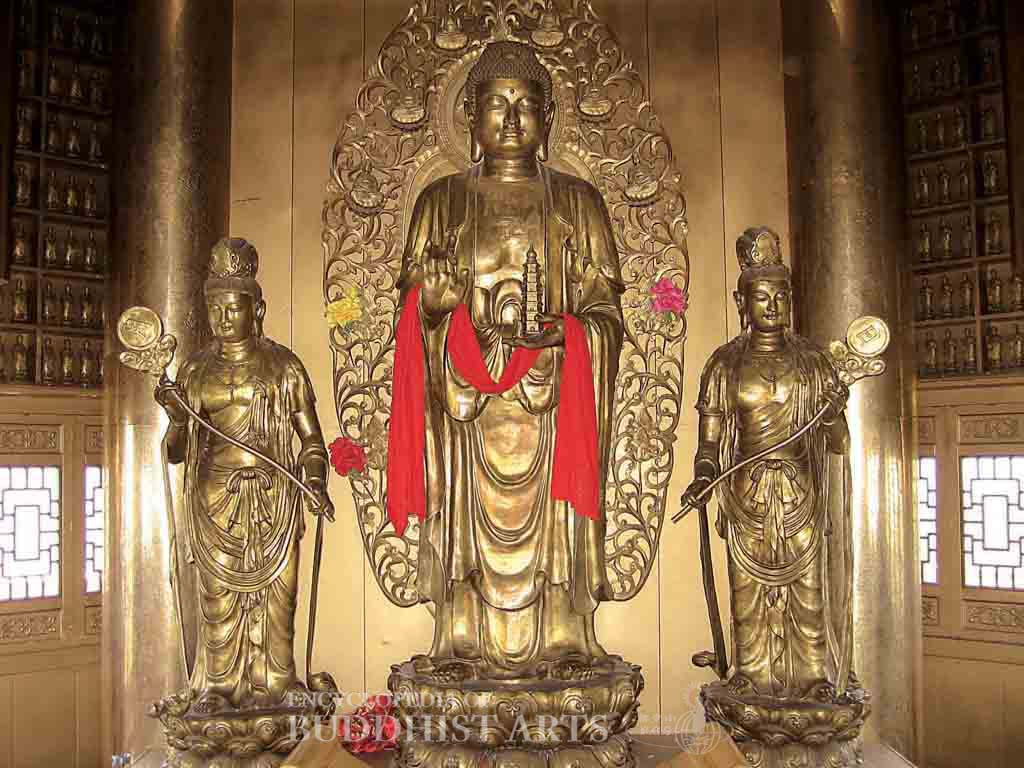
Jiuhuashan: Huixiang Pavilion - Ten Thousand Buddha Pagoda (interior)
Jiuhuashan
CHINA, Anhui, Chizhou
Jiuhuashan means Nine Glorious Mountains. It is one of the Four Sacred Buddhist Mountains of China and is dedicated to Ksitigarbha Bodhisattva. It is said that Ksitigarbha Bodhisattva resided here during his lifetime. The mountain range occupies more than 100 sq km.
According to the records, Huacheng Temple was the first to be founded here in 401 during the Eastern Jin dynasty. It was believed by Chinese Buddhists that Kim Gyo Gak, a Korean prince who came to practice the Dharma at this place, was the manifestation of Ksitigarbha Bodhisattva. After he passed away in 794 at the age of 99 years, his followers built a pagoda at Huacheng Temple to commemorate him. They named him the Golden Ksitigarbha. The temple became the largest on the mountain, with thousands of Buddhist pilgrims visiting the temple every day.
The popularity of Jiuhuashan peaked during the Ming (1368–1644) and Qing (1644–1911) dynasties with more than 360 temples on the mountain. Currently, there are only 99 temples in the area. In the Tiantai scenic area are Tiantai Temple, Baijing Terrace, and Fuxi Temple. The Minyuan Park scenic area includes the Huiji and Chaoyin Temples. The front of the mountain and street area include Huacheng Temple, the Corporeal Relic Hall, Baisui Temple, Zhiyuan Temple, Ganlu Temple, the sandalwood forest, the upper meditation hall, and Huixiang Pavilion. The Ten Thousand Buddha Pagoda within Huixiang Pavilion was completed in 2006.
The temples are either built along the mountainous terrain or upon the peaks. Most of the buildings are in local styles, which display a simplicity of design. The temples and residences mostly have two or three courtyards, with the main halls generally located at the back. Apart from the main halls, which have hip-and-gable roofs covered with glazed terracotta tiles, most of the buildings have flush gable roofs covered with locally-made glazed tiles in dark sienna. The temples house a collection of more than a thousand Buddhist and historical artifacts, such as ancient Sanskrit palm leaf manuscripts, sutras written in blood, calligraphy, and paintings, in addition to golden seals bestowed by the emperor, imperial jade seals, and imperial edicts.
For more details, go to the Encyclopedia of Buddhist Arts: Architecture G-L, page 538.
Cite this article:
author = Hsingyun and Youheng and Johnson, Peter and Mankuang and Lancaster, Lewis,
booktitle = {Encyclopedia of Buddhist Arts: Architecture G-L},
pages = 538,
title = {{Jiuhuashan}},
volume = 2,
year = {2016}}