
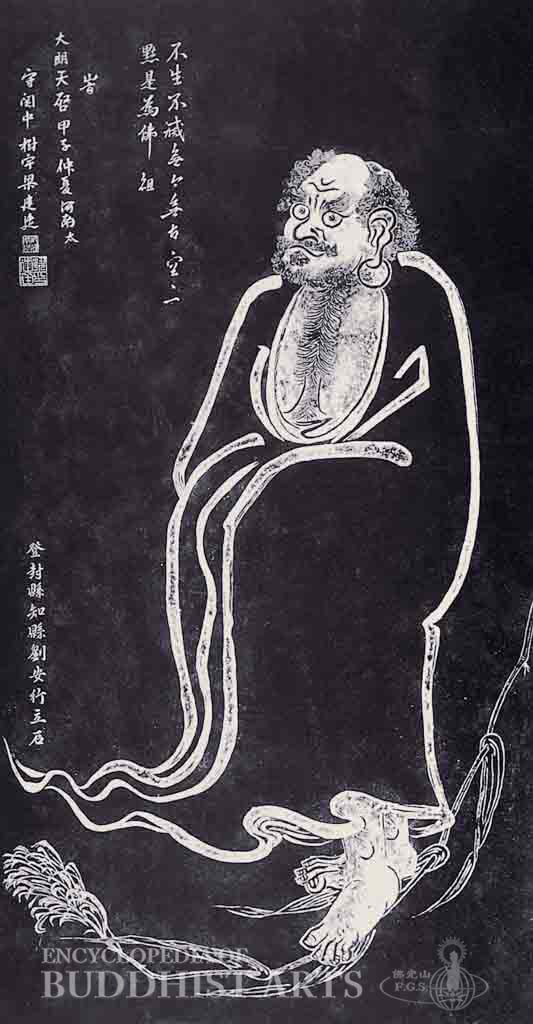
Shaolin Temple: Bodhidharma Crossing the River
Rubbing
Shaolin Temple: Bodhidharma Crossing the River
CHINA, Henan, Zhengzhou; Ming dynasty
This is a rubbing of a carved stone at Shaolin Temple. Bodhidharma is portrayed as a rugged Indian monk with wide, round eyes, furrowed brows, curled hair, and a beard. His roughly outlined robe is partially open, revealing a hairy chest. The bare feet stand on a reed and the lower hem of the robe appears to flutter in the wind, creating a sense of movement and symbolically representing the crossing of the river. The delicate chisel cuts used to outline the face, chest, and feet contrast sharply with the broad, minimalistic lines used to depict the robe. The poem inscribed on the upper left reads “Non-arising, non-ceasing. Without past, without present. Emptiness is the Buddha.” Beside and beneath the poem are the signatures of the governor of Henan and the magistrate of Dengfeng.
For more details, go to the Encyclopedia of Buddhist Arts: Painting P-Z, page 823.
Cite this article:
author = Hsingyun and Youheng and Youlu and Wilson, Graham and Manho and Mankuang and Huntington, Susan,
booktitle = {Encyclopedia of Buddhist Arts: Painting P-Z},
pages = 823,
title = {{Shaolin Temple: Bodhidharma Crossing the River}},
volume = 16,
year = {2016}}