
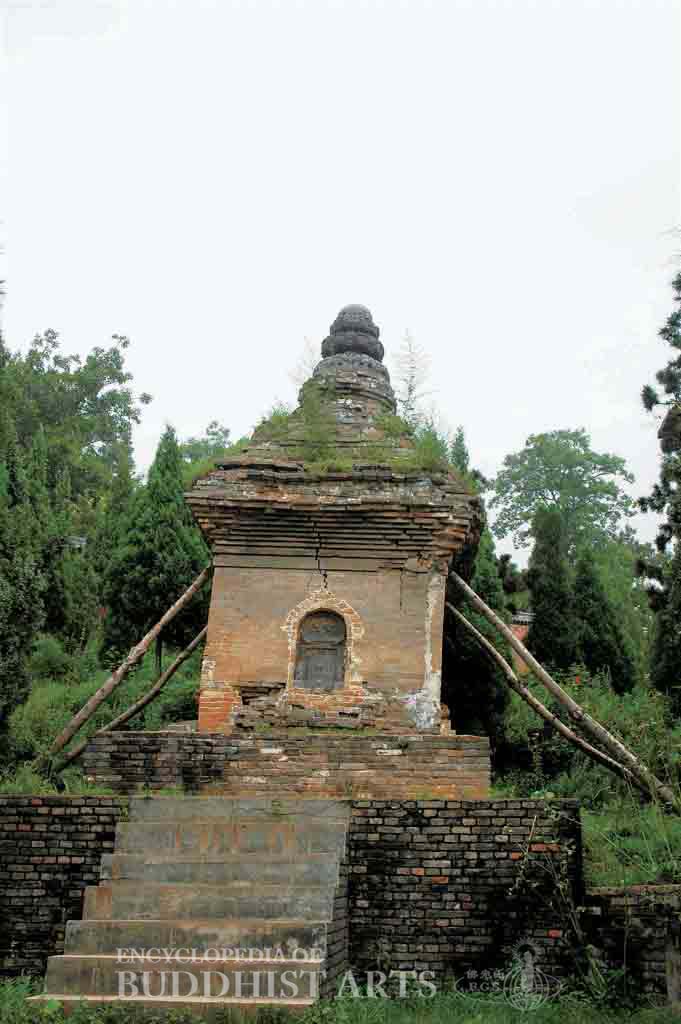
Shaolin Temple Forest of Pagodas Fawan Pagoda
Shaolin Temple Forest of Pagodas Fawan Pagoda
CHINA, Henan, Zhengzhou
The pagoda is located on the northwest side of the forest of pagodas. It was built in 791 during the Tang dynasty, and is the pagoda with the oldest inscription here. As part of the Historic Monuments of Dengfeng, it was listed as a UNESCO World Heritage Site in 2010.
The square brick pagoda has a single-eave roof and is 8 m high. There are no decorations on the pagoda body. However, the limestone front face is carved with the outlines of a door, door nails, and a lock, while the tympanum is decorated with carvings of apsaras, kalavinkas, and Vajrapanibalin. This is a reflection of the resplendent doors of the Tang dynasty (618–907). The eaves consist of corbeling, while the roof is in the form of reverse corbeling. The spire consists of an inverted bowl, upturned lotus, and wish-fulfilling jewel. At the back there is an inscription describing the life of Chan Master Fawan and his successors.
For more details, go to the Encyclopedia of Buddhist Arts: Architecture M-S, page 976.
Cite this article:
author = Hsingyun and Youheng and Johnson, Peter and Mankuang and Lancaster, Lewis,
booktitle = {Encyclopedia of Buddhist Arts: Architecture M-S},
pages = 976,
title = {{Shaolin Temple Forest of Pagodas Fawan Pagoda}},
volume = 3,
year = {2016}}