
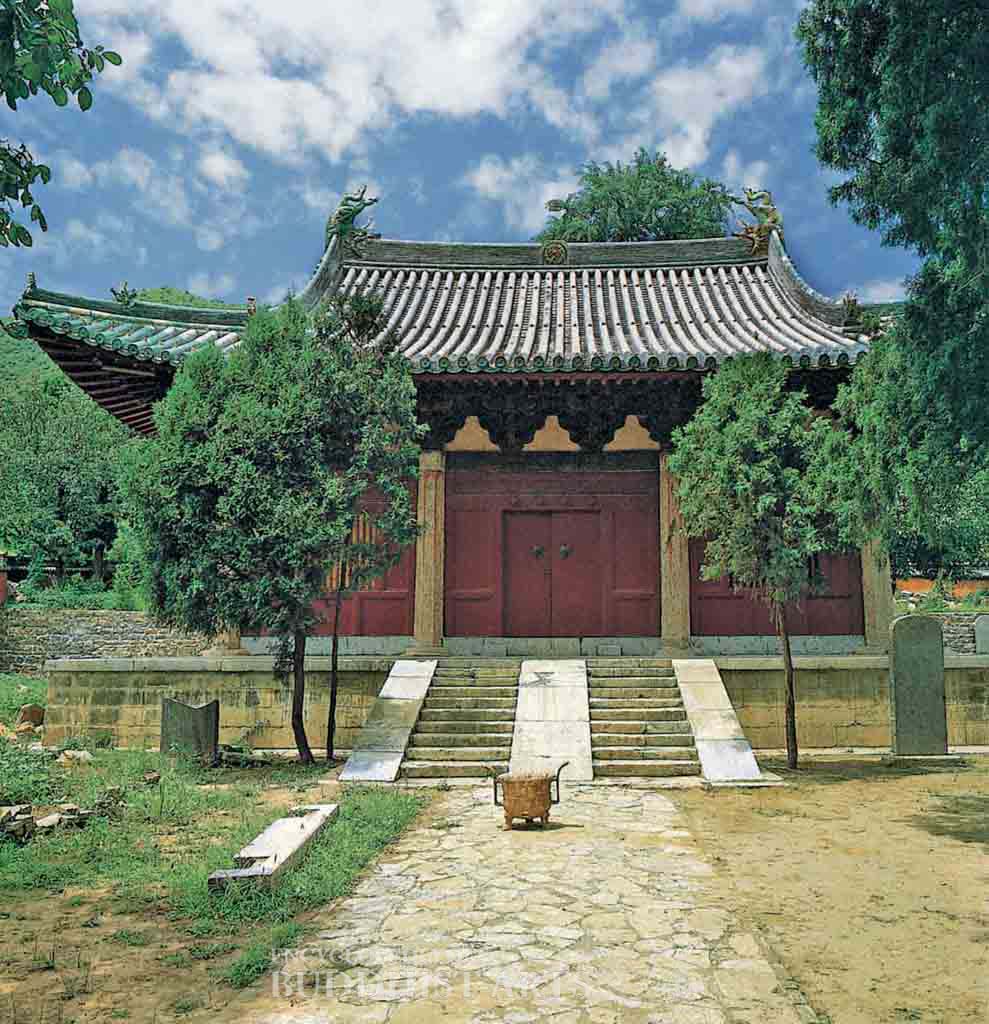
Shaolin Temple First Patriarch Temple: Main Hall
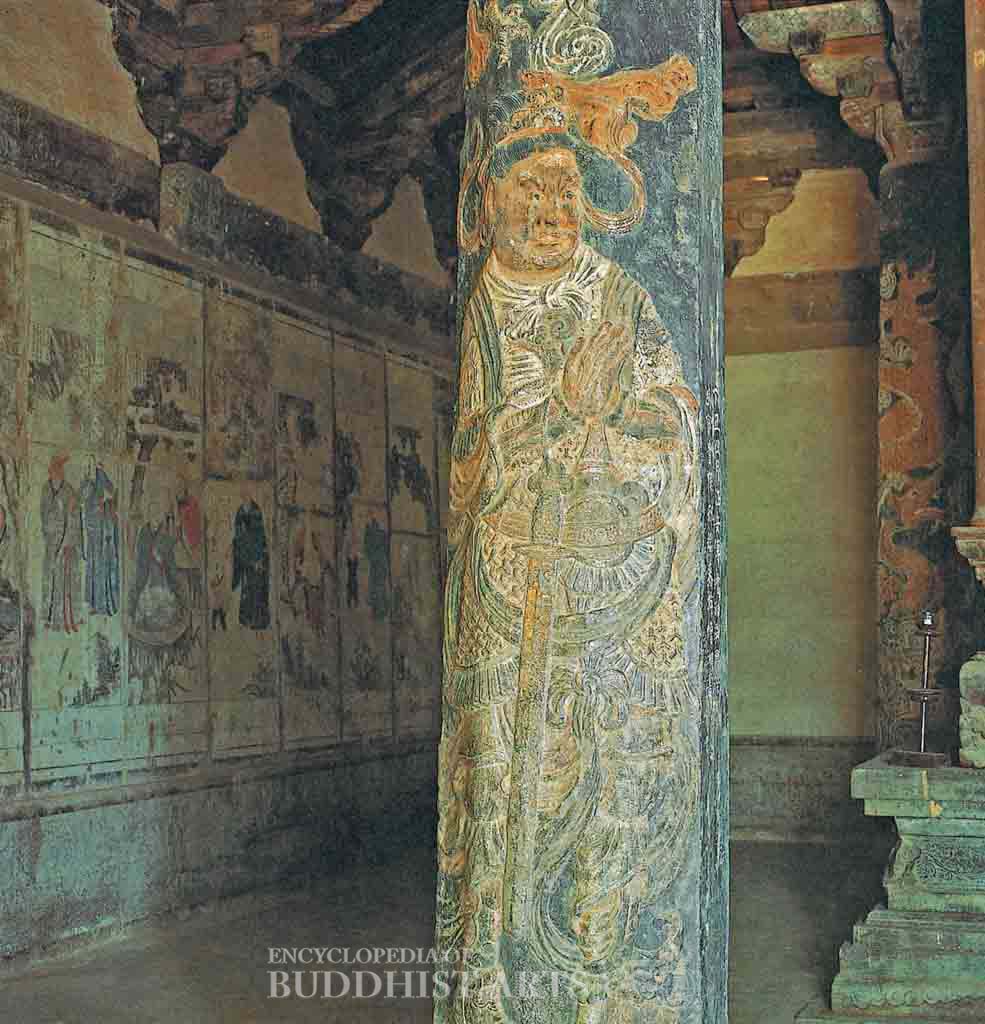
Shaolin Temple First Patriarch Temple: Main Hall (interior)
Shaolin Temple First Patriarch Temple
CHINA, Henan, Zhengzhou
The temple is located to the northwest of Shaolin Temple under Wuru Peak. It is also called Wall-Facing Temple. It was built during the Northern Song dynasty (960–1127) to commemorate Bodhidharma, who sat here in meditation for many years. The main hall is the oldest wood and stone structure in the Henan province. The temple was listed as a National Cultural Heritage Site in 1996, and, as part of the Historic Monuments of Dengfeng, it was listed as a UNESCO World Heritage Site in 2010.
The temple occupies 3,000 sq m and includes the main gate, main hall, Wall-Facing Pavilion, and the Thousand Buddha Chamber. The main gate was constructed during the Jin (1115–1234) and Yuan (1271–1368) dynasties, and restored in 1986. The main hall was built in 1125 during the Northern Song dynasty. Although it has been repaired a number of times, the original structure is still evident. The three-by-three bay hall has a single-eave hip-and-gable roof. There are wooden doors in the central bay, while the side bays have vertical bar windows. The height of the columns gradually increases towards corners in a noticeable way. Inside the hall there are 16 octagonal stone columns. The inner columns at the back have been shifted slightly backwards to make way for the Buddha niche. The lower sections of the Sumeru throne, stone columns, and walls are decorated with carvings such as warriors, apsaras, dragons, peacocks, and floral patterns. They are highly treasured Song dynasty stone carvings. Statues of Bodhidharma and the Fifth Patriarch Hongren are enshrined inside the hall. The north, east, and west walls are filled with portraits of Bodhidharma and 23 other patriarchs; there were originally 36 portraits, but 13 are now missing. There are approximately 40 steles, including two famous ones from the Song dynasty. In front of the Patriarchal Temple there is an old cedar tree planted by the Sixth Patriarch, Master Huineng.
For more details, go to the Encyclopedia of Buddhist Arts: Architecture M-S, page 974.
Cite this article:
author = Hsingyun and Youheng and Johnson, Peter and Mankuang and Lancaster, Lewis,
booktitle = {Encyclopedia of Buddhist Arts: Architecture M-S},
pages = 974,
title = {{Shaolin Temple First Patriarch Temple}},
volume = 3,
year = {2016}}