
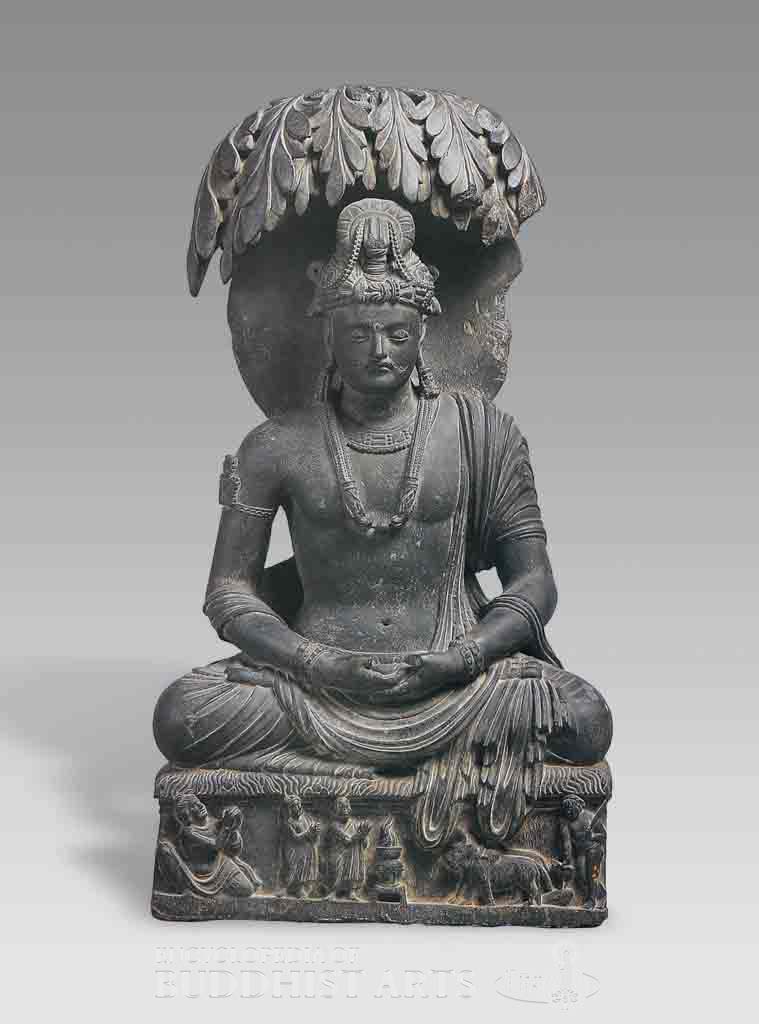
Sahri Bahlol: Life of the Buddha - The First Meditation
Schist
Sahri Bahlol: Life of the Buddha - The First Meditation
PAKISTAN, Khyber Pakhtunkhwa, Peshawar
The statue was discovered among temple ruins in 1912. According to the Lalitavistara Sutra, when Prince Siddhartha accompanied his father to the countryside, he realized the impermanence of life when he witnessed farmers ploughing the field and how the exposed worms were eaten by birds. He then contemplated under a tree and entered a statue to deep meditation. The work here depicts a slightly older, mustached prince sitting upon a carpet of grass as the tree bends its branches to shelter him. The figure is in full lotus position with hands in dhyana (meditation) mudra. The prince wears a wide stole that winds around the shoulder and falls over the skirt. An elaborate headdress and pieces of jewelry decorate the body.
The narrative setting of this scene is portrayed along the frieze at the base. King Suddhodana is featured on the far left, with palms joined and kneeling. Two priests are in the act of worshipping at the fire altar in the center, while a farmer is driving the two oxen that draws his plow at the far right.
For more details, go to the Encyclopedia of Buddhist Arts: Sculpture N-Sr, page 891.
Cite this article:
author = Hsingyun and Youheng and Lovelock, Yann and Chou, Yuan and Huntington, Susan and Edson, Gary and Neather, Robert,
booktitle = {Encyclopedia of Buddhist Arts: Sculpture N-Sr},
pages = 891,
title = {{Sahri Bahlol: Life of the Buddha - The First Meditation}},
volume = 12,
year = {2016}}