
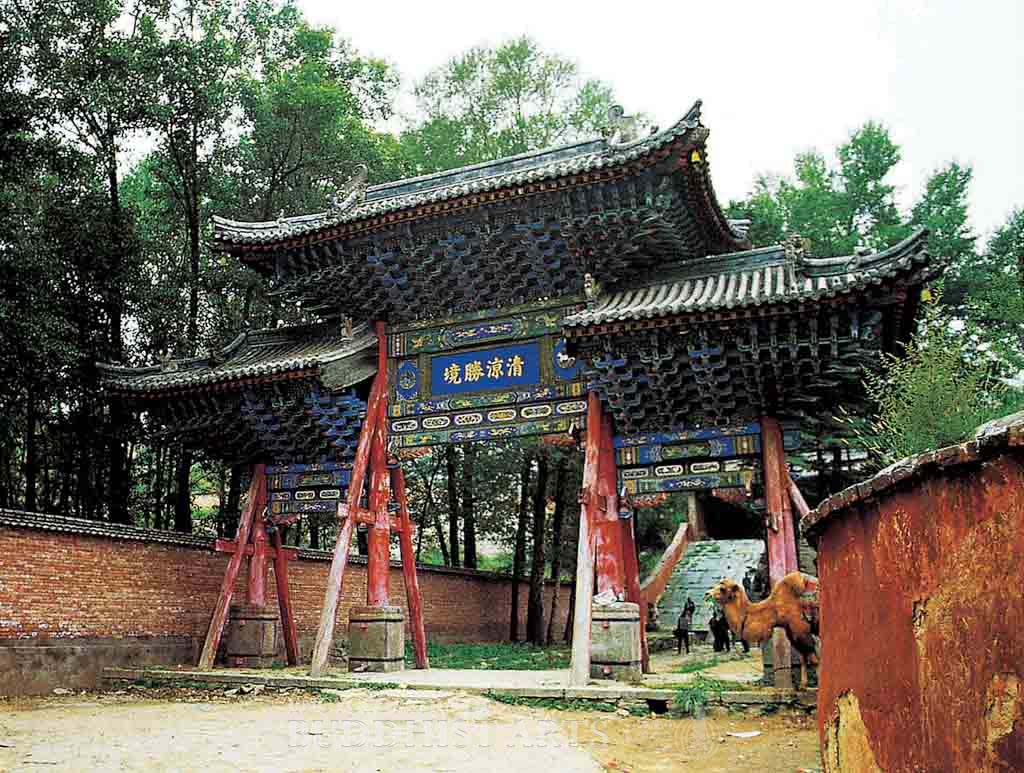
Wutaishan: Gate
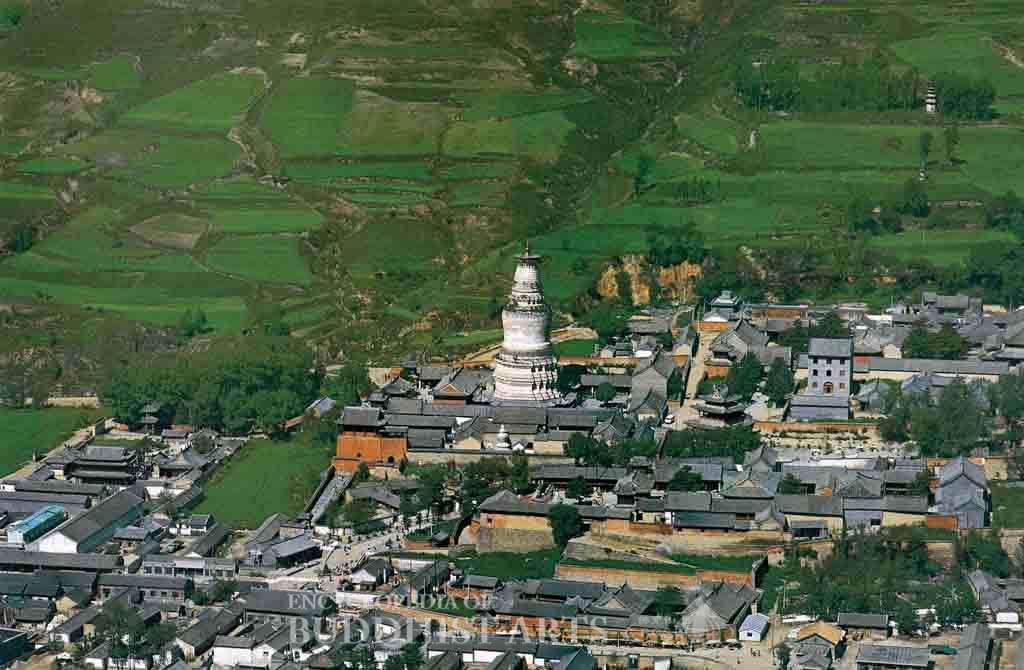
Wutaishan (aerial view)
Wutaishan
CHINA, Shanxi, Xinzhou
Wutaishan means Five Plateau Mountain and it consists of five rounded peaks. Since the weather is always cool, it is also known as Qingliangshan (Clear Cool Mountain). It is one of China’s Four Sacred Buddhist Mountains and is known as the abode of Manjusri Bodhisattva. Here Chinese Buddhism and Tibetan Buddhism have come together.
The earliest temple built on Wutaishan was Dafulingjiu Temple (present day Xiantong Temple) in 68 during the Eastern Han dynasty. The mountain first became popular as a center for Buddhism during the Northern Dynasties (386–581). Emperor Xiaowen (reigned 471–499) of the Northern Wei dynasty once personally visited Wutaishan to oversee the construction of a temple. By the Northern Qi dynasty (550–577) there were more than 200 temples and the mountain became a center for studying the Avatamsaka Sutra in northern China. Unfortunately the persecution of Buddhism by Emperor Wu (reigned 560–578) during the Northern Zhou period left most of the temples in ruins.
The mountain’s most prosperous period was during the Sui (581–681) and Tang (618–907) dynasties. In 581 Emperor Wen (reigned 581–604) of the Sui dynasty issued a decree to construct a temple on each of the five peaks. By the Tang dynasty there were more than 360 temples. During this time, many eminent monks from different schools of Buddhism visited the mountain to propagate the Dharma.
During the Yuan dynasty (1271–1368) the emperors paid great respect to the Buddhist community on Wutaishan. Chogyal Phakpa, the fifth leader of the Sakya school in Mongolia, visited the mountain in 1257. The presence of Tibetan Buddhism increased when Vajra Master Danupa stayed at Shouning Temple during the rule of Kublai Khan (1260–1294). The emperors of the Ming dynasty (1368–1644) fully supported the development of the Gelug school on Wutaishan. Under the Qing dynasty (1644–1911) both Mahayana and Vajrayana Buddhism continued to be propagated there. Emperor Shunzhi (reigned 1644–1661) converted ten of the temples to the Gelug school.
According to a survey taken in 1956, there were 97 Chinese Buddhist temples and 25 Tibetan temples on the mountain. The famous ones include Bishan Temple, Foguang Temple, Guangji Temple, Jinge Temple, Longquan Temple, Luohou Temple, Nanchan Temple, Shuxiang Temple, Tayuan Temple, Xiantong Temple, Yanqing Temple, Yanshan Temple, Zhenhai Temple, and Zunsheng Temple.
For more details, go to the Encyclopedia of Buddhist Arts: Architecture T-Z, page 1282.
Cite this article:
author = Hsingyun and Youheng and Johnson, Peter and Mankuang and Lancaster, Lewis,
booktitle = {Encyclopedia of Buddhist Arts: Architecture T-Z},
pages = 1282,
title = {{Wutaishan}},
volume = 4,
year = {2016}}