
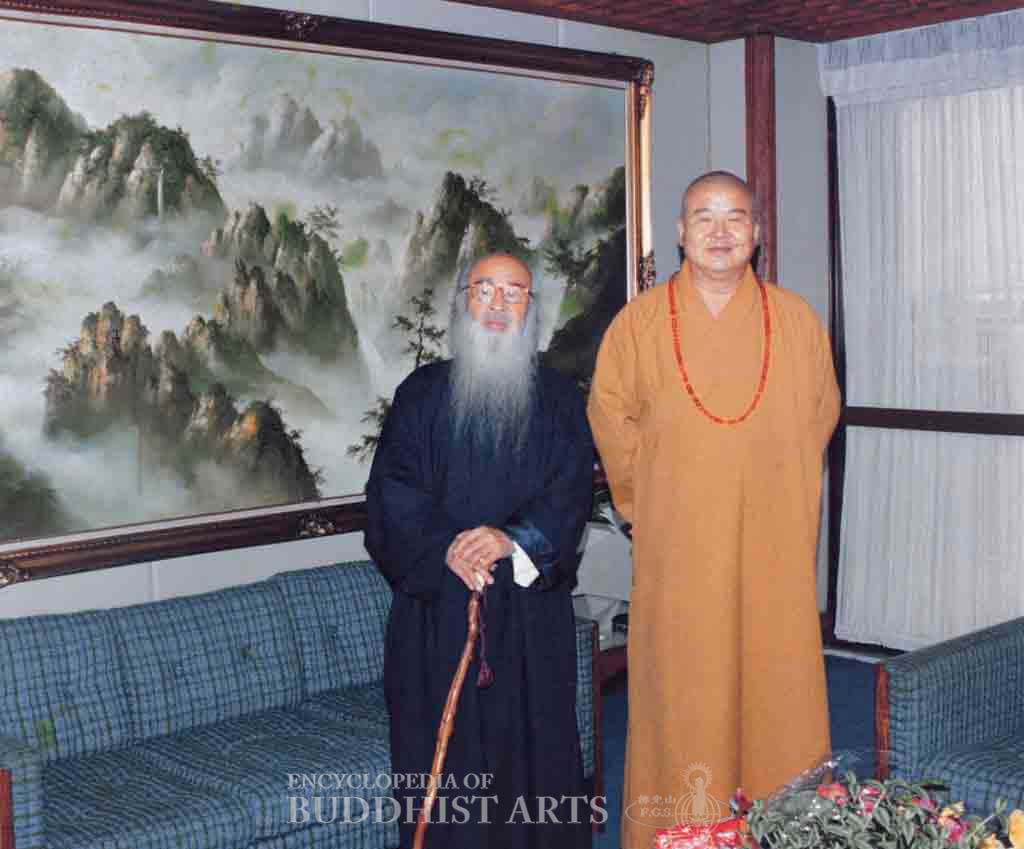
Chang Dai-Chien
Chang Dai-Chien
CHINA, Sichuan, Neijiang
Chang Dai-Chien, also spelled Zhang Daqian, was a painter whose original name was Zhang Zhenquan and had a nickname of Yuan. As a young adult, he went to Kyoto, Japan to study art with his elder brother, Zhang Ze, who was also an artist. After returning to China, he went to Shanghai where he studied calligraphy under two well-known masters, Zeng Xi and Li Ruiqing. His intention was to infuse calligraphic style into his paintings. At the age of 21, he renounced at Chanding Temple in Songjiang, Jiangsu, and took the name Daqian. Three months later, he returned to secular life, cultivating his artistic talents and becoming one of the most outstanding Chinese painters of the 20th century.
At the age of 42, Chang went to Dunhuang, where for three years he committed himself to copying the murals at the Mogao Caves, Yulin Grottoes, and Western Thousand Buddha Caves. His painting style changed dramatically during this time, completing over 200 works in thick colors. In 1949 he moved overseas, settling in Brazil for a while. In 1956, he was invited to exhibit his paintings in Paris and met Picasso in Nice, France. It was Western abstract painting that possibly influenced him to use more carefree strokes in his paintings and to create new perspectives by using the splashed-ink technique. In 1967, he finally settled in Taiwan, and in 1983, he painted Lushan, which was his last work.
Chang’s paintings are collected in many museums around Asia. Avalokitesvara Bodhisattva is retained at Fo Guang Shan Monastery in Kaohsiung, Taiwan, Avalokitesvara with a Fish Basket is kept at the Yunnan Provincial Museum, China and the Naga Girl Paying Respect to the Buddha in the Tang style is at the National Palace Museum in Taipei, Taiwan.
For more details, go to the Encyclopedia of Buddhist Arts: People, page 13.
Cite this article:
author = Hsingyun and Youheng and Youlu and Pokorski, Stefanie and Yichao and Mankuang and Miaohsi,
booktitle = {Encyclopedia of Buddhist Arts: People },
pages = 13,
title = {{Chang Dai-Chien}},
volume = 19,
year = {2016}}