
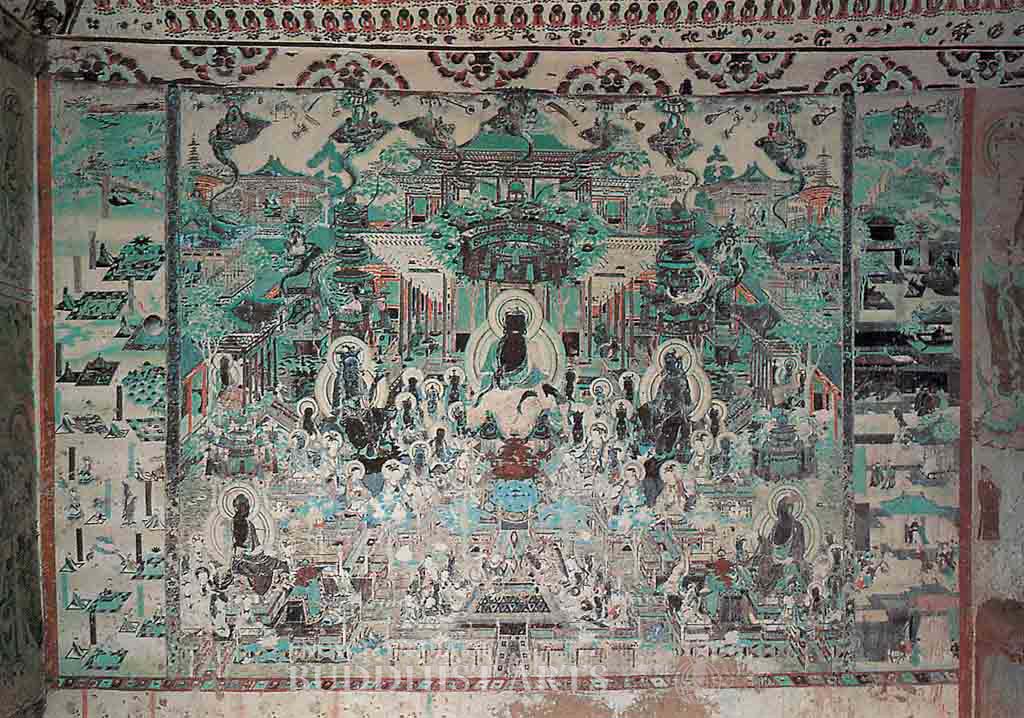
Mogao Cave 172: Illustrations of the Amitayurdhyana Sutra (south wall)
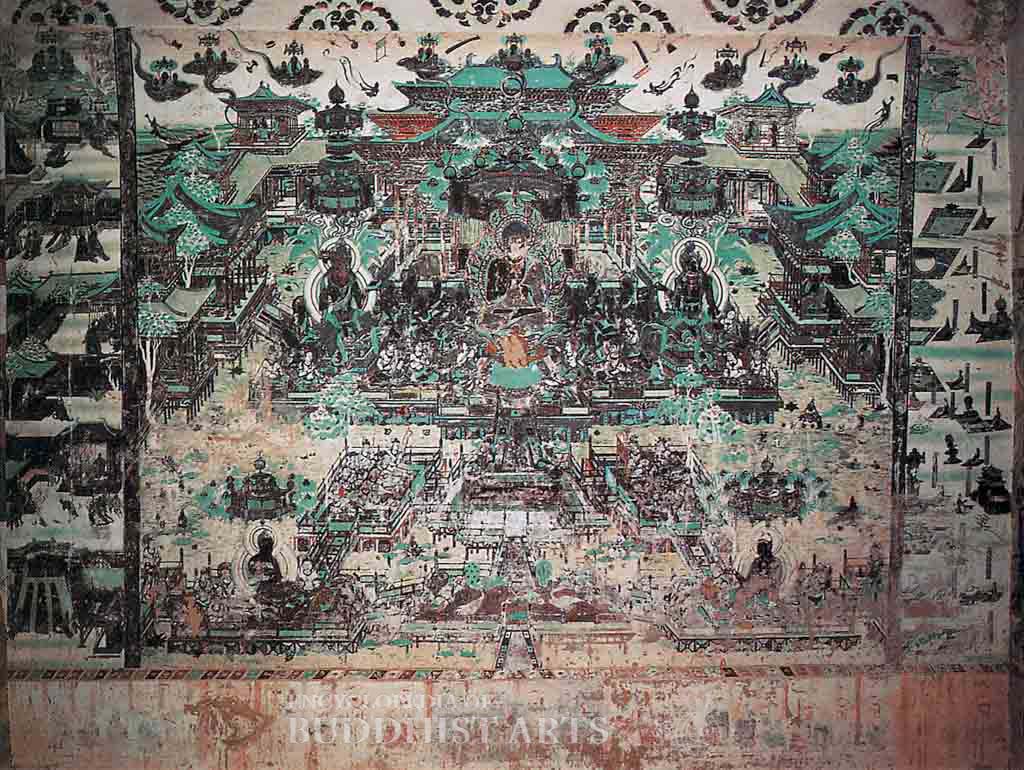
Mogao Cave 172: Illustrations of the Amitayurdhyana Sutra (north wall)
Mogao Cave 172: Illustrations of the Amitayurdhyana Sutra
CHINA, Gansu, Dunhuang; Tang dynasty
These High Tang period (712–756) illustrations of the Amitayurdhyana Sutra are on the walls of the main chamber. The Western Pure Land is depicted in both illustrations, with Amitabha Buddha flanked by two Bodhisattvas in the center, shrines and pavilions at the top, and musicians on platforms above a lotus pond below. The panels on each side of the murals illustrate the Sixteen Contemplations and the story of Ajatasatru. The illustration on the south wall is predominantly green and white. It has a delicate, clear, and lively appearance, having suffered less color change over the years than the mural on north wall, which has darkened from oxidation and now has a solemn appearance.
In each mural, the highest pavilion is in the center of the upper register, directly above Amitabha Buddha. The Buddha is larger than the other figures, and is the visual focus of the murals. This effect is enhanced by the symmetrical layout of the paintings and the precise rendering of the architecture. Amitabha is flanked by Avalokitesvara and Mahasthamaprapta Bodhisattvas, and is surrounded by a gathering of Bodhisattvas and heavenly beings. A splendid canopy hangs above the Buddha, and a striking nimbus and aureole are painted behind the figure. Below the Buddha are three platforms: musicians perform on the central platform, and the two small platforms on either side hold Buddhas and Bodhisattvas.
For more details, go to the Encyclopedia of Buddhist Arts: Caves M-Mo, page 1004.
Cite this article:
author = Hsingyun and Youheng and Johnson, Peter and Mankuang and Huntington, Susan and Edson, Gary and Neather, Robert,
booktitle = {Encyclopedia of Buddhist Arts: Caves M-Mo},
pages = 1004,
title = {{Mogao Cave 172: Illustrations of the Amitayurdhyana Sutra}},
volume = 7,
year = {2016}}