
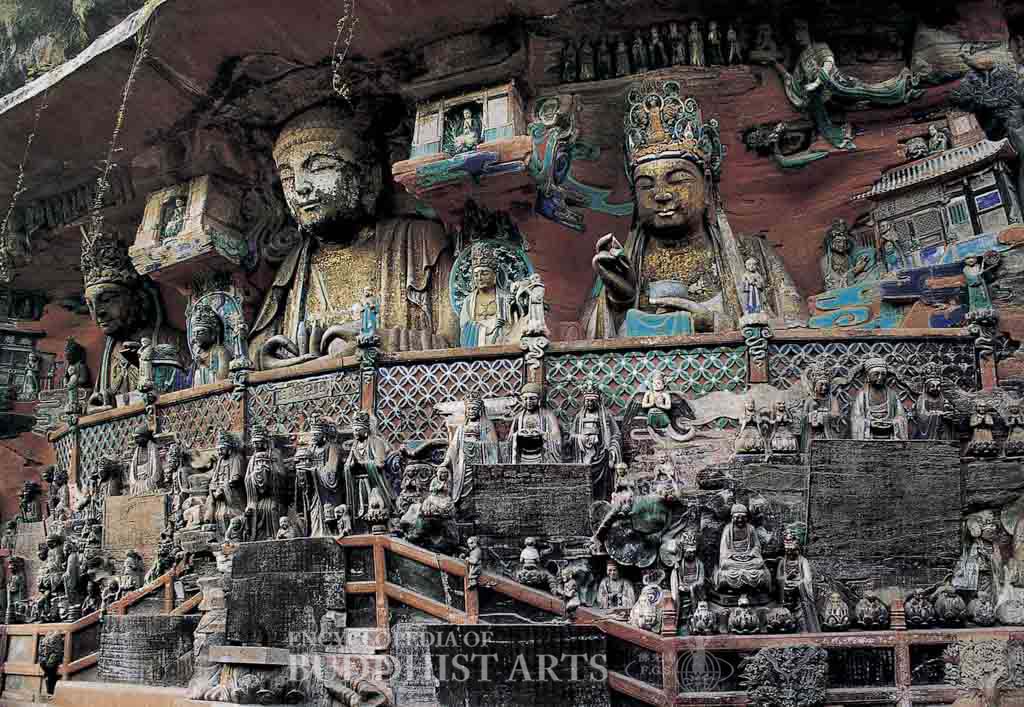
Dazu Rock Carvings Baodingshan Great Buddha Bay Niche 18: Illustration of the Amitayurdhyana Sutra
Stone
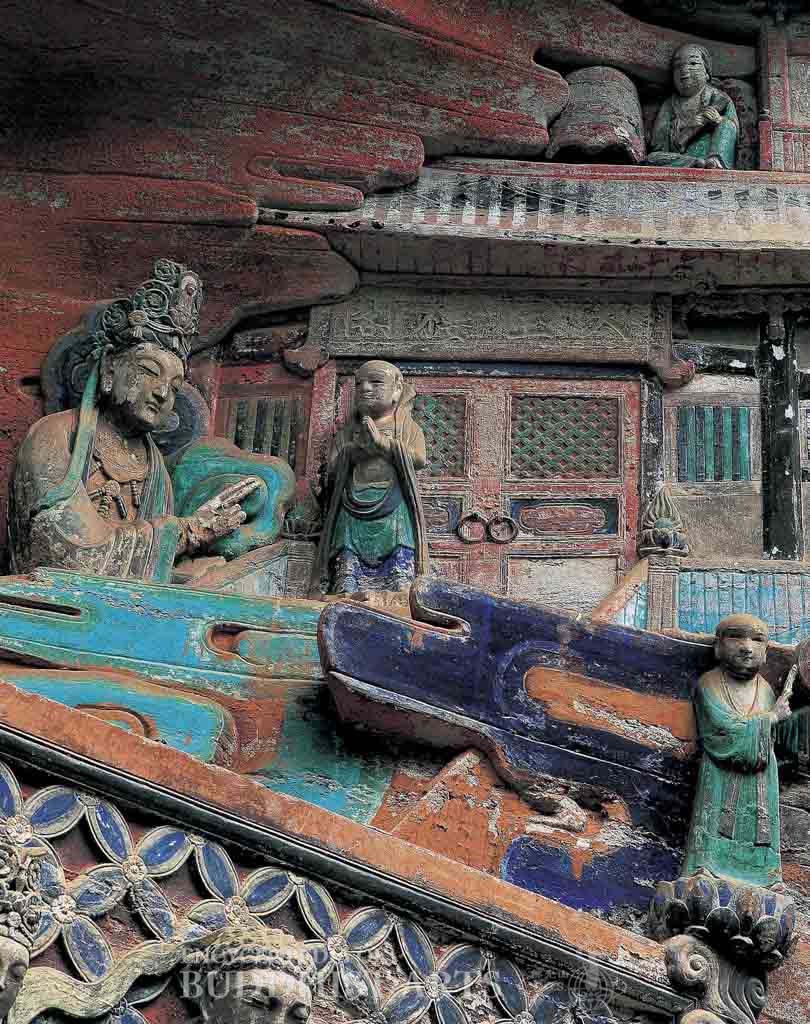
Dazu Rock Carvings Baodingshan Great Buddha Bay Niche 18: Illustration of the Amitayurdhyana Sutra - Great Treasure Shrine
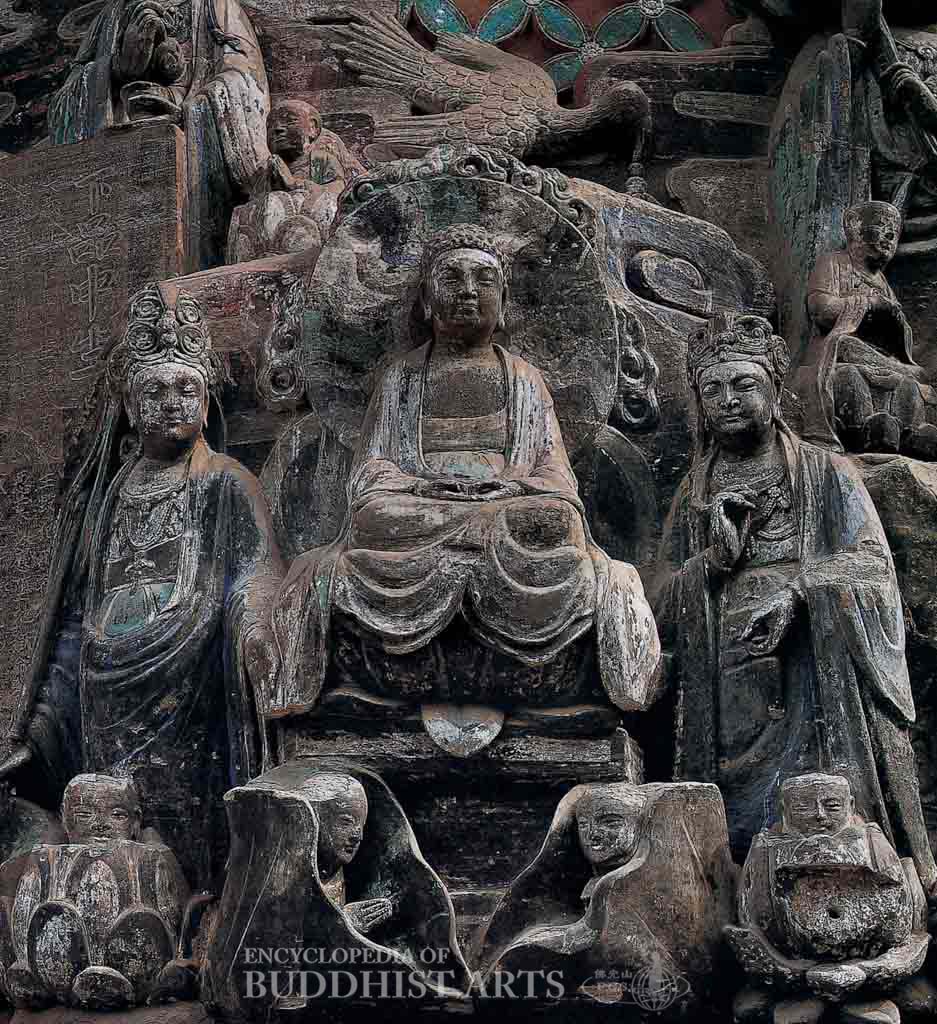
Dazu Rock Carvings Baodingshan Great Buddha Bay Niche 18: Illustration of the Amitayurdhyana Sutra - Middle Grade of the Lowest Class
Dazu Rock Carvings Baodingshan Great Buddha Bay Niche 18: Illustration of the Amitayurdhyana Sutra
CHINA, Chongqing, Dazu; Southern Song dynasty
Situated within the north cliff, Niche 18 has a flat ceiling and is 20.2 m in width, 8.1 m in height, and 2.5 m in depth. It contains the largest illustration of the Amitayurdhyana Sutra found in Chinese caves.
There are large carvings of the Amitabha Buddha Triad in the center of the niche. Amitabha Buddha is in the middle, flanked by Avalokitesvara Bodhisattva on the right and Mahasthamaprapta Bodhisattva on the left. Amitabha has a usnisa, wears a monastic robe, and forms a mudra with both hands. Avalokitesvara wears a headdress decorated with a Buddha, holds an alms bowl in the left hand, and grasps a willow branch in the right hand. Mahasthamaprapta wears a tall headdress and holds an object in one hand while the other forms a mudra.
The Buddhas of the Ten Directions are carved above the Bodhisattvas. Between Amitabha and each Bodhisattva is a shrine containing a seated figure. Under each shrine stands another Bodhisattva. A carving of the Great Treasure Shrine appears on the outer side of Avalokitesvara, while the carving of the Jewel Building is located on the outer side of Mahasthamaprapta. Surrounding the Amitabha Buddha Triad are other Bodhisattvas, heavenly beings, apsaras, and figures playing musical instruments.
Carvings of the nine grades of rebirth listed in the sutra can be found in front of the balustrade below the Amitabha Buddha Triad. The three grades of the highest class are depicted in the center, while the three grades of the middle class are on the right, and the three grades of the lowest class are on the left. With the exceptions of the highest grade of the highest class, which is carved with four Bodhisattvas, all the other grades contain a depiction of the Amitabha Buddha Triad welcoming the deceased. Inscriptions containing passages from the sutra are found within each carving.
On the side edges of the niche, as well as the east and west walls, are carvings of the Sixteen Contemplations, along with their corresponding verses. The figures in these scenes include monks, officials, generals, and various other beings.
For more details, go to the Encyclopedia of Buddhist Arts: Caves A-E, page 253.
Cite this article:
author = Hsingyun and Youheng and Johnson, Peter and Mankuang and Huntington, Susan and Edson, Gary and Neather, Robert,
booktitle = {Encyclopedia of Buddhist Arts: Caves A-E},
pages = 253,
title = {{Dazu Rock Carvings Baodingshan Great Buddha Bay Niche 18: Illustration of the Amitayurdhyana Sutra}},
volume = 5,
year = {2016}}