
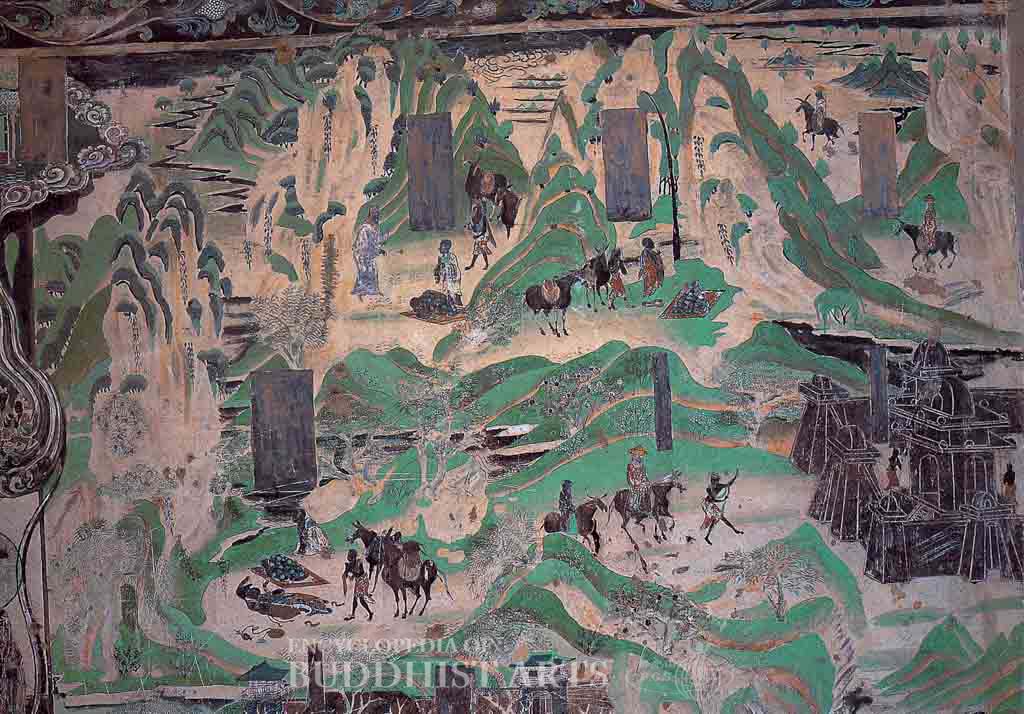
Mogao Cave 217: Illustration of the Lotus Sutra - Chapter on the Parable of the Phantom City
Mogao Cave 217: Illustration of the Lotus Sutra - Chapter on the Parable of the Phantom City
CHINA, Gansu, Dunhuang; Tang dynasty
This scene is part of the mural on the south wall of the main chamber. The parable of the phantom city compares the Buddha’s use of skillful means to encourage and guide sentient beings along the difficult path to enlightenment to a guide leading a group of people on a lengthy journey to seek out precious jewels. The route is arduous and the weary group begins to doubt their quest and consider turning back. At this point, the guide manifests a beautiful oasis where they are able to rest and rejuvenate. This renews the resolve of the people, and they continue onward with enthusiasm. The painting assumes a bird’s eye view. Figures are shown journeying through a mountainous landscape. The mountain ranges are thinly outlined and filled in with a green wash, demonstrative of the unique style of landscape painting during the High Tang period (712–756). Thick paint is employed for the line work. Of particular significance are the greenery and trees on the slopes, which distinguishes this style from the purely ink-based landscape paintings that evolved in subsequent periods.
For more details, go to the Encyclopedia of Buddhist Arts: Caves M-Mo, page 1023.
Cite this article:
author = Hsingyun and Youheng and Johnson, Peter and Mankuang and Huntington, Susan and Edson, Gary and Neather, Robert,
booktitle = {Encyclopedia of Buddhist Arts: Caves M-Mo},
pages = 1023,
title = {{Mogao Cave 217: Illustration of the Lotus Sutra - Chapter on the Parable of the Phantom City}},
volume = 7,
year = {2016}}