
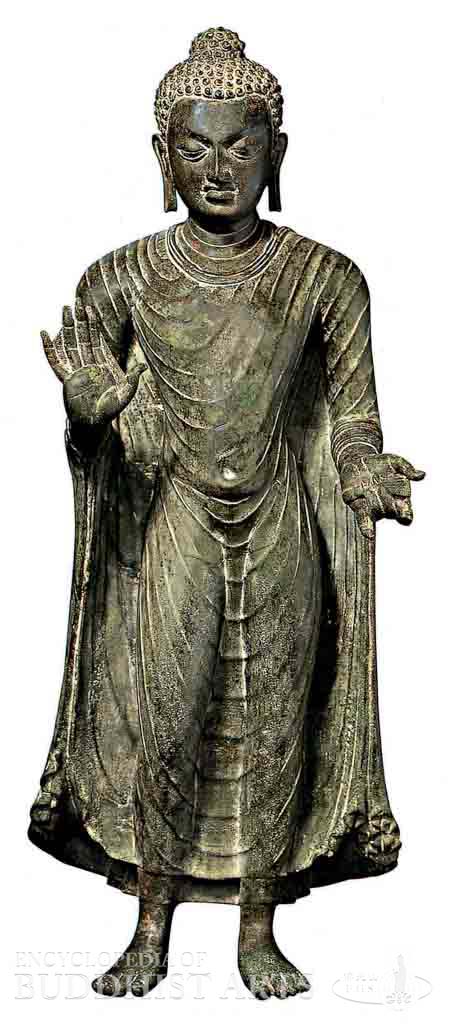
Standing Buddha
Copper alloy
Standing Buddha
INDIA
Several Buddha characteristics are represented in this statue, including a rounded usnisa, lengthened earlobes, three lines on the neck, and webbing between the long, slender fingers and the toes. The eyes gaze downward, the line of the nose and the shape of the lips are well defined. The figure is dressed in a monastic robe that covers both shoulders and flares out at the sides, with folds that curve downwards. The robe’s material clings to the shape of the body. The right hand is held in abhaya (fearlessness) mudra while the left hand tightens the fold of the robe over the arm. The right leg is slightly bent to accentuate the forward motion of the foot.
The shape of the figure and its clothing are influenced by the sculptural style of the Gupta period (circa 320–550), while some details seem to indicate an origin in the Bihar and West Bengal regions.
For more details, go to the Encyclopedia of Buddhist Arts: Sculpture St-Z, page 1138.
Cite this article:
author = Hsingyun and Youheng and Lovelock, Yann and Chou, Yuan and Huntington, Susan and Edson, Gary and Neather, Robert,
booktitle = {Encyclopedia of Buddhist Arts: Sculpture St-Z},
pages = 1138,
title = {{Standing Buddha}},
volume = 13,
year = {2016}}