
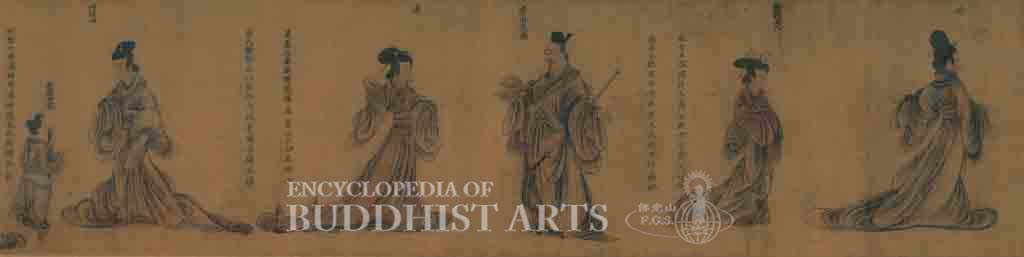
Copy of Gu Kaizhi’s Wise and Benevolent Heroines (detail); Song dynasty
Ink and color on paper
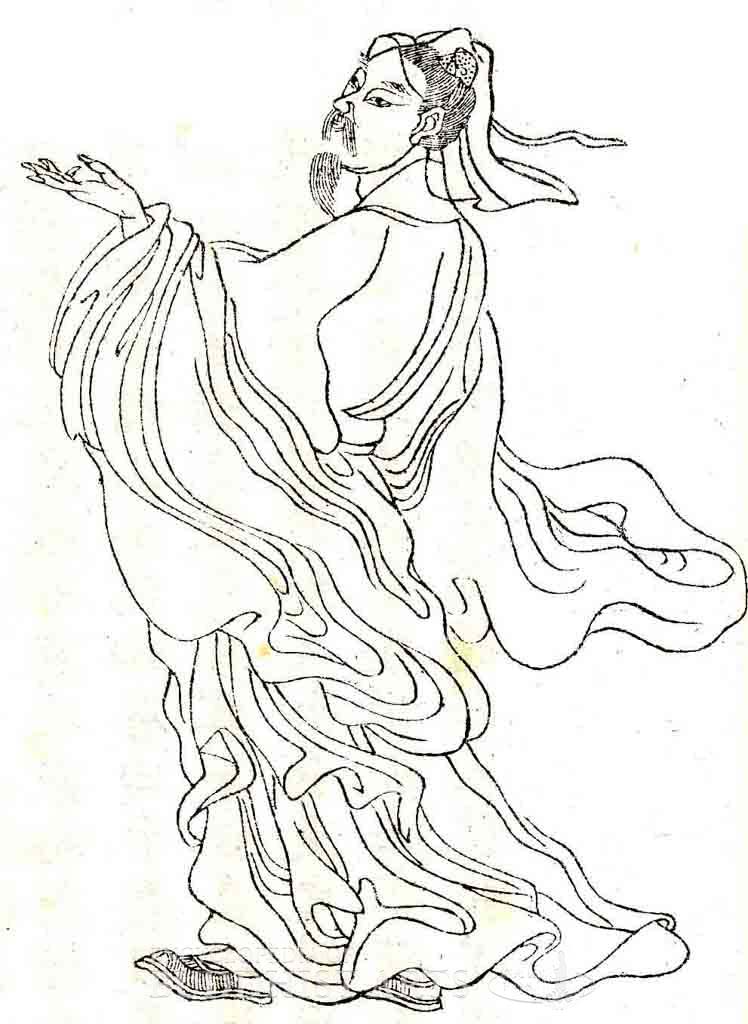
Gu Kaizhi
Gu Kaizhi
CHINA, Jiangsu, Wuxi; Eastern Jin dynasty
Gu Kaizhi, also known as Changkang, was a painter, art theorist, and government official. Having exceptional character and skill, he was adept in poetry and calligraphy, as well as painting portraits, landscapes, Buddhist images, and animals. Gu, who is thought to be the first literary painter and art theorist of ancient China, authored several books such as Comments on Paintings and Introduction of Famous Paintings of Wei and Jin Dynasties, among others. These literary works, which outlined his views on painting and creative theory, greatly impacted later generations.
Based on the works of Wei Xie, Gu developed his own style in which he utilized form to show the essence or “spirit” of a figure. The faces he painted are decorated with thick color and the background imagery makes the figure itself discernible. The eyes, which serve as the focal point, give the figure a lively appearance. Gu, alongside Cao Buxing, Zhang Sengyao, and Lu Tanwei, was acclaimed as one of the Four Great Painters of the Six Dynasties (220–589). Of these artists, Gu was the most distinguished.
Gu’s paintings are recorded in Famous Paintings in History, Painting Annals of the Zhenguan Period, and Xuanhe Catalog of Paintings. Gu illustrated Vimalakirti on the wall of the North Hall in Waguan Temple in Jiangsu. The painting reveals a countenance that is distinct and thin in both form and spirit, and is considered a valuable piece of the collection of Buddhist works at Waguan Temple. Copies of his paintings include Admonitions of the Instructress to the Court Ladies, kept at the British Museum in London; Luo River Goddess, kept at the Palace Museum in Beijing and Liaoning Provincial Museum; and Wise and Benevolent Heroines, retained at the Palace Museum in Beijing.
For more details, go to the Encyclopedia of Buddhist Arts: People, page 82.
Cite this article:
author = Hsingyun and Youheng and Youlu and Pokorski, Stefanie and Yichao and Mankuang and Miaohsi,
booktitle = {Encyclopedia of Buddhist Arts: People },
pages = 82,
title = {{Gu Kaizhi}},
volume = 19,
year = {2016}}