
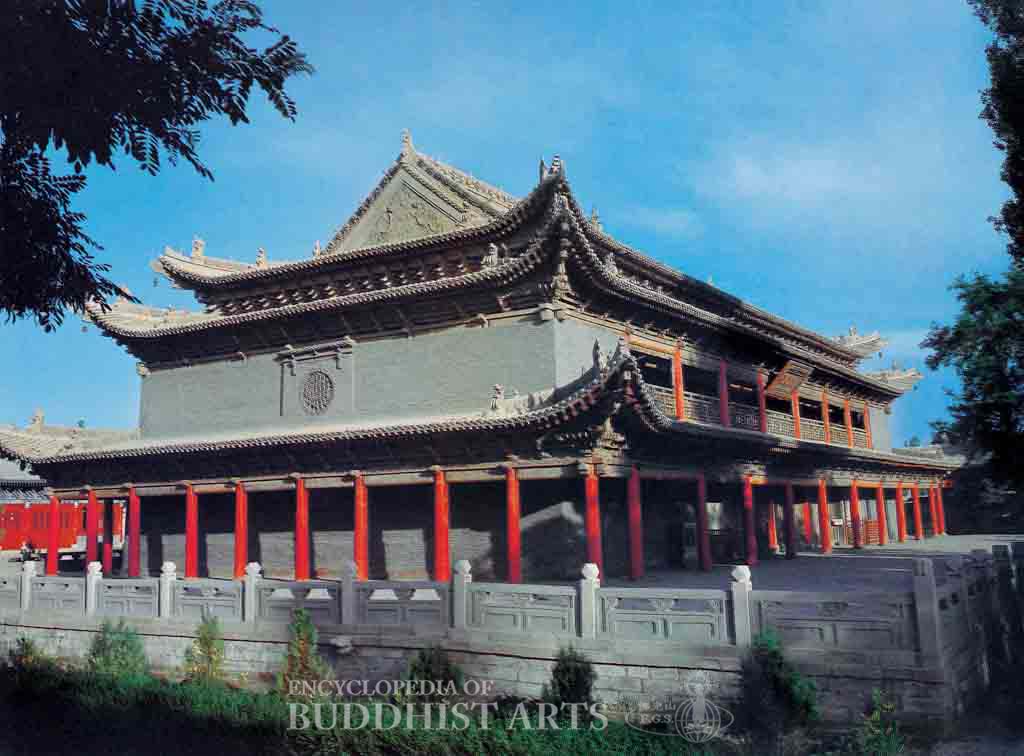
Dafo Temple: Great Buddha Hall
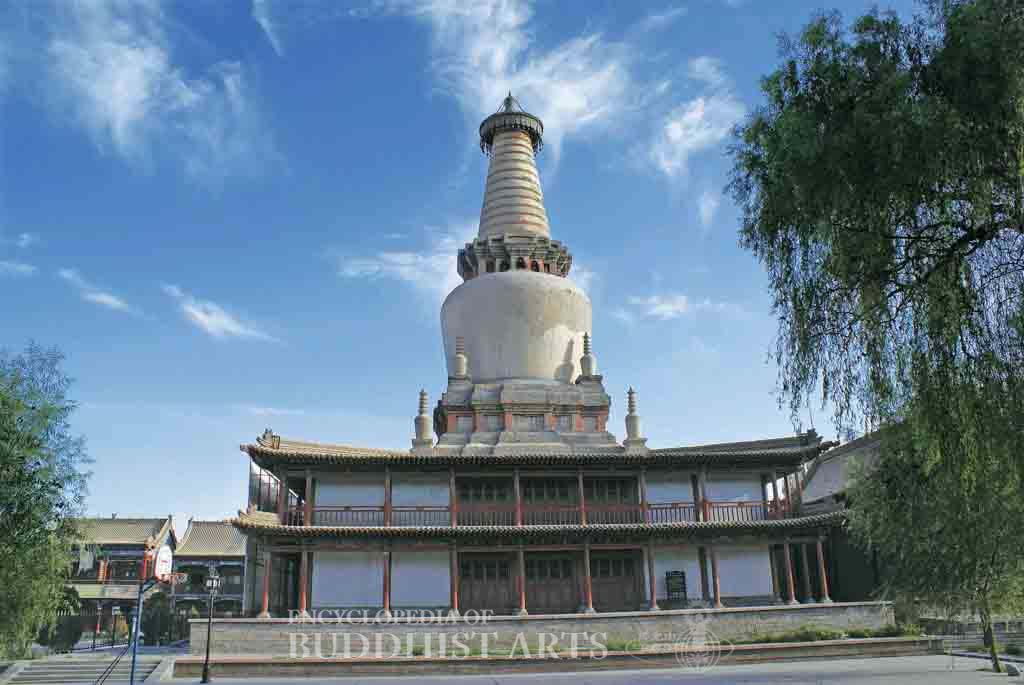
Dafo Temple: Earthen Stupa
Dafo Temple
CHINA, Gansu, Zhangye
Dafo means Great Buddha. The temple was built in the Hexi Corridor in 1099 during the Western Xia period and has undergone renovation throughout the dynasties. Due to a reclining Buddha statue enshrined within the temple, it is also known as Wofo (Reclining Buddha) Temple. It was listed as a National Cultural Heritage Site in 1996.
The temple faces west and occupies 2.3 ha. Along the central axis there are the Great Buddha Hall, sutra repository, and Earthen Stupa. The two-story, nine-by-seven bay Great Buddha Hall covers 1,370 sq m and is around 20 m high. It has a double-eave hip-and-gable roof. The hall is surrounded by a wooden veranda. The architraves and both sides of the doors are decorated with delicate wooden carvings and brick reliefs. On either side of the entrance there are depictions of the Western Pure Land and the Buddha Teaching the Dharma at Jetavana Monastery. Within the hall, 31 colored molded sculptures depict the Parinirvana scene from the Life of the Buddha. The main statue is a 34.5 m long reclining Sakyamuni Buddha made of clay on a wooden frame and painted in gold. It is the longest indoor reclining Buddha statue in China. Behind the Buddha there are the Ten Great Disciples in mourning. The Eighteen Arhats are lined up in front of the north and south walls. There are extensive murals painted during the Ming dynasty (1368–1644) covering an area of around 330 sq m and illustrating subjects such as Buddhas, Bodhisattvas, disciples, heavenly beings, and Master Xuanzang’s Journey to Obtain the Sutras.
The sutra repository contains treasures, such as the Yongle Northern Tripitaka from the Ming dynasty consisting of 3,584 fascicles, and 600 fascicles of scriptures inscribed in gold ink.
The Earthen Stupa is built of earth and brick and is 33.4 m high. The stupa stands on a two-story structure with a veranda below and a balcony above supported by columns. The base consists of a two-tier Sumeru throne with multiple corners. The main stupa body is shaped like an inverted bowl. Above that is a single-tier multi-corner Sumeru throne with Buddha niches. The finial consists of 13 stacked rings surmounted by a canopy.
For more details, go to the Encyclopedia of Buddhist Arts: Architecture A-F, page 189.
Cite this article:
author = Hsingyun and Youheng and Johnson, Peter and Mankuang and Lancaster, Lewis,
booktitle = {Encyclopedia of Buddhist Arts: Architecture A-F},
pages = 189,
title = {{Dafo Temple}},
volume = 1,
year = {2016}}