
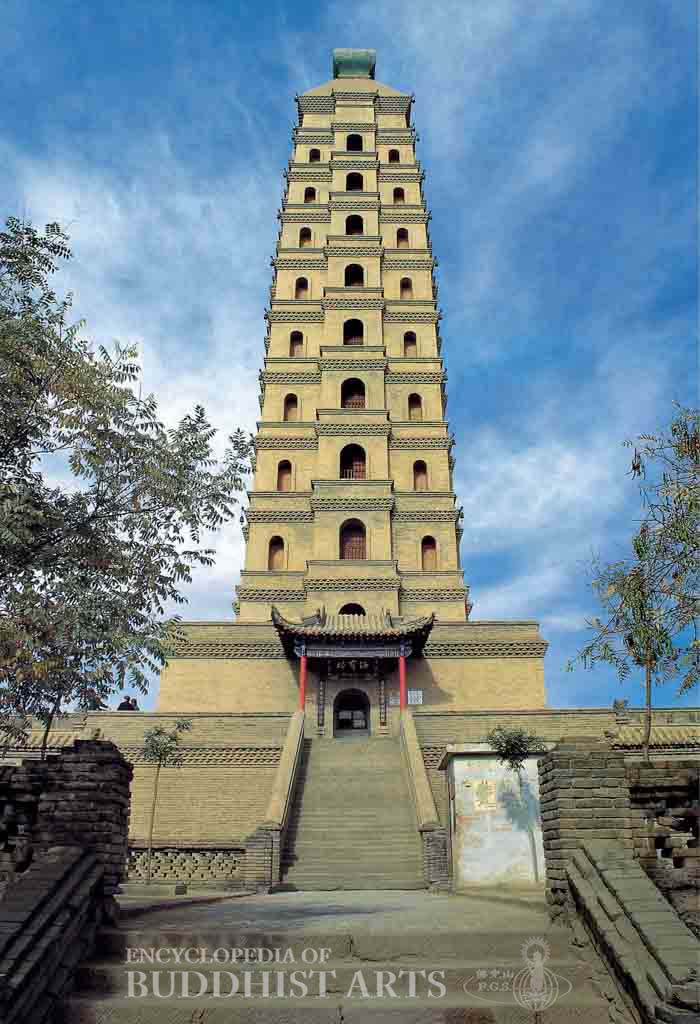
Haibao Temple Pagoda
Haibao Temple Pagoda
CHINA, Ningxia, Yinchuan
It is not known when the pagoda was constructed but one source states that it was renovated by order of Emperor Helian Bobo (reigned 407–425) of the Great Xia Kingdom. During the rule of Emperor Kangxi (reigned 1661–1722) and Emperor Qianlong (reigned 1736–1796), the pagoda collapsed following earthquakes and was reconstructed each time. The pagoda is built on the temple’s central axis and is situated between two halls. It was listed as a National Cultural Heritage Site in 1961.
The nine-story, square, brick pagoda is 60 m high. It stands on a high platform, which has two levels. On the lower level on the east side there are steps leading up to the entrance, which is in the upper level. In front of the entrance there is a portico with a hip-and-gable roof. The pagoda body has multiple corners with an arched doorway in the center of each story, while on either side there are arched niches. Above the doorways and niches there are three courses of dogtooth bricks, followed by corbeling. The chambers are square with wooden floors and there are stairs connecting each story. At the top there is an extra story without openings or niches followed by a truncated pyramidal roof. The spire is in the form of a large jewel made of green glazed bricks. The present-day pagoda is a Qing dynasty (1644–1911) reconstruction with unique features.
For more details, go to the Encyclopedia of Buddhist Arts: Architecture G-L, page 424.
Cite this article:
author = Hsingyun and Youheng and Johnson, Peter and Mankuang and Lancaster, Lewis,
booktitle = {Encyclopedia of Buddhist Arts: Architecture G-L},
pages = 424,
title = {{Haibao Temple Pagoda}},
volume = 2,
year = {2016}}