
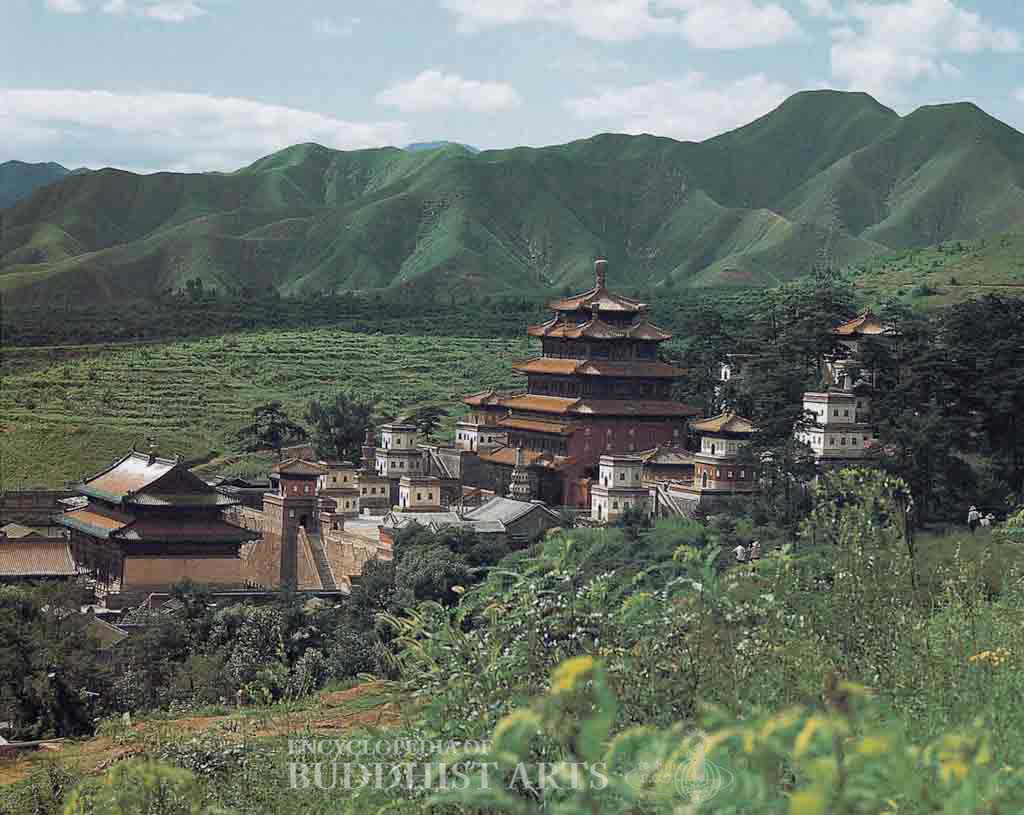
Chengde Puning Temple
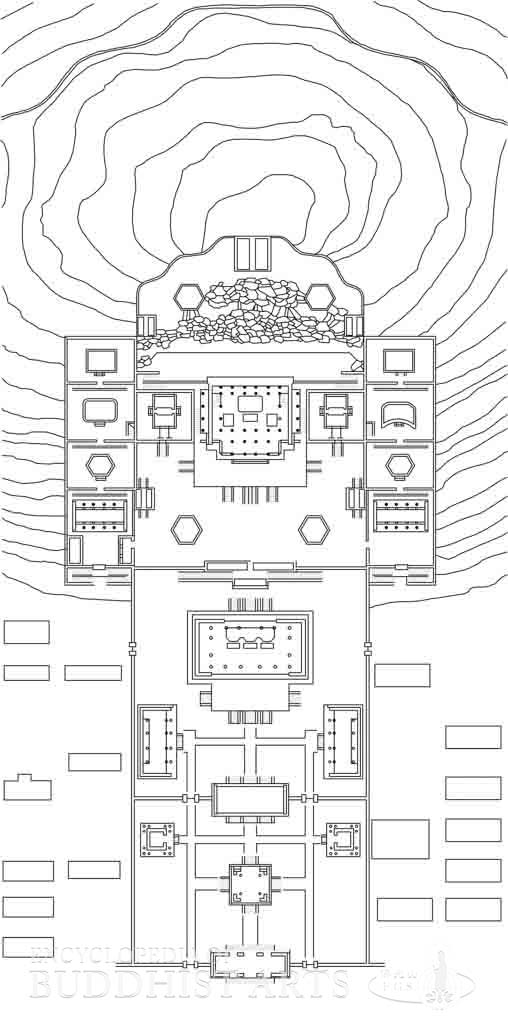
Chengde Puning Temple (site layout)
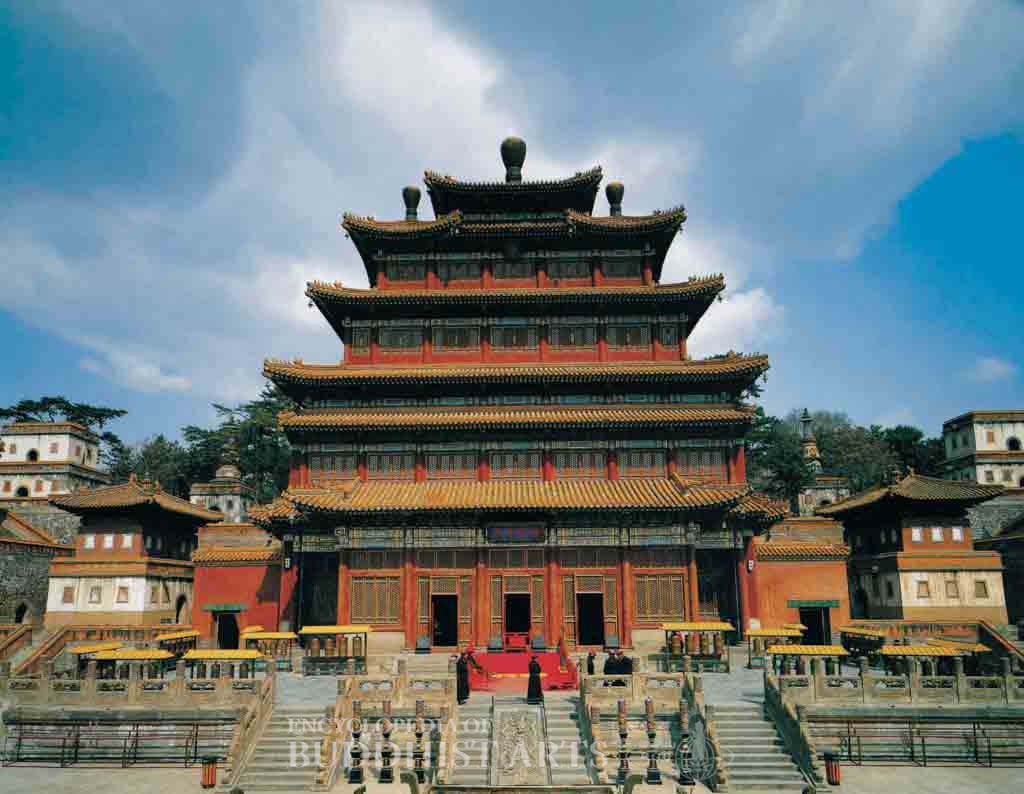
Chengde Puning Temple: Mahayana Hall
Chengde Puning Temple
CHINA, Hebei, Chengde
Puning means Universal Peace and the temple is located 2.5 km northwest of the Chengde Mountain Resort. It was built in 1755 during the Qing dynasty, after Emperor Qianlong (reigned 1736–1795) had twice defeated the Dzungars. It was listed as a National Cultural Heritage Site in 1961.
The temple faces south and covers an area of 10.2 ha. It is divided into the front and rear areas and its main buildings are arranged symmetrically. The buildings in the front area are in a typical Chinese layout, consisting of the main temple gate, imperial stele pavilion, the bell and drum towers, Heavenly King Hall, the side halls in the east and west, and the Great Hero Hall.
The rear area is modeled on the Tibetan Samye Monastery at Chatang, the design of which is based on Buddhist cosmology. The buildings stand on an 8.9 m high granite platform. In the center there is the Mahayana Hall, which symbolizes Mount Sumeru, the center of the universe. On either side there are two-story halls, symbolizing the sun and moon. There are two-story halls, built in different styles, located in the north, south, east, and west of the Mahayana Hall. They represent the four continents. Each hall is accompanied by a pair of white halls, representing the eight smaller continents. At the four corners there are four stupas in red, green, white, and black, representing the Four Heavenly Kings. The exterior is surrounded by a high curved wall, which symbolizes the large and small Cakravala Mountains, which are the boundaries of the universe.
Externally the seven-by-five bay, three-story Mahayana Hall appears to have five stories and it is 37.4 m high. It has a hip roof with six sets of eaves. The building is hollow inside with an internal height of 24 m. A 22.3 m high Thousand-Armed, Thousand-Eyed Avalokitesvara Bodhisattva is enshrined within. The statue weighs 110 t and is considered to be the largest wooden statue of Avalokitesvara in China.
For more details, go to the Encyclopedia of Buddhist Arts: Architecture A-F, page 132.
Cite this article:
author = Hsingyun and Youheng and Johnson, Peter and Mankuang and Lancaster, Lewis,
booktitle = {Encyclopedia of Buddhist Arts: Architecture A-F},
pages = 132,
title = {{Chengde Puning Temple}},
volume = 1,
year = {2016}}