
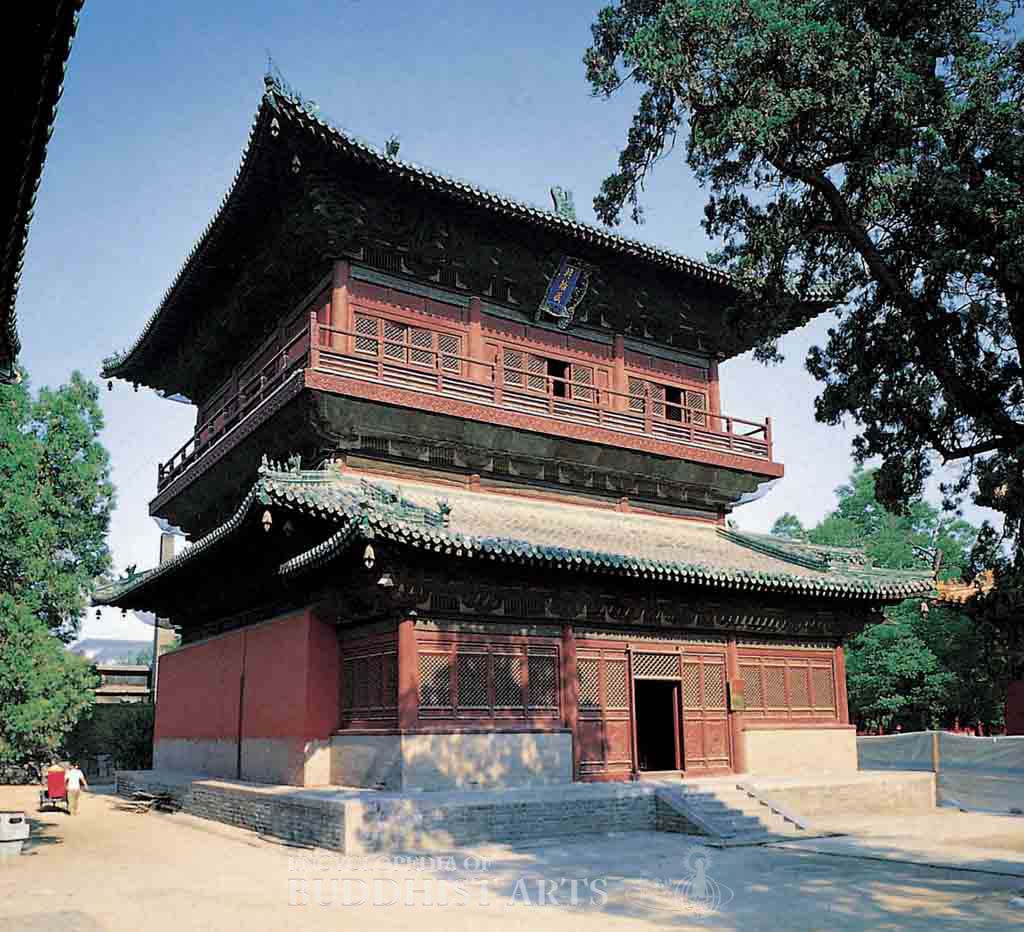
Longxing Temple Revolving Sutra Repository
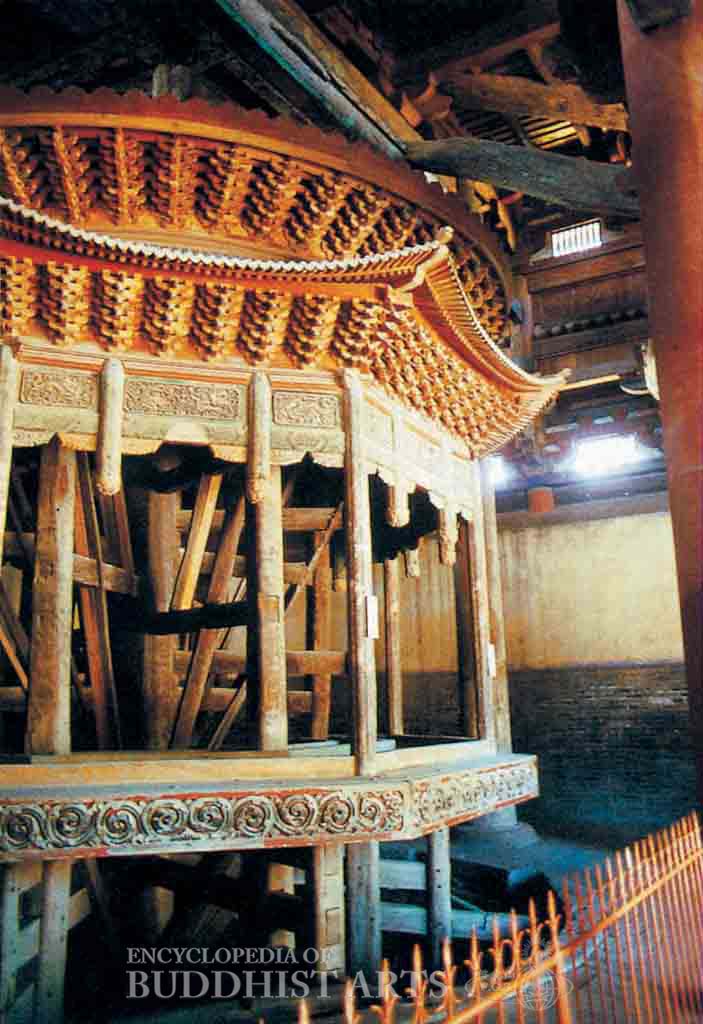
Longxing Temple Revolving Sutra Repository: Sutra Case
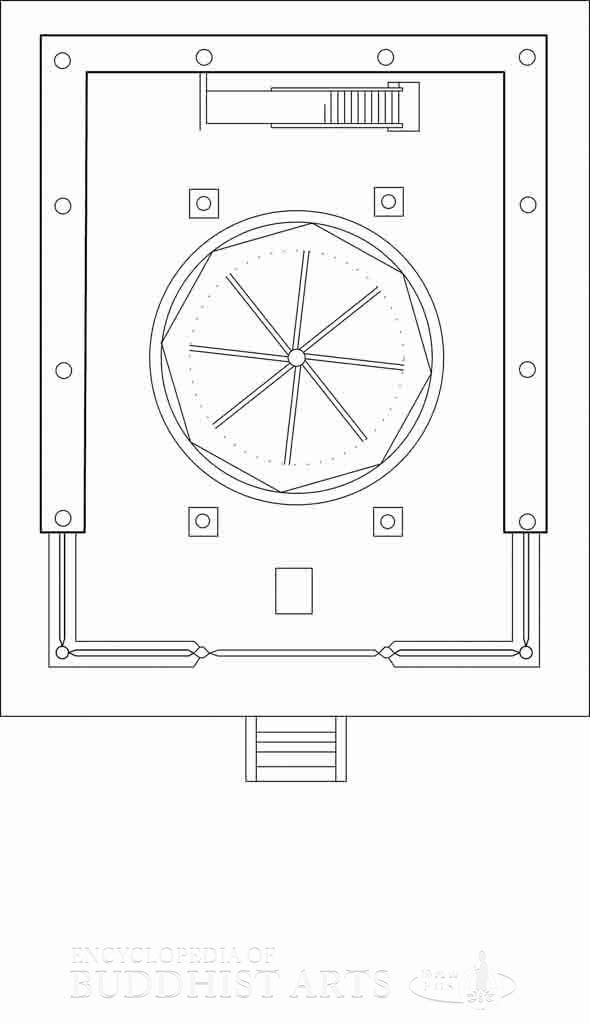
Longxing Temple Revolving Sutra Repository (section drawing)
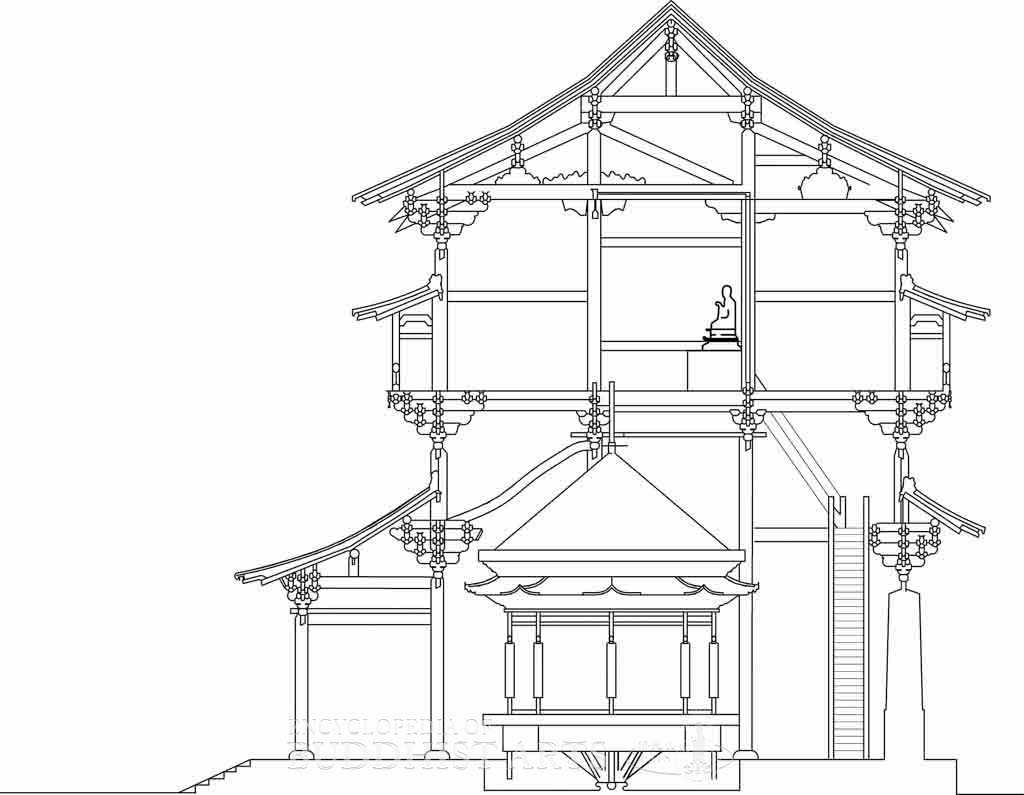
Longxing Temple Revolving Sutra Repository (plan)
Longxing Temple Revolving Sutra Repository
CHINA, Hebei, Shijiazhuang
This sutra repository was built during the Northern Song dynasty (960–1127). It is a two-story, three-by-three bay building with a hip-and-gable roof. On the first story there is an extension at the front. The second story is surrounded by low balustrades. There are lattice doors in the central bay and lattice windows on each side on both stories.
Inside the first story there is an octagonal wooden revolving sutra case with a diameter of 7 m. The sutra case is intricately carved with slim columns, delicate architraves, inverted newel posts, and double eaves. The lower eaves are octagonal, while the upper eaves are circular. They are supported by multiple bracket sets.
The interior is adapted to accommodate the revolving sutra case; for example, there is a curved beam that connects with the beam above but makes room for the pyramidal roof and allows the sutra case to rotate. The columns supporting the ceiling of the first story are also placed to the side to make room for the sutra case. The column and beam structure on the second story is more conventional.
For more details, go to the Encyclopedia of Buddhist Arts: Architecture G-L, page 700.
Cite this article:
author = Hsingyun and Youheng and Johnson, Peter and Mankuang and Lancaster, Lewis,
booktitle = {Encyclopedia of Buddhist Arts: Architecture G-L},
pages = 700,
title = {{Longxing Temple Revolving Sutra Repository}},
volume = 2,
year = {2016}}