
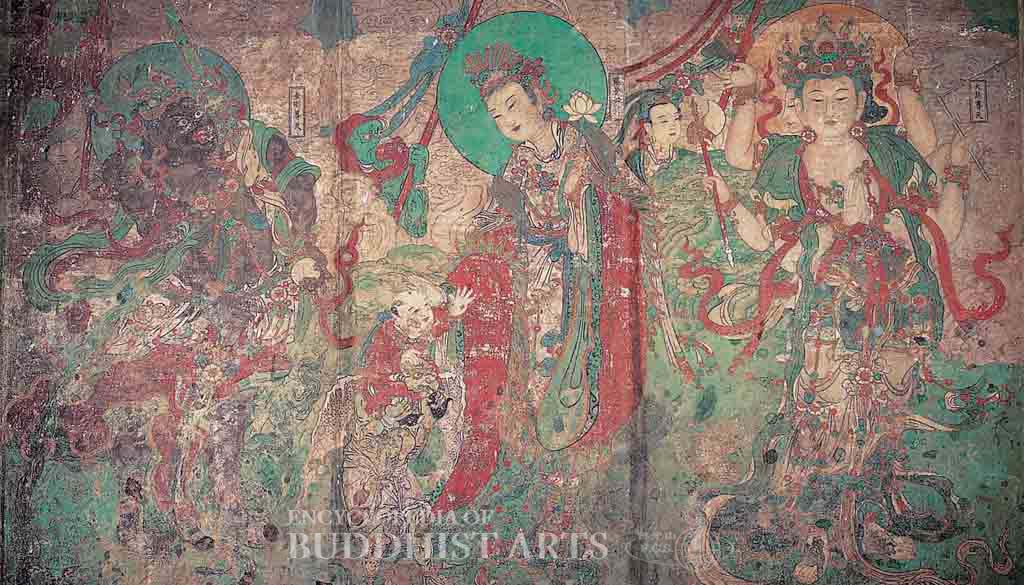
Longxing Temple Mani Hall Murals: Twenty-Four Heavenly Beings (detail)
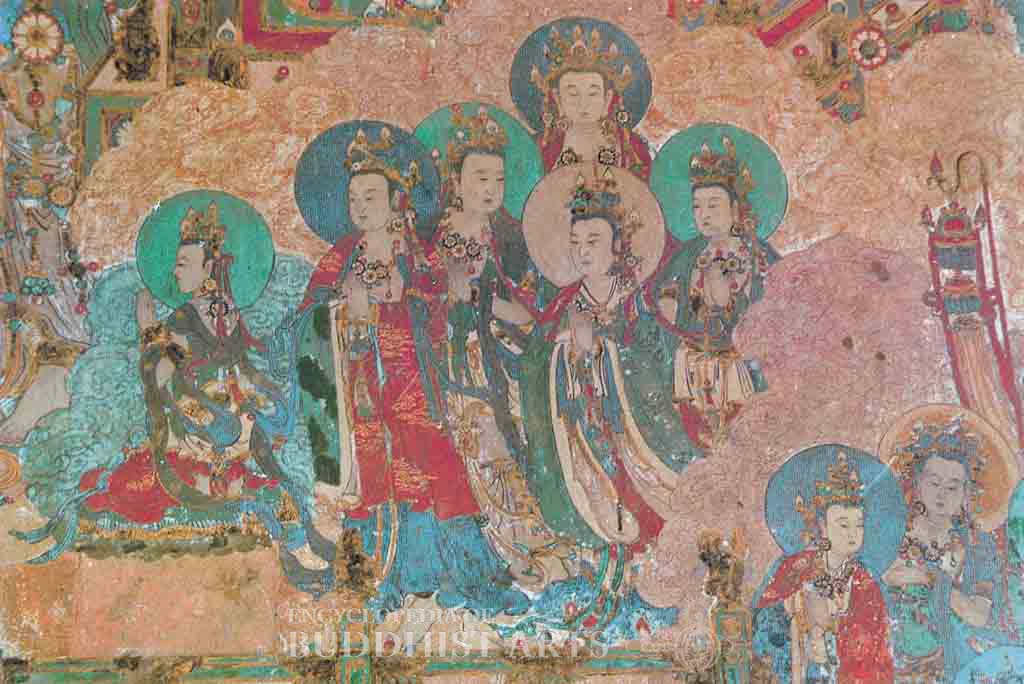
Longxing Temple Mani Hall Murals: Western Pure Land (detail)
Longxing Temple Mani Hall Murals
CHINA, Hebei, Shijiazhuang; Ming dynasty
All of the walls in the Mani Hall are covered with murals. On the inner side of the peripheral wall, there are scenes of the Life of the Buddha from birth to parinirvana. The east and west screen walls in the inner area are decorated with murals from the Qing dynasty (1644–1911) that depict the Twelve Perfect Enlightenment Bodhisattvas and the Eight Great Bodhisattvas. The Western and Eastern Pure Lands are painted on the exterior walls, and Twenty-Four Heavenly Beings cover the four porticos, each accompanied by an identifying inscription. Except for the Qing dynasty illustrations on the screen walls, the murals in the hall date from the Ming dynasty (1368–1644).
Mahakarunadeva, Hariti, and Vajradeva are painted on the south wall of the east portico. The Three-Headed, Six-Armed Mahakarunadeva wears an elaborate headdress. Two of the hands form the anjali (reverence) mudra, two other hands hold a battle-ax and a ruler, and the remaining two hands are raised beside the head. Hariti clasps a lotus in her left hand. She stands sideways, looking down at a smiling child who rides on the shoulders of a green demon. Vajradeva has a muscular black body and wide eyes. His mouth is open, and he rests a large vajra against his left shoulder. Vajradeva’s robust, frightening appearance contrasts with the peaceful Hariti. The image is primarily colored in red and green. Billowing white clouds are painted in the background.
In the mural depicting the Western Pure Land, the Amitabha Buddha Triad is shown surrounded by Arhats, apsaras, and sages. A group of Bodhisattvas wearing ornate headdresses and colorful robes stand or kneel on clouds. The bright colors and creative details are characteristic of all the murals in the temple.
For more details, go to the Encyclopedia of Buddhist Arts: Painting I-O, page 495.
Cite this article:
author = Hsingyun and Youheng and Youlu and Wilson, Graham and Manho and Mankuang and Huntington, Susan,
booktitle = {Encyclopedia of Buddhist Arts: Painting I-O},
pages = 495,
title = {{Longxing Temple Mani Hall Murals}},
volume = 15,
year = {2016}}