
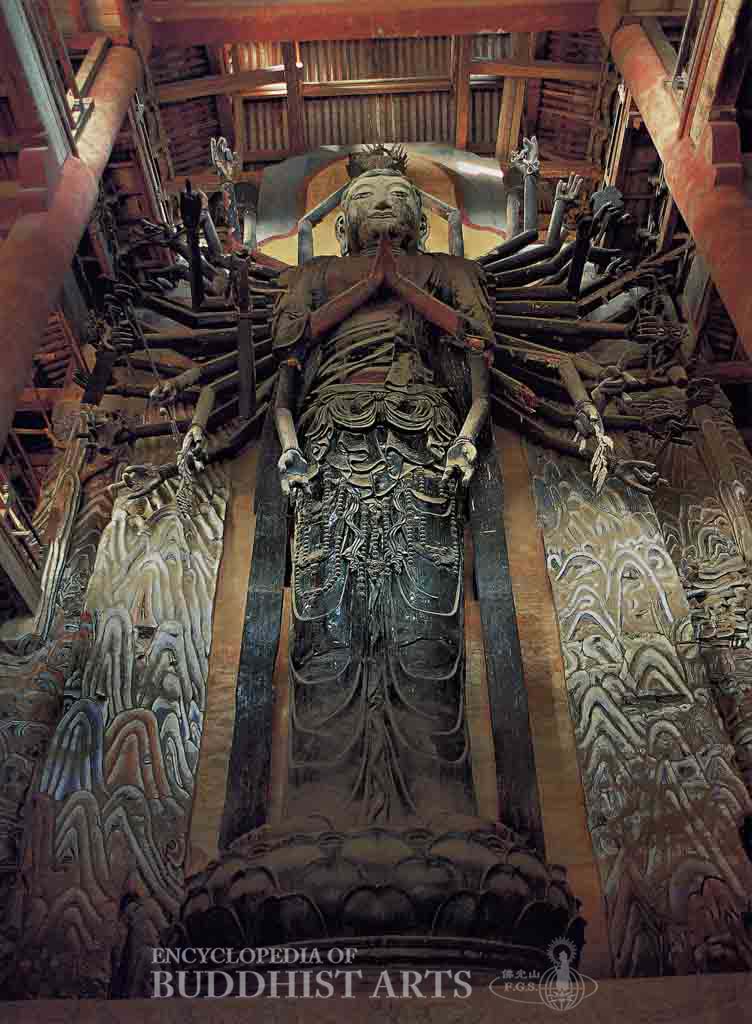
Longxing Temple Great Compassion Pavilion: Thousand-Armed, Thousand-Eyed Avalokitesvara
Copper alloy
Longxing Temple Great Compassion Pavilion: Thousand-Armed, Thousand-Eyed Avalokitesvara
CHINA, Hebei, Shijiazhuang; Northern Song dynasty
According to a stele at the temple, the statue was constructed under order of Emperor Taizu (reigned 960–976) of the Northern Song dynasty. The emperor himself came to check its progress on three occasions during its construction. The statue required more than 3,000 artisans to complete. The hall was built around it after its completion in 971. It is considered to be one of the earliest and largest Avalokitesvara Bodhisattva statues in China.
The image was created according to the Great Compassion Dharani Sutra. The crowned figure stands on a many-petaled lotus pedestal and numerous beaded ornaments cascade over the rippling skirt. The thousand arms are conventionally reduced to 42. Most are held out around the body, while one pair is raised before the heart in anjali (reverence) mudra. The original arms were made of bronze but were damaged during the 18th century and replaced with wooden ones in 1944, when the building was also repaired.
For more details, go to the Encyclopedia of Buddhist Arts: Sculpture G-M, page 621.
Cite this article:
author = Hsingyun and Youheng and Lovelock, Yann and Chou, Yuan and Huntington, Susan and Edson, Gary and Neather, Robert,
booktitle = {Encyclopedia of Buddhist Arts: Sculpture G-M},
pages = 621,
title = {{Longxing Temple Great Compassion Pavilion: Thousand-Armed, Thousand-Eyed Avalokitesvara}},
volume = 11,
year = {2016}}