
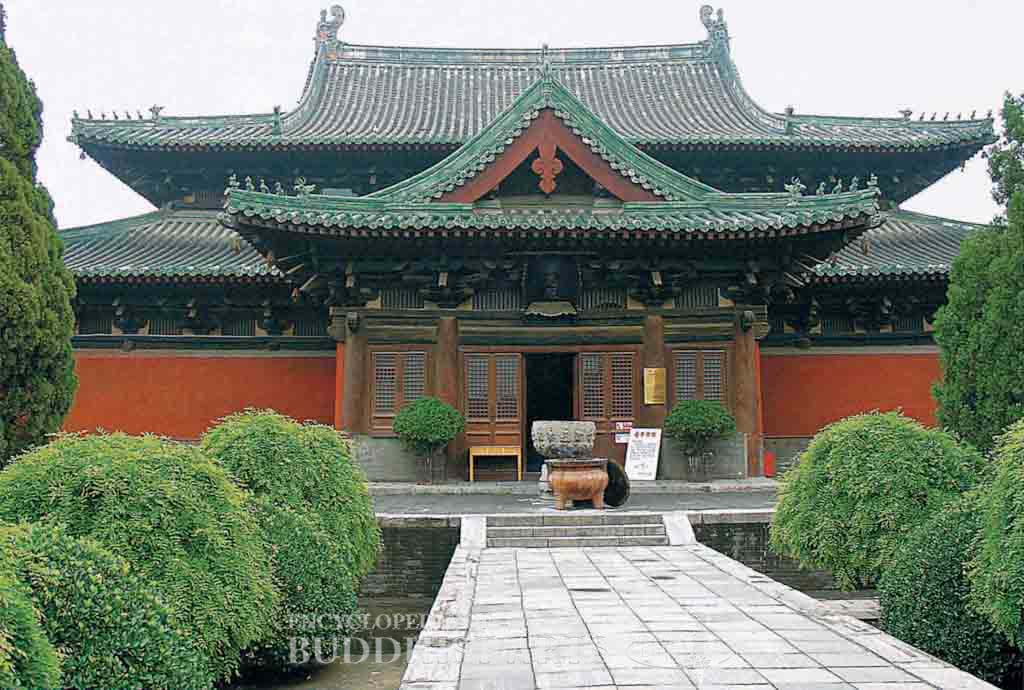
Longxing Temple Mani Hall
Longxing Temple Mani Hall
CHINA, Hebei, Shijiazhuang
The hall was built in 1052 during the Northern Song dynasty. The Sanskrit word “mani” refers to magical jewels which can end disasters, diseases, purify unclean water, and change the color of water.
The seven-by-seven bay hall has a double-eave hip-and-gable roof. There are porticos with hip-and-gable roofs extending out from each side of the building making a cross formation when seen from above. This type of structure is commonly seen in Song dynasty (960–1279) paintings but rarely seen on actual buildings. Within the hall there are five statues enshrined upon the altar: those of Sakyamuni Buddha, Mahakasyapa and Ananda were molded in the Song dynasty, while those of Manjusri and Samantabhadra Bodhisattvas were added during the Ming dynasty (1368–1644). Behind the altar, there is a high relief of Mount Sumeru with a Ming dynasty statue of Avalokitesvara Bodhisattva sitting at ease in the center. The walls are decorated with Buddhist stories painted during the rule of Emperor Chenghua (reigned 1464–1487) of the Ming dynasty. The murals cover an area of about 400 sq m.
For more details, go to the Encyclopedia of Buddhist Arts: Architecture G-L, page 699.
Cite this article:
author = Hsingyun and Youheng and Johnson, Peter and Mankuang and Lancaster, Lewis,
booktitle = {Encyclopedia of Buddhist Arts: Architecture G-L},
pages = 699,
title = {{Longxing Temple Mani Hall}},
volume = 2,
year = {2016}}