
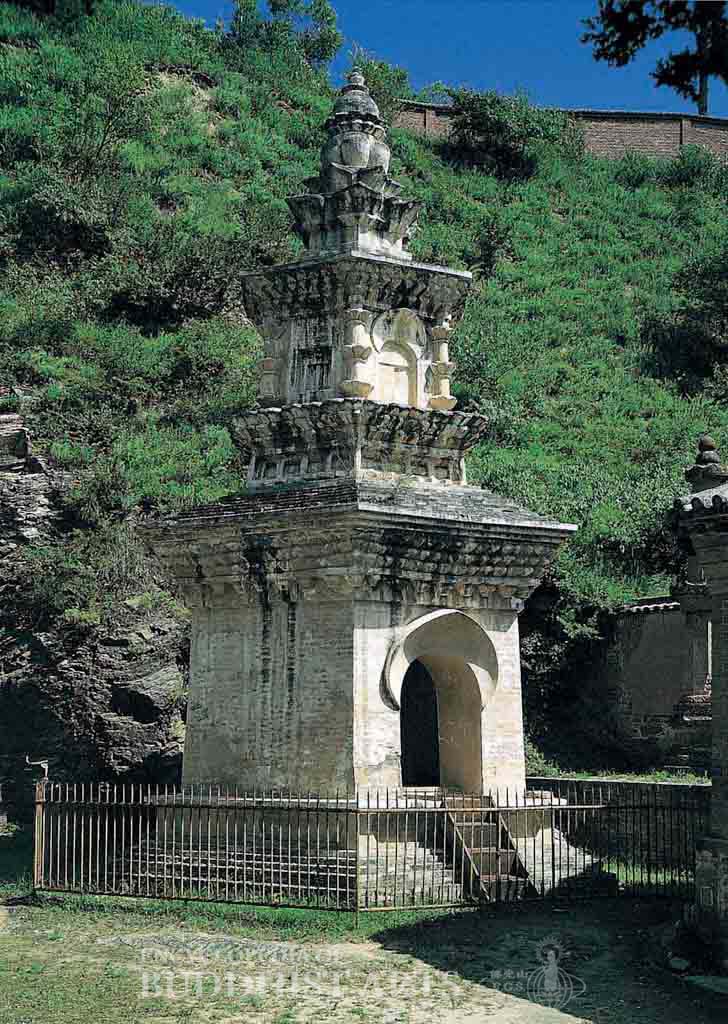
Wutaishan Foguang Temple Patriarch Pagoda
Wutaishan Foguang Temple Patriarch Pagoda
CHINA, Shanxi, Xinzhou
The pagoda is located to the south of the Eastern Hall within Foguang Temple. There is no dated inscription on the pagoda but it is believed that it was built during the later Northern Dynasties (386–581). It is said that it was the funerary pagoda for the founding abbot of Foguang Temple, hence its name. It is the only surviving structure from the original temple.
This hexagonal, two-story, brick pagoda is 8 m high. A chamber is located within the lower story, while the upper story is solid. The walls of the first story are all unadorned except for the entrance located on the west side. It is arched with a tympanum in the form of a lotus petal. The eaves consist of petal-shaped corbeling. On the second story a false door is located on the west side, a much smaller version of the one below. The walls on the sides have false windows. The pilasters at the corners are decorated with lotuses. The spire has a double lotus base, followed by an inverted bowl and jewels.
It is extremely rare to find a stone pagoda from the Northern Dynasties. This particular design is the only one of its kind in China and offers researchers important insights into early Buddhist pagodas in China.
For more details, go to the Encyclopedia of Buddhist Arts: Architecture T-Z, page 1287.
Cite this article:
author = Hsingyun and Youheng and Johnson, Peter and Mankuang and Lancaster, Lewis,
booktitle = {Encyclopedia of Buddhist Arts: Architecture T-Z},
pages = 1287,
title = {{Wutaishan Foguang Temple Patriarch Pagoda}},
volume = 4,
year = {2016}}