
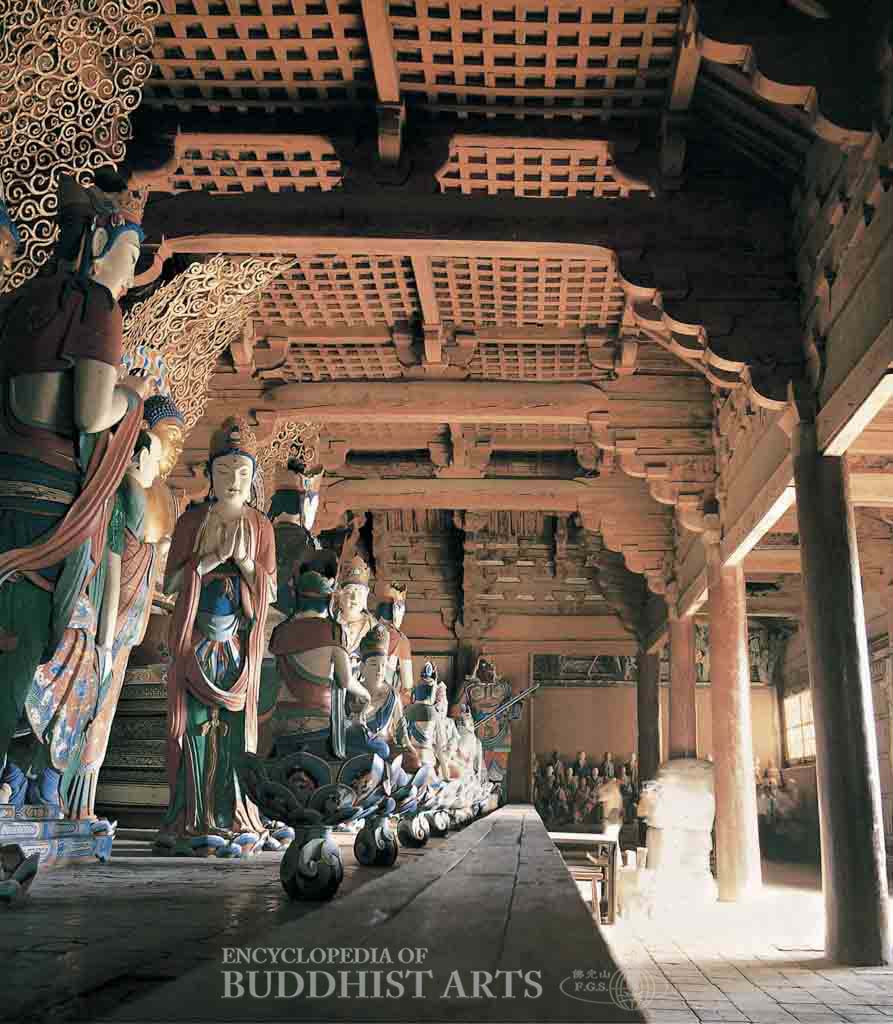
Wutaishan Foguang Temple East Hall (interior)
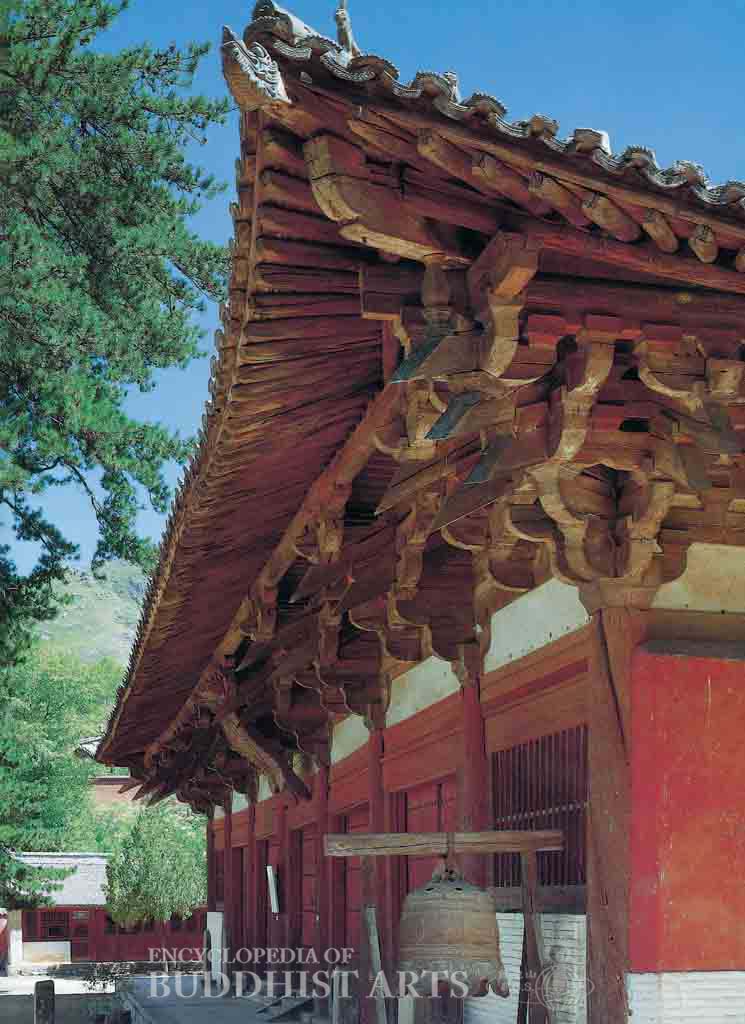
Wutaishan Foguang Temple East Hall
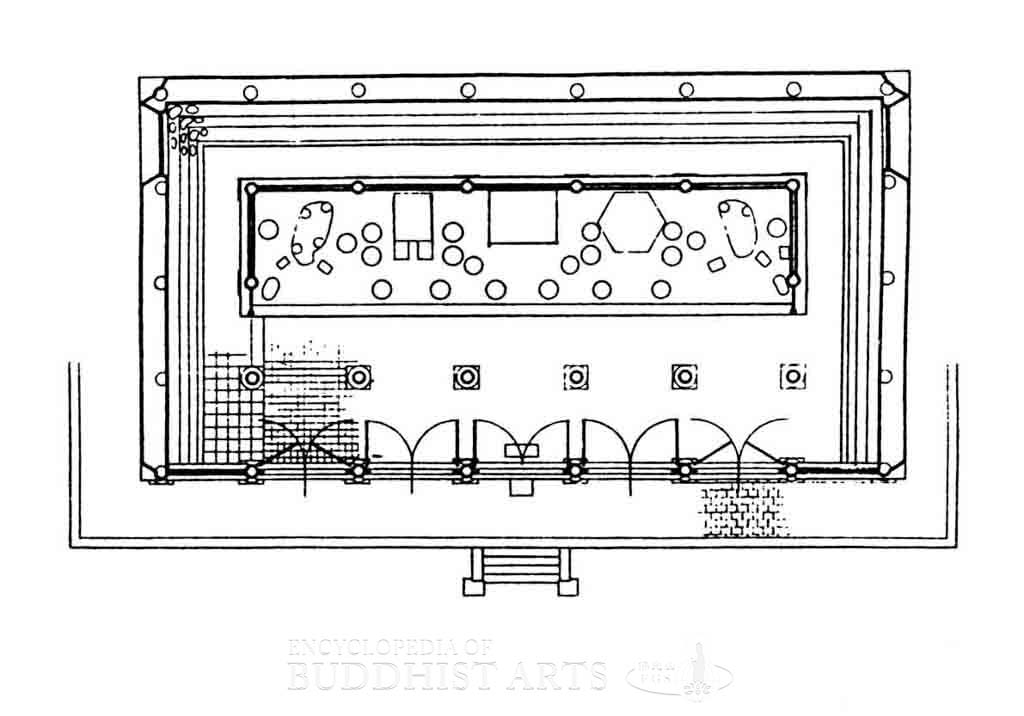
Wutaishan Foguang Temple East Hall (plan)
Wutaishan Foguang Temple East Hall
CHINA, Shanxi, Xinzhou
The hall was constructed in 857 during the Tang dynasty on the site of the Maitreya Pavilion, which was destroyed during the persecution of Buddhism in 845. It is regarded as the oldest existing timber-frame hall in China, along with the main hall at Nanchan Temple on Wutaishan. It is also the most typical surviving wooden structure from the Tang dynasty (618–907).
The seven-by-four bay hall has a single-eave hip roof. There are doors in the five central bays, while the outermost bays have windows. The roof is covered with flat tiles and at the ends of the main ridge there are decorations from the Yuan dynasty (1271–1368). The tapered columns incline slightly. The bracket sets are almost half as high as the columns themselves, which are exceptionally large. There are intermediate bracket sets between each bay. The extended eaves protrude 4 m from the building. The structure inside consists of both exposed and hidden rafters.
The interior of the hall is divided into two areas by a ring of columns. The outer area is lower and narrower and used as a place for veneration, while the inner area contains the platform, which is five bays wide. Upon the platform are Tang dynasty statues of the Buddhas Sakyamuni, Maitreya, and Amitabha, along with Manjusri and Samantabhadra Bodhisattvas. Before each Buddha is a pair of Bodhisattvas kneeling upon long-stemmed lotuses and making offerings. There are Heavenly Kings at each end of the platform. Behind the partition walls there are rows of Arhat statues, which were added during the Ming dynasty (1368–1644).
There are 22 Tang dynasty murals on the walls occupying almost 62 sq m. One of the murals is painted behind the Sumeru throne, where the Buddha statues are placed, while the others are scattered on the panels between the bracket sets. They are the only surviving murals from the Tang dynasty painted in a timber-frame hall in a Chinese temple.
For more details, go to the Encyclopedia of Buddhist Arts: Architecture T-Z, page 1286.
Cite this article:
author = Hsingyun and Youheng and Johnson, Peter and Mankuang and Lancaster, Lewis,
booktitle = {Encyclopedia of Buddhist Arts: Architecture T-Z},
pages = 1286,
title = {{Wutaishan Foguang Temple East Hall}},
volume = 4,
year = {2016}}