
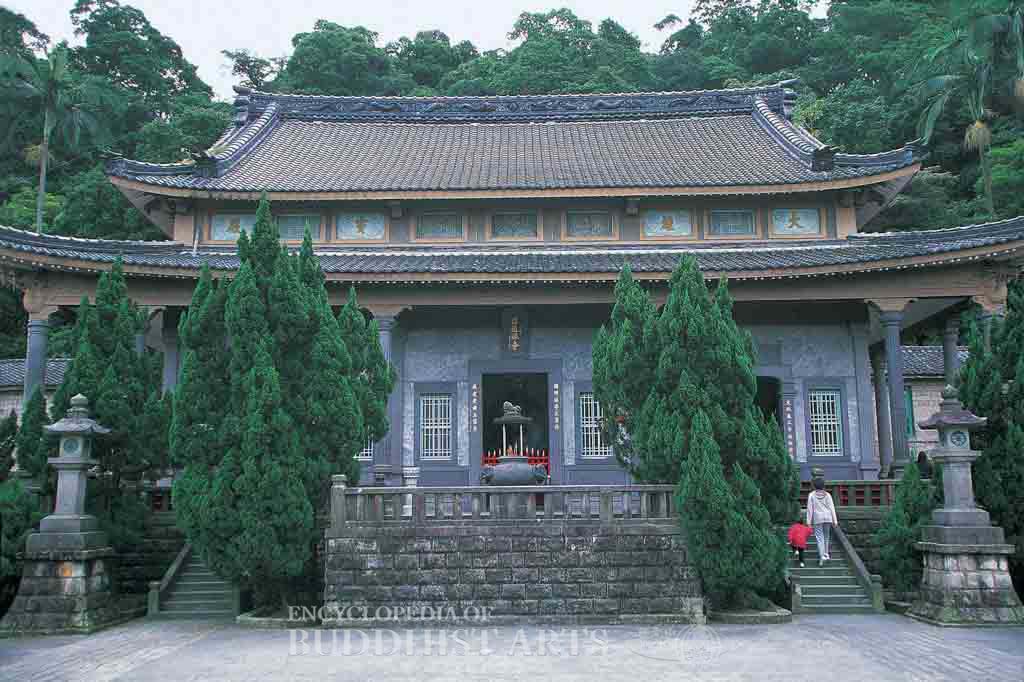
Yuan Tung Temple: Great Hero Hall
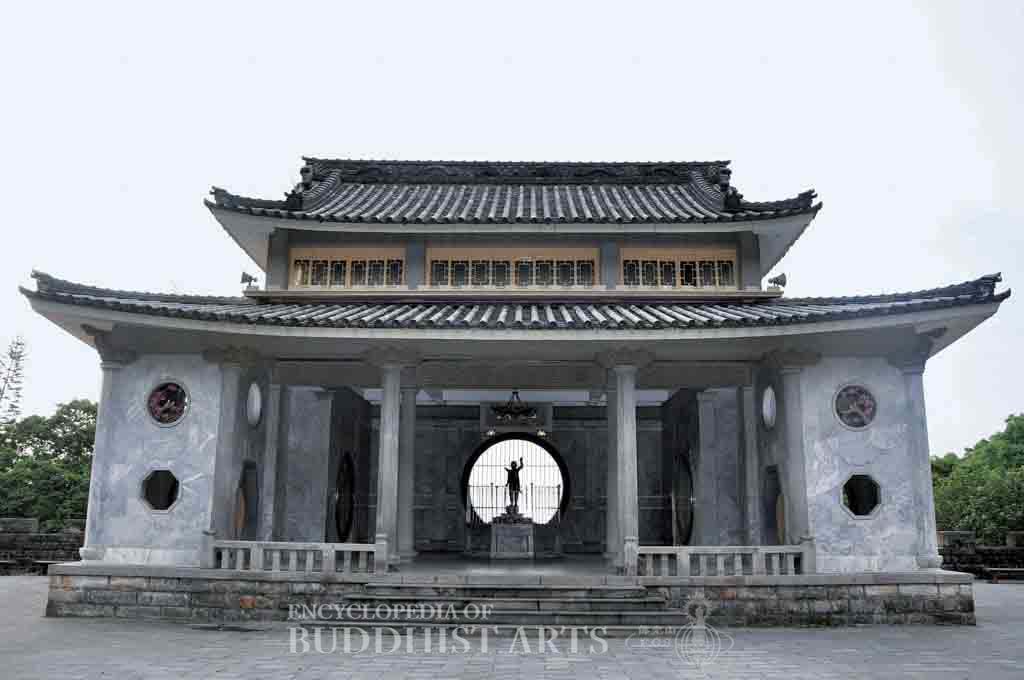
Yuan Tung Temple: Front Hall
Yuan Tung Temple
TAIWAN, New Taipei City
Yuan Tung means Perfect Understanding. The temple was built in 1926 by the nun Miaoqing to use as a nunnery, and was reconstructed in 1953. A recent construction work on the temple was carried out in 1977.
The north-facing temple is built in accordance with the hilly terrain and consists of the main temple gate, front hall, Great Hero Hall, and Return to Tranquility Pagoda. The main temple gate houses a statue of Maitreya Bodhisattva. On each side of the arched gateway there are stone statues of a lion and an elephant. The five-bay wide front hall has a double-eave hip-and-gable roof. It has windows of various sizes and shapes, including square, round, and hexagonal, filled with patterns of birds or flowers. A statue of Prince Siddhartha standing on a lotus pedestal is enshrined within the hall.
The five-by-four bay Great Hero Hall has a double-eave hip-and-gable roof covered by black tiles. Each gable is decorated with circular floral patterns and medallion-like reliefs. The hall is surrounded by a veranda whose columns have Baroque capitals. The hall houses statues of Sakyamuni Buddha, Manjusri Bodhisattva, and Samantabhadra Bodhisattva. An incense burner decorated with elephant heads stands in front of the hall. On the sides there are Japanese-style stone lanterns, which represent supreme wisdom. Below the Return to Tranquility Pagoda, there is a cliff, at the foot of which the original temple platform can be found. It is now a small shrine. There are many stone carvings of Buddhas, Arhats, and lions on the cliff. A large engraved Chinese character for Buddha, approximately the height of six people, is also engraved on the cliff face.
For more details, go to the Encyclopedia of Buddhist Arts: Architecture T-Z, page 1369.
Cite this article:
author = Hsingyun and Youheng and Johnson, Peter and Mankuang and Lancaster, Lewis,
booktitle = {Encyclopedia of Buddhist Arts: Architecture T-Z},
pages = 1369,
title = {{Yuan Tung Temple}},
volume = 4,
year = {2016}}