
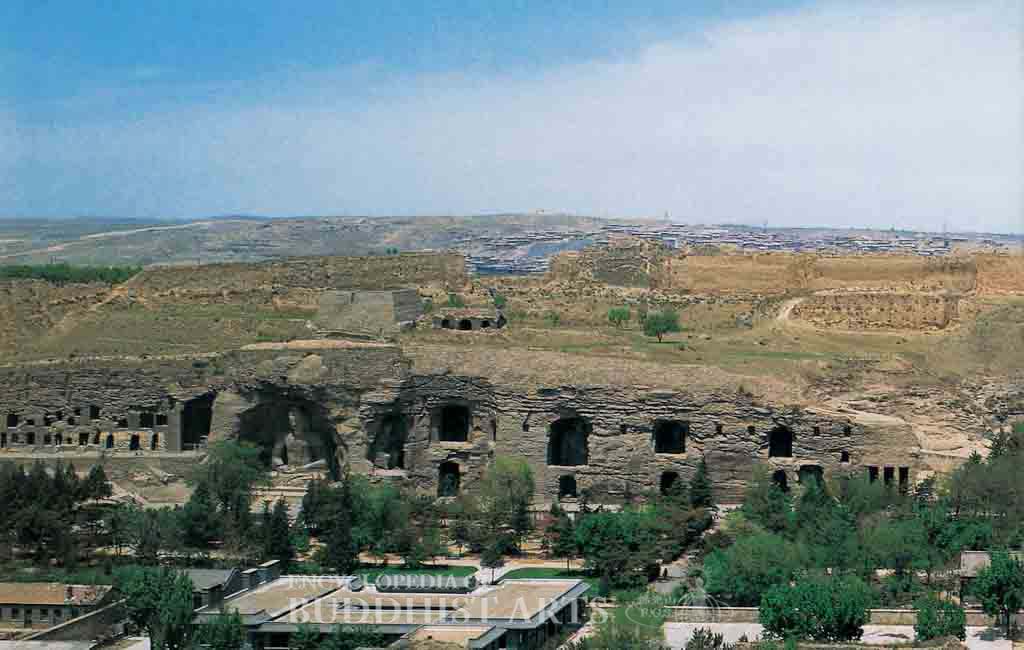
Yungang Grottoes 16 to 20
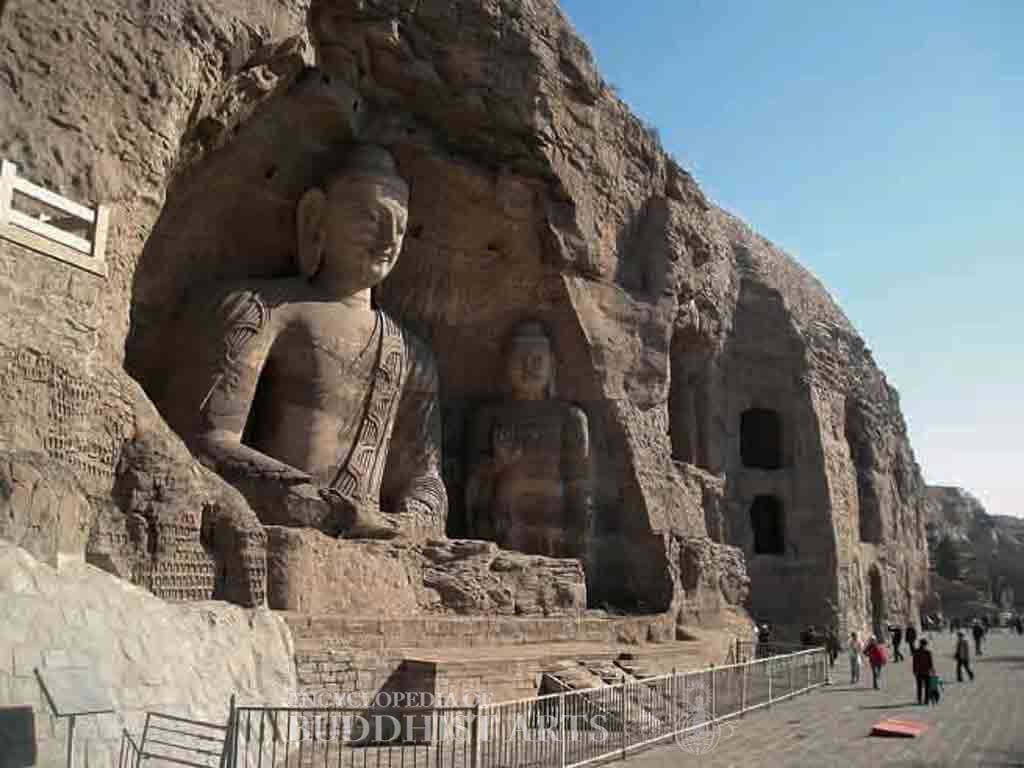
Yungang Grottoes 16 to 20
Yungang Grottoes 16 to 20
CHINA, Shanxi, Datong
Constructed by the monk Tanyao during the Northern Wei dynasty (386–534), these five great Buddha grottoes are generally known as the Five Grottoes of Tanyao. The exact timing of their creation is unclear, but scholars have concluded that the most likely construction dates are from 460 to 465, as described in the Book of Wei. Construction began with Grotto 20 and moved eastward, finishing with Grotto 16. Grottoes 18 to 20 share a similar subject matter and layout, and are believed to have been completed on time according to the original plans of Tanyao. The completion of Grottoes 16 and 17, on the other hand, appears to have stretched into the second and third phases of Yungang construction. This is evidenced by the style of the artwork, which incorporates elements that became popular only in the later periods of construction. Each grotto faces south and has a U-shaped layout, a vaulted ceiling, and an upper window above the grotto doorway. Grottoes 17 to 20 originally contained three Buddha statues, while Grotto 16 features a single standing Buddha.
According to records from the Book of Wei, the Buddha sculptures in the Five Grottoes of Tanyao may have been intended to represent five prominent Emperors: Emperor Daowu (reigned 386–409), Emperor Mingyuan (reigned 409–423), Emperor Taiwu (reigned 423–452), and Emperor Wencheng (reigned 452–465), as well as Crown Prince Tuoba Huang, who was posthumously known as Emperor Jingmu. This interpretation provides insight into the relationship between religion and the imperial court at the time.
The main sculpture in Grotto 20 is a seated Buddha measuring 13.7 m in height, flanked by a smaller standing Buddha on the east wall. The other standing Buddha was originally located on the west wall, but was ruined when the exterior and west wall of the grotto collapsed.
Grotto 19 is the largest of the five grottoes. The back (north) wall features a 16.8 m high carving of Sakyamuni Buddha, flanked by auxiliary chambers containing smaller seated Buddhas and attendant Bodhisattvas. The inner wall of the grotto is filled with carvings of the Thousand Buddhas, as well as the story of the Buddha’s Encounter with Rahula depicted on the upper section of the inner front (south) wall. The style of the carvings in the east and west auxiliary chambers suggests that they may have been completed between the years 477 and 499.
The Sakyamuni Buddha statue carved on the back wall of Grotto 18 stands 15.5 m in height, and wears robes decorated with images of the Thousand Buddhas. He is flanked by sculptures of a Bodhisattva on each side, as well as standing Buddhas on the east and west walls. Surrounding the figures are carvings of disciples and the Thousand Buddhas.
The featured carving in Grotto 17 is Maitreya Bodhisattva, seated with legs crossed at the ankles and measuring 15.6 m in height. There are two large niches carved on the east and west walls, containing a seated and standing Buddha, respectively. Numerous additional niches carved on the inner and outer walls of the grotto contain a variety of Buddhist figures. An inscription dating to the year 489 is preserved on the east side of the upper window, providing a valuable resource for determining the age of the Yungang Grottoes.
The single sculpture of Sakyamuni Buddha on the back wall of Grotto 16 has a height of 13.5 m. Although the lower portion of the carving has almost entirely worn away due to weathering, the upper body is relatively well preserved. The east and west walls are filled with images of the Thousand Buddhas and arch-shaped Buddha niches.
For more details, go to the Encyclopedia of Buddhist Arts: Caves T-Z, page 1716.
Cite this article:
author = Hsingyun and Youheng and Johnson, Peter and Mankuang and Huntington, Susan and Edson, Gary and Neather, Robert,
booktitle = {Encyclopedia of Buddhist Arts: Caves T-Z},
pages = 1716,
title = {{Yungang Grottoes 16 to 20}},
volume = 9,
year = {2016}}