
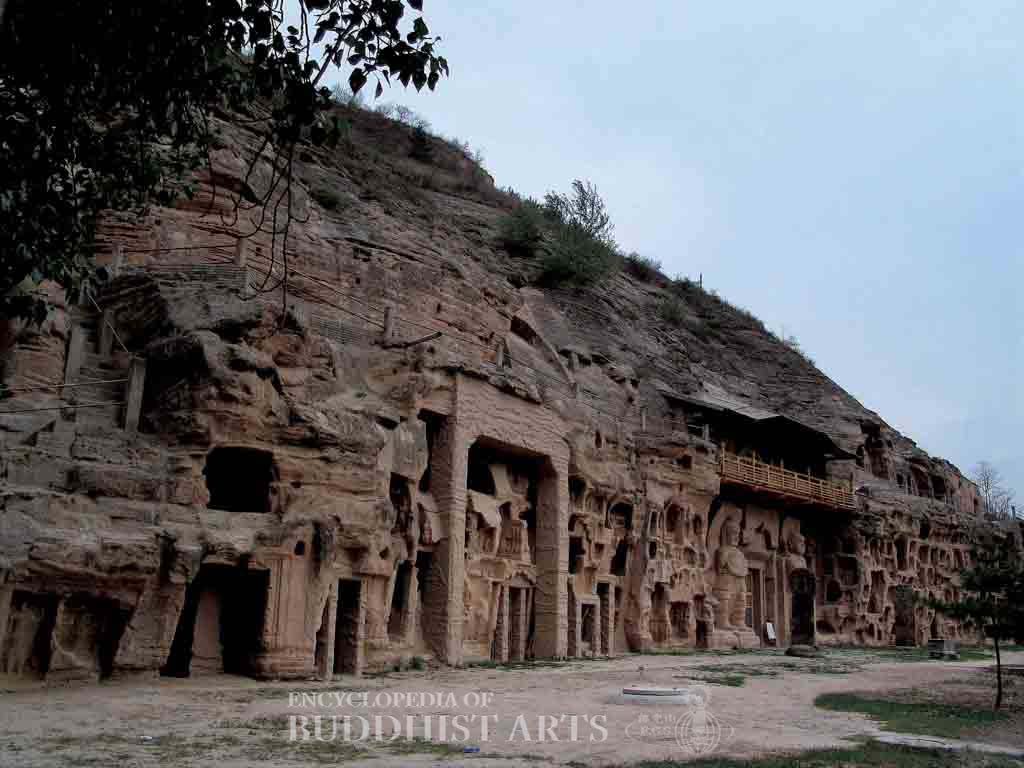
North Cave Temple
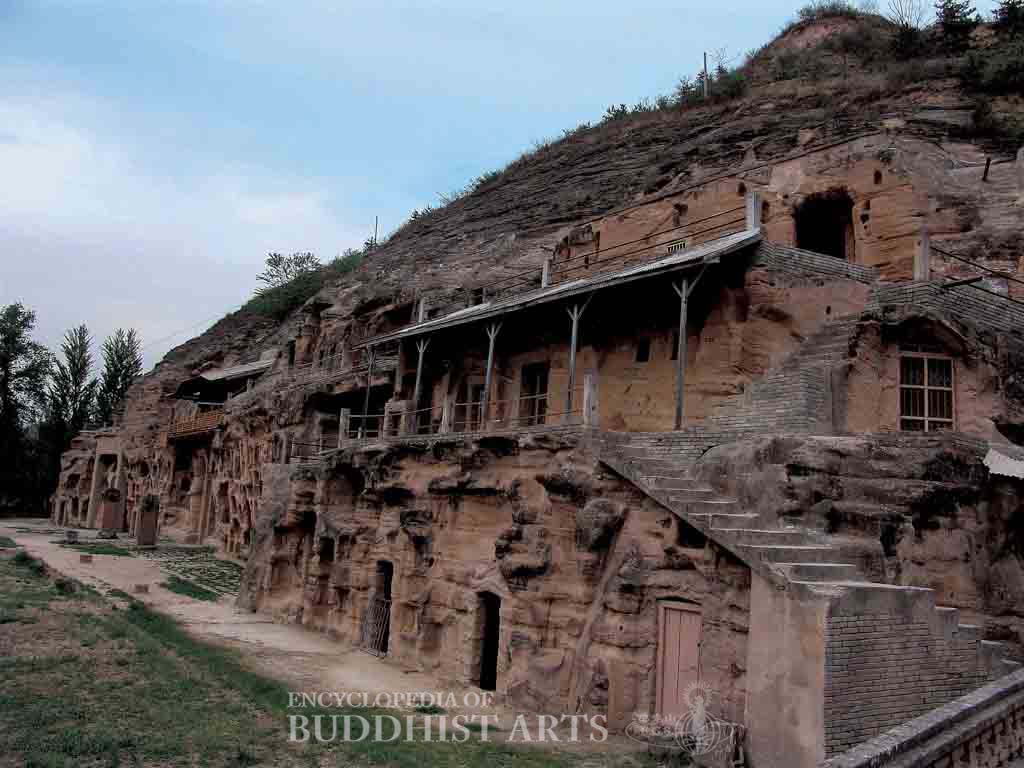
North Cave Temple
North Cave Temple
CHINA, Gansu, Qingyang
This cave temple is also known as the Sigou (Temple Valley) Caves. According to a stele recording the restoration of shrines at the Cave Temple dated 1795 and the Zhenyuan County Gazetteer, the North Cave Temple was built in 509 during the Northern Wei dynasty. Both sources apparently retrieved this information from Tang dynasty (618–907) steles. The caves were dug out of a sandstone cliffside. The temple area spans 120 m from the north to the south, and is composed of three levels. The highest level is more than 10 m above ground. During the Northern Wei dynasty (386–534), the caves were called the North Cave Temple, and the South Cave Temple was built later to correspond with it. After its initial creation during the Northern Wei dynasty, this temple was continuously expanded through the Western Wei (535–556), Northern Zhou (557–581), Sui (581–618), and Tang dynasties. There are currently 296 caves and niches within the system, containing 2,126 sculptures, 150 inscriptions, and 7 steles. It was listed as a National Cultural Heritage Site in 1988.
The most exquisite caves and niches are among those created during the Northern Wei and Tang dynasties, and over two-thirds of all the caves were built during the Tang dynasty. The interiors of the Tang-style caves are square, rectangular, or U-shaped. Cave 32 is considered the most magnificent cave from the High Tang period (712–756), containing statues of the Buddha, disciples, Bodhisattvas, and Vajrapanibalin. The largest cave in the system is Cave 165, made during the Northern Wei. It is also the central cave, with all other caves expanding outwards from it.
For more details, go to the Encyclopedia of Buddhist Arts: Caves Mo-S, page 1274.
Cite this article:
author = Hsingyun and Youheng and Johnson, Peter and Mankuang and Huntington, Susan and Edson, Gary and Neather, Robert,
booktitle = {Encyclopedia of Buddhist Arts: Caves Mo-S},
pages = 1274,
title = {{North Cave Temple}},
volume = 8,
year = {2016}}