
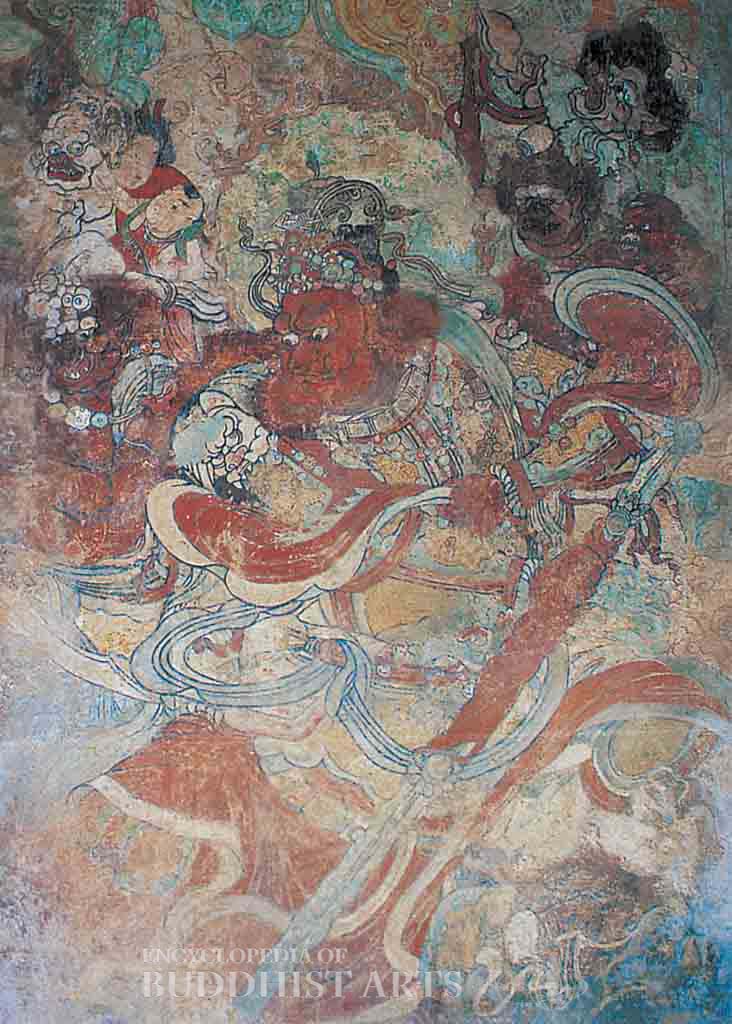
Fogong Temple Shijia Pagoda Murals: Guhyapadavajra
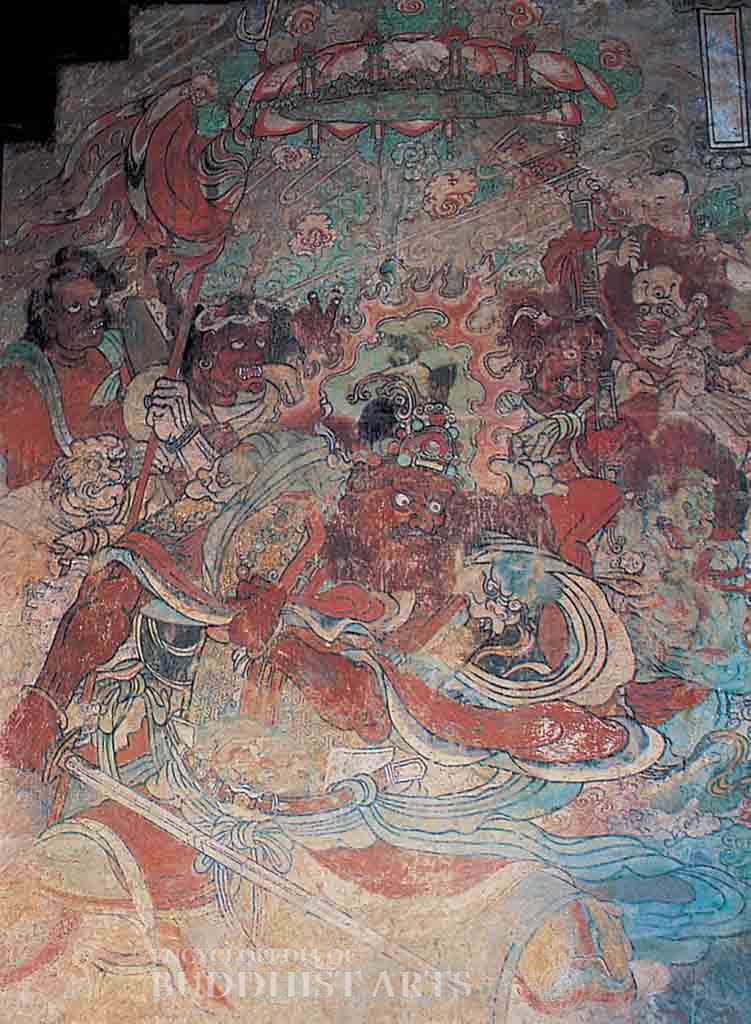
Fogong Temple Shijia Pagoda Murals: Guhyapadavajra
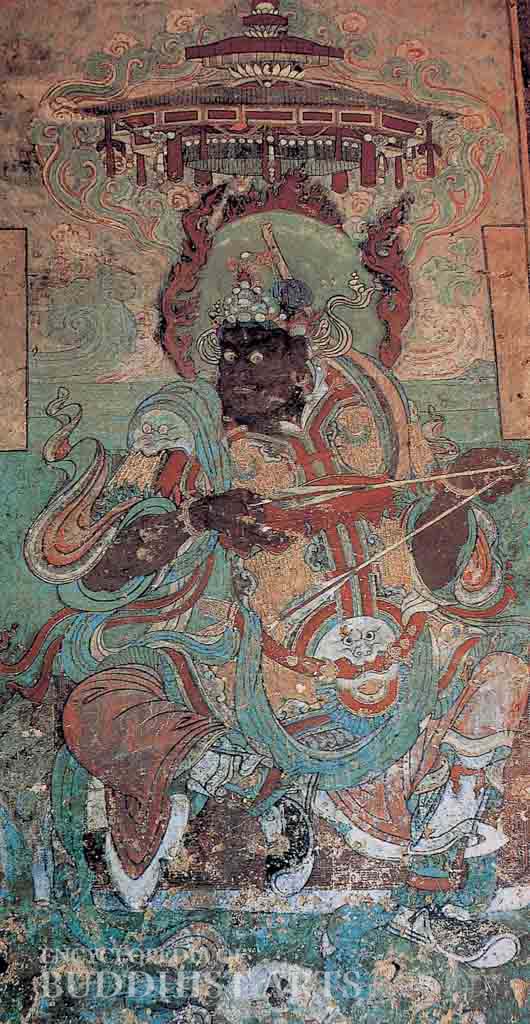
Fogong Temple Shijia Pagoda Murals: Dhrtarastra
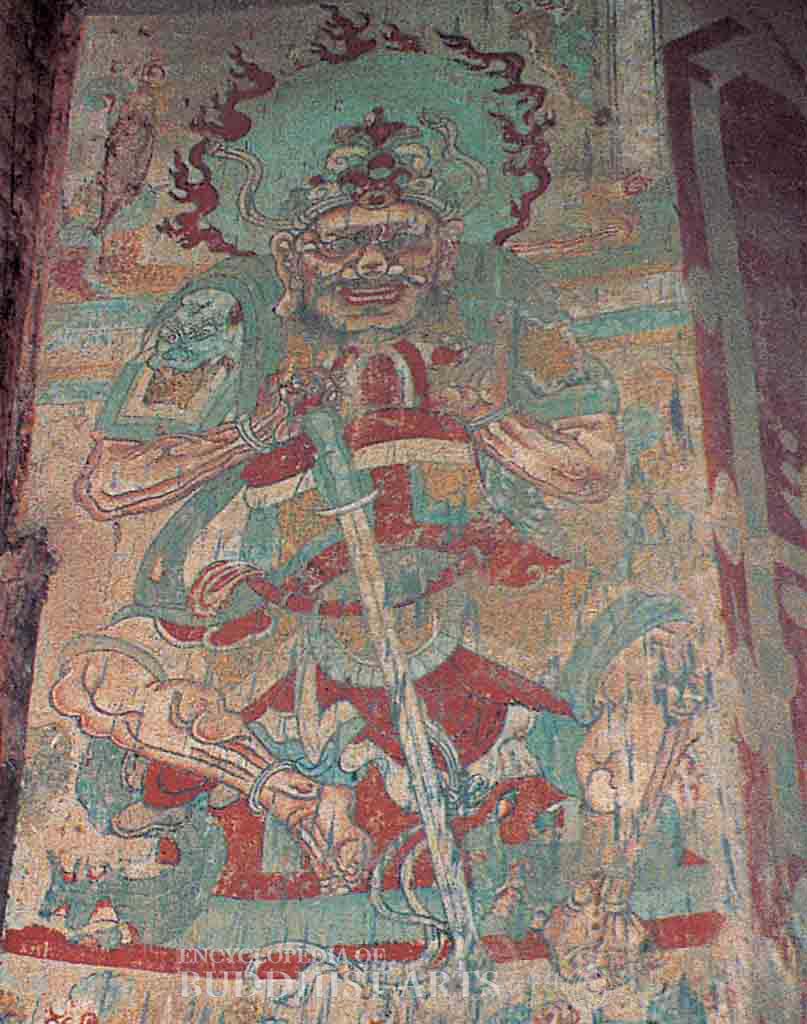
Fogong Temple Shijia Pagoda Murals: Guhyapadavajra
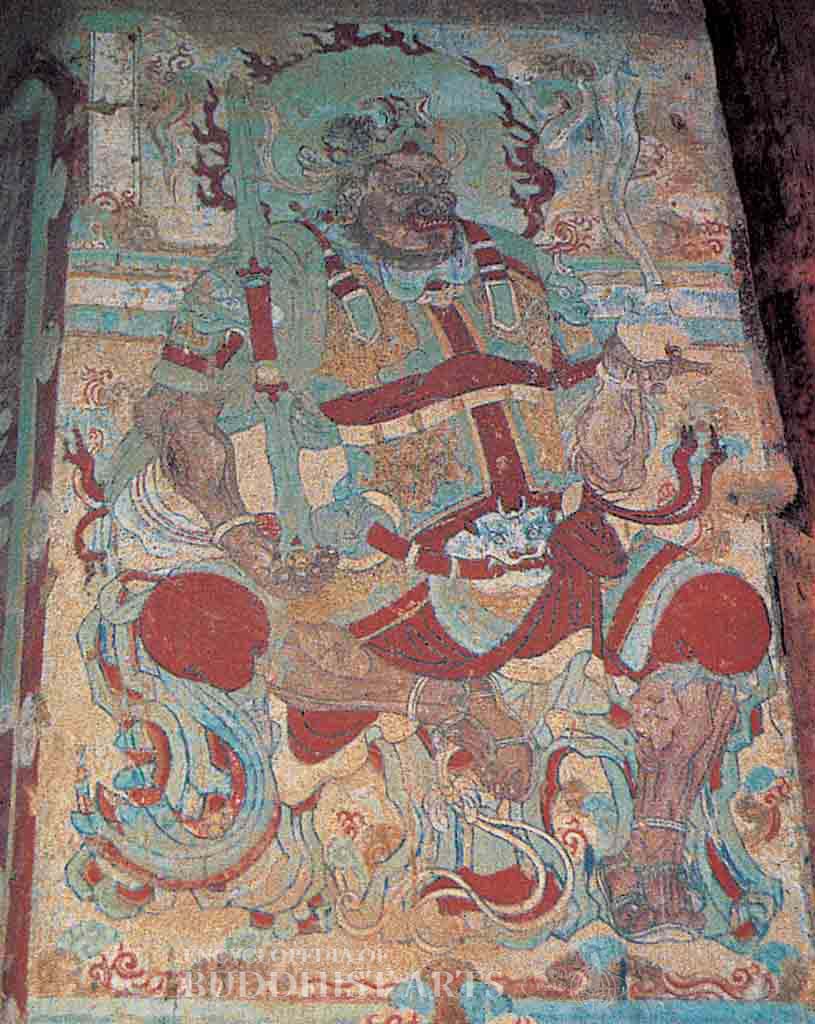
Fogong Temple Shijia Pagoda Murals: Guhyapadavajra
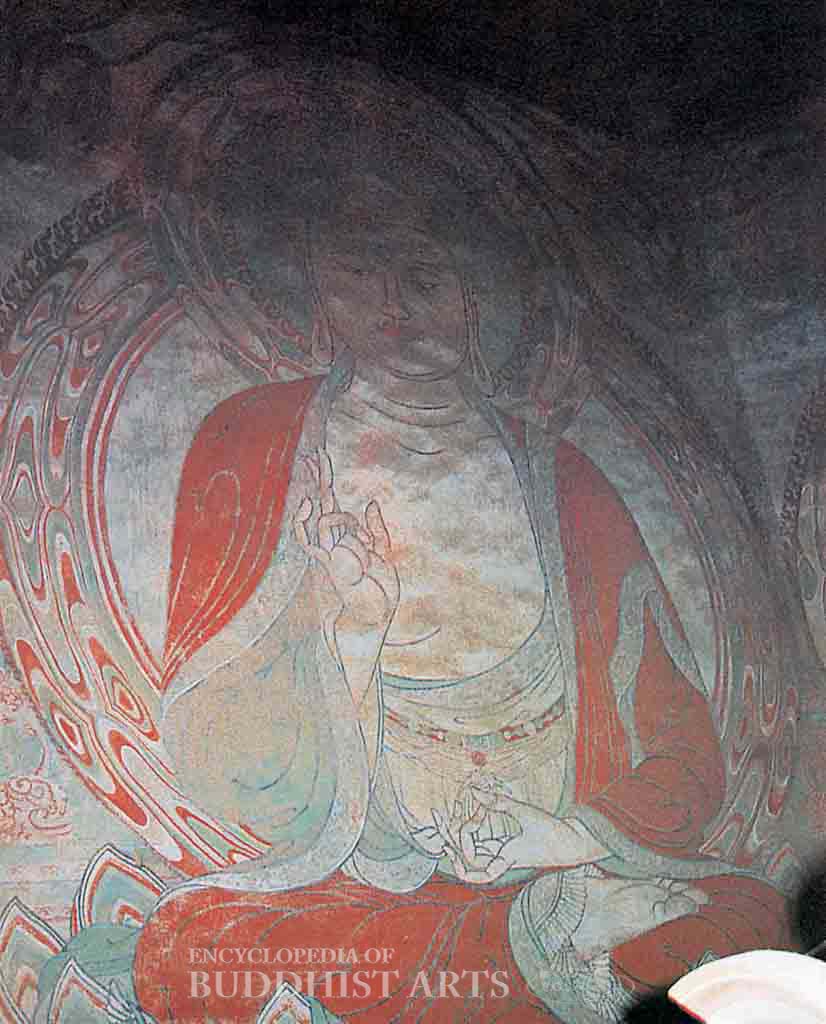
Fogong Temple Shijia Pagoda Murals: Seated Buddha
Fogong Temple Shijia Pagoda Murals
CHINA, Shanxi, Shuozhou; Liao to Jin dynasty
Among the multi-story wooden pagodas in China that still stand, the Shijia Pagoda is the oldest and tallest. It was built in 1056 during the Liao dynasty. Although some of the murals inside have been repainted, most of them are original works from the Liao (907–1125) and Jin (1115–1234) dynasties. The murals are mainly painted on the lower half of the walls and on the boards onto which bracket sets adhere. They cover a total surface area of 304 sq m.
The pagoda is octagonal, with doors installed at the front and back of the first story. There are identical illustrations of Guhyapadavajra on both sides of the front (south) door. Guhyapadavajra wears a warrior’s helmet and is dressed in armor. His eyes are wide and he holds a sword and a vajra in his hands. He is accompanied by ghost soldiers and attendants. The clothing and the appearance of the figures suggest that this is one of the original murals; however, judging by the painting technique and the coloring, it was probably repainted by later generations using the original mural as a guide.
On each of the lintels above the door frames inside the first story, there are illustrations of three worshippers. The figures above the south door are female, while those on the north side are male. Mahakasyapa and Ananda are located on the walls by the south door; vajras are depicted by the north door. During the Jin dynasty, images of the Four Heavenly Kings were added to the bottom of the walls, below Mahakasyapa, Ananda, and the vajras. The Heavenly Kings hold a vajra, an axe, a bow, and other weapons, which differ from the pipas, swords, jewels, and pagodas held by the Heavenly Kings in Yuan (1271–1368) and Ming (1368–1644) dynasty paintings. These images are a valuable source of information on early Buddhist iconography.
On the other six walls, there are large Buddha figures with apsaras flying above them on floating clouds. The Buddha figures are 600 cm in height, taking up almost the entire wall and leaving little room for images of attendants. The faces, usnisas, and monastic robes of the Buddhas are painted in a style similar to that of the Jin dynasty murals in the Amitabha Hall of Chongfu Temple in Shuozhou.
These murals are colored with several coats of paint. The Buddhas are mainly vermilion and mineral green, the Heavenly Kings and vajras are blue and green, and the figures making offerings and the apsaras are colored in vermilion and white. The figures are depicted using “iron-wire,” “nail-head,” and “rat-tail” lines.
For more details, go to the Encyclopedia of Buddhist Arts: Painting A-H, page 253.
Cite this article:
author = Hsingyun and Youheng and Youlu and Wilson, Graham and Manho and Mankuang and Huntington, Susan,
booktitle = {Encyclopedia of Buddhist Arts: Painting A-H},
pages = 253,
title = {{Fogong Temple Shijia Pagoda Murals}},
volume = 14,
year = {2016}}