

Fogong Temple Shijia Pagoda
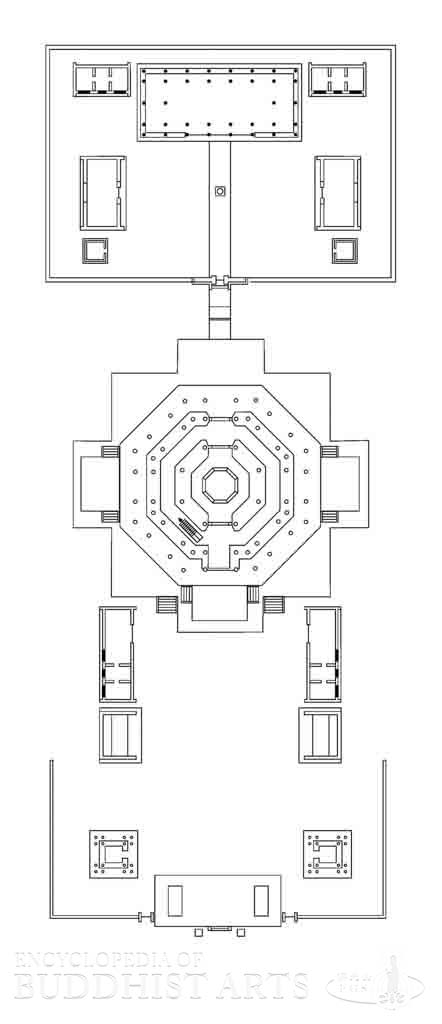
Fogong Temple (site layout)
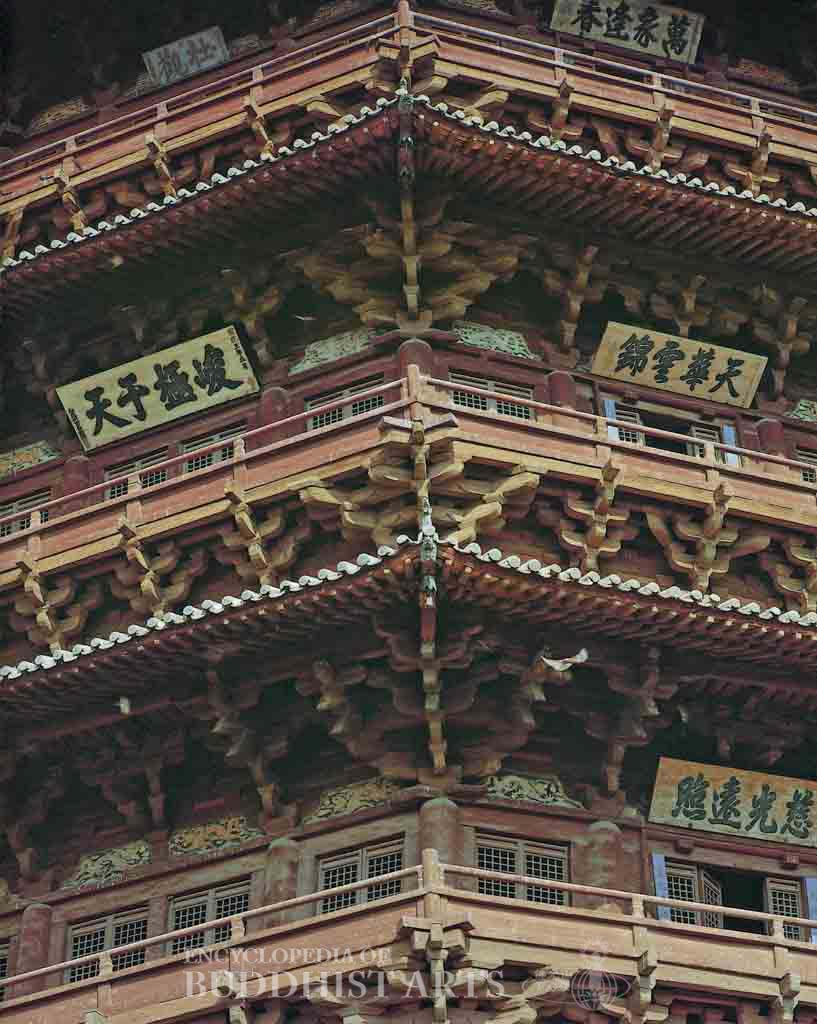
Fogong Temple Shijia Pagoda (detail)
Fogong Temple Shijia Pagoda
CHINA, Shanxi, Shuozhou
The pagoda is also known as the Wooden Pagoda of Yingxian County and it is China’s oldest and the world’s tallest existing multi-story tower-style timber pagoda. It was built in 1056 during the Liao dynasty. The pagoda is situated in the center of the temple compound with the main temple gate in front and the Buddha Hall behind it. It was listed as a National Cultural Heritage Site in 1961.
Facing south, the five-story octagonal wooden pagoda is 65.9 m high. There are four hidden levels within the pagoda for a total of nine stories. The stone base platform is 4 m high with two layers, one square and the other octagonal. A veranda surrounds the first story and the eaves are supported by a ring of columns. The interior is supported by two rings of columns. The first story has double eaves, while all subsequent stories have single eaves. The second story and above is surrounded by a balustrade. The appearance and style of the pagoda is reminiscent of the architectural style of the Tang dynasty (618–907).
There are 54 different types of bracket sets featured outside and inside the building, from column capitals to intercolumnar bracket sets to those found at the corners. They vary according to their position and function and are a prominent feature of this pagoda. The octagonal pyramidal roof is covered with cylindrical tiles. The base of the spire is made of brick and is 1.9 m high. The iron spire is 9.9 m high and consists of an upright lotus, an inverted bowl, stacked rings, a moon, and jewels.
The first story houses an 11 m high seated Sakyamuni Buddha. The ceiling is in an octagonal caisson design. Most of the murals are located on the first story. Apart from some murals, which were retouched by later generations, most of them are the originals from the Liao dynasty.
Precious artifacts have been discovered within the pagoda, including a scroll painting of Shennong Collecting Medicinal Herbs. The most precious is the blocked-printed edition of the Khitan Tripitaka, which was printed in Yanjing (present day Beijing) during the Liao dynasty. This discovery has allowed historians to fill in the gaps in the history of block-printing.
For more details, go to the Encyclopedia of Buddhist Arts: Architecture A-F, page 341.
Cite this article:
author = Hsingyun and Youheng and Johnson, Peter and Mankuang and Lancaster, Lewis,
booktitle = {Encyclopedia of Buddhist Arts: Architecture A-F},
pages = 341,
title = {{Fogong Temple Shijia Pagoda}},
volume = 1,
year = {2016}}