
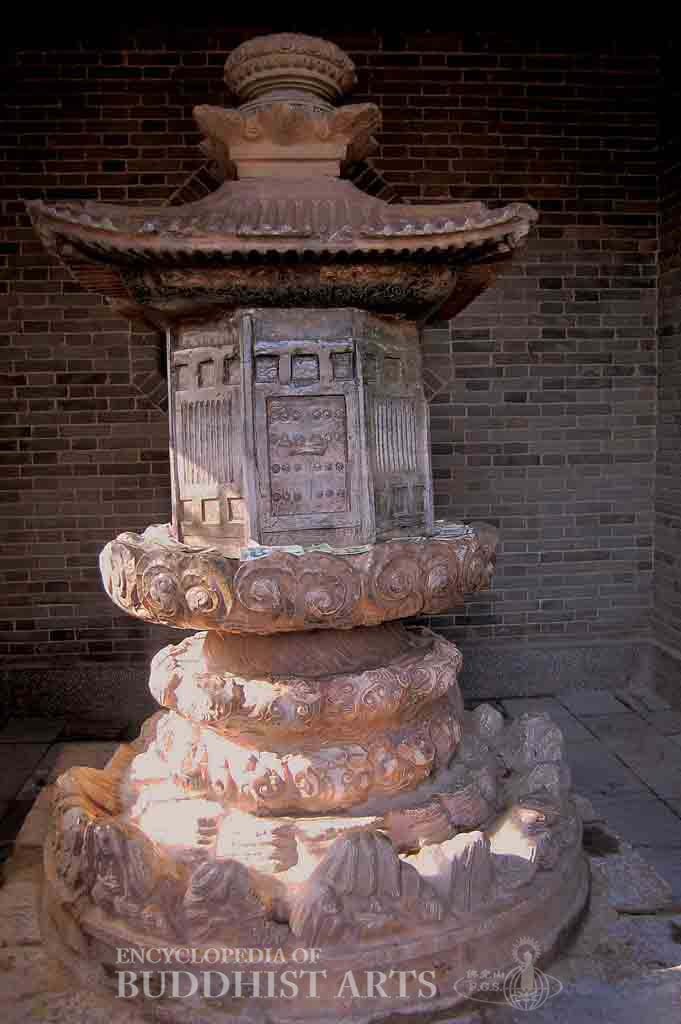
Caotang Temple Kumarajiva Relic Stupa

Caotang Temple Kumarajiva Relic Stupa (detail)
Caotang Temple Kumarajiva Relic Stupa
CHINA, Shaanxi, Xi’an
The stupa was built in 413 during the Later Qin Kingdom for the eminent monk, Kumarajiva. It is constructed from eight types of precious stones in eight different colors: white jade, slate blue, black, bright yellow, light yellow, light blue, reddish purple, and charcoal gray. It is known locally as the Stupa of Eight Precious Stones. It was listed as a National Cultural Heritage Property in 2001.
The octagonal stone stupa is built in a pavilion style and measures 2.5 m in height. The base platform is square and is followed by a three-layer circular Sumeru base. The first layer is carved with mountain peaks, while the second and third layers are in the form of clouds and waves. The stupa body rests upon an upright lotus. On alternate sides of the stupa body there are representations of doors and vertical bar windows. The carved door on the south side includes details such as a lock and doornails, while the door frame on the north side is carved with the words “Relic Stupa of Kumarajiva, the Tripitaka Master of the Later Qin Kingdom.” There are Buddhas and apsaras incised beneath the eaves. The square pyramidal roof is surmounted by an unusual spire. The harmika is followed by a large lotus which supports a big, flat, round jewel.
For more details, go to the Encyclopedia of Buddhist Arts: Architecture A-F, page 121.
Cite this article:
author = Hsingyun and Youheng and Johnson, Peter and Mankuang and Lancaster, Lewis,
booktitle = {Encyclopedia of Buddhist Arts: Architecture A-F},
pages = 121,
title = {{Caotang Temple Kumarajiva Relic Stupa}},
volume = 1,
year = {2016}}