
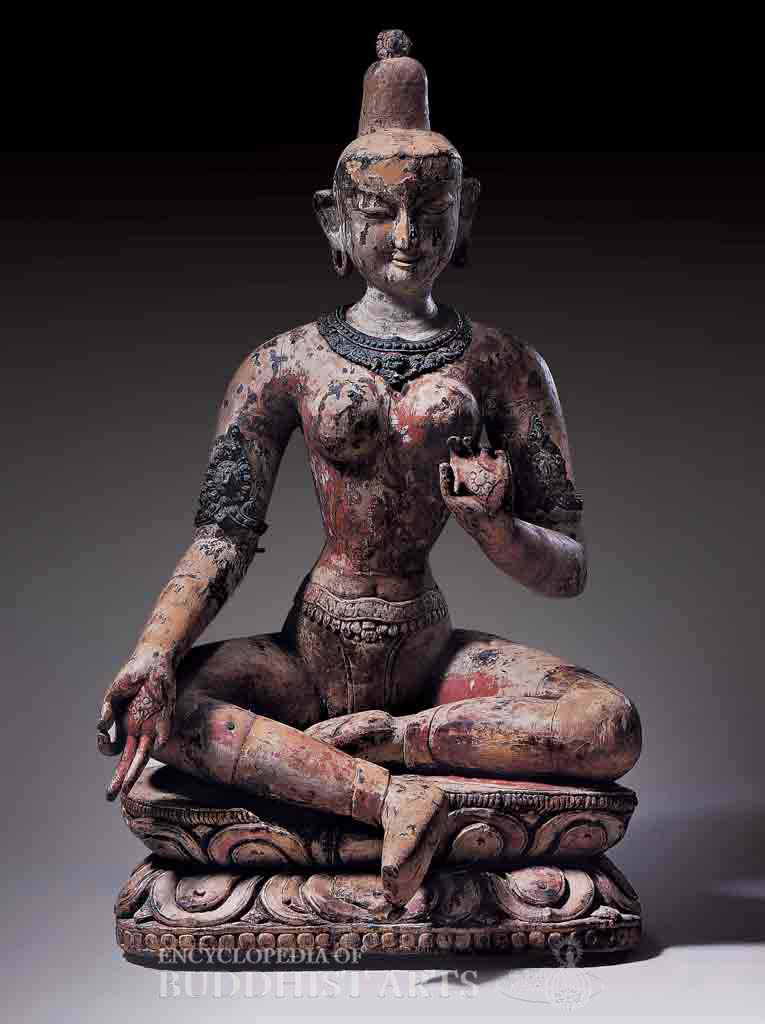
Tara
Wood and copper
Tara
NEPAL
The Museum identifies this form of the Bodhisattva as the Victorious Wisdom Tara. Although carved principally from wood, the figure’s ornaments, that were added later, are made from copper and inlaid with gems. Notable among the ornaments are the floral jewel on top of the large domed usnisa and the lion’s head necklace.
Tara is typically depicted with the full-chested, slim-waisted body of a teenage girl. The Bodhisattva sits in a variation of the royal ease posture on a double lotus throne, with one hand held over the knee and the other raised in vitarka (teaching) mudra showing a variation of the Dharma wheel imprinted on the palms. The imprint on this statue shows an eight petaled lotus contained within a diamond. Much of the original paint is gone, but floral patterns remain on the lower chest and abdomen.
For more details, go to the Encyclopedia of Buddhist Arts: Sculpture St-Z, page 1195.
Cite this article:
author = Hsingyun and Youheng and Lovelock, Yann and Chou, Yuan and Huntington, Susan and Edson, Gary and Neather, Robert,
booktitle = {Encyclopedia of Buddhist Arts: Sculpture St-Z},
pages = 1195,
title = {{Tara}},
volume = 13,
year = {2016}}