
Dazu Rock Carvings Baodingshan Great Buddha Bay Niche 19: Controlling the Six Senses
Stone
Dazu Rock Carvings Baodingshan Great Buddha Bay Niche 19: Controlling the Six Senses
CHINA, Chongqing, Dazu; Southern Song dynasty
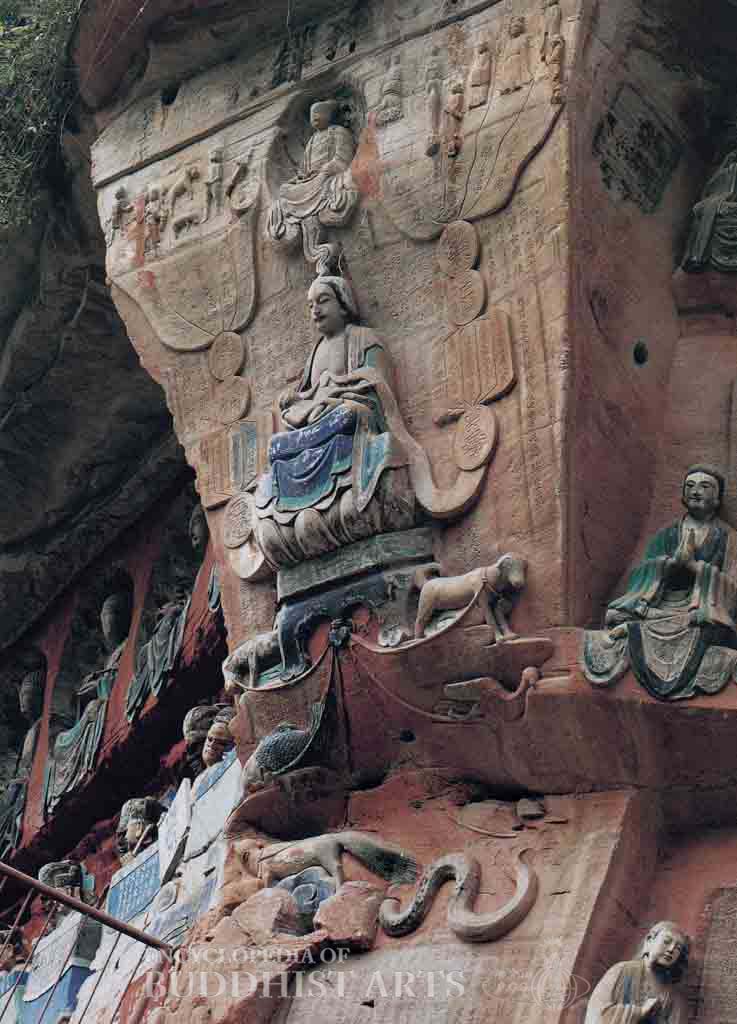
This carving is located on the north cliff. The full title of this scene is “Taming the Restless, Monkey-Like Mind and Controlling the Six Senses,” which is inscribed horizontally above the niche. Inscriptions with the words “Manifested Maitreya Buddha” and “made by Fu Dashi” are also found before and after the title.
The figure in the center of the carving is a practitioner. He sits in full lotus position on a lotus throne holding a monkey, which represents the restless mind. Tethered to the base of the throne are a dog, bird, snake, fox, fish, and horse. These animals represent the six senses: the dog represents sight, the bird is hearing, the snake is smell, the fox is taste, the fish is touch, and the horse is thought. The image is intended to symbolize that control over the mind, which is restless like a monkey, is necessary in order to tame the six senses, which can otherwise be distracting and misleading.
A curved ray of light rises upwards from the top of the figure’s head, touching the base of a round niche containing a Buddha seated in full lotus position. Two other rays of light from the chest of the practitioner drape down on each side. The ray on the right is engraved with the word “virtuous,” above which are “fortune” and “happiness,” which are said to lead to heaven and human realms, as well as Bodhisattva and Buddha states. The ray on the left is carved with “evil,” which results in “misfortune” and “suffering,” and ultimately leads to the lower realms. Another inscription states that people control their fate of going to heaven or hell, or even becoming the Buddha, and that the mind determines actions, which will affect the future.
Zhao Zhifeng, who was in charge of the construction of the Great Buddha Bay, strove to turn the abstract ideas of Fu Dashi into easily recognizable and relatable images.
For more details, go to the Encyclopedia of Buddhist Arts: Caves A-E, page 257.
Cite this article:
author = Hsingyun and Youheng and Johnson, Peter and Mankuang and Huntington, Susan and Edson, Gary and Neather, Robert,
booktitle = {Encyclopedia of Buddhist Arts: Caves A-E},
pages = 257,
title = {{Dazu Rock Carvings Baodingshan Great Buddha Bay Niche 19: Controlling the Six Senses}},
volume = 5,
year = {2016}}