
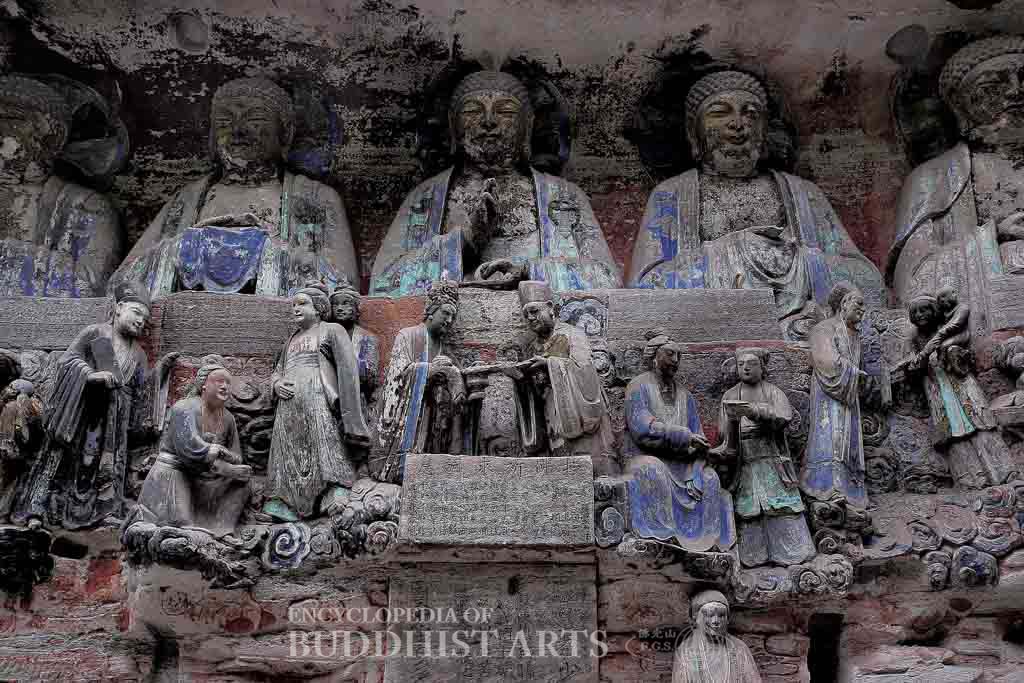
Dazu Rock Carvings Baodingshan Great Buddha Bay Niche 15: Illustration of the Sutra on the Profound Kindness of Parents (detail)
Stone
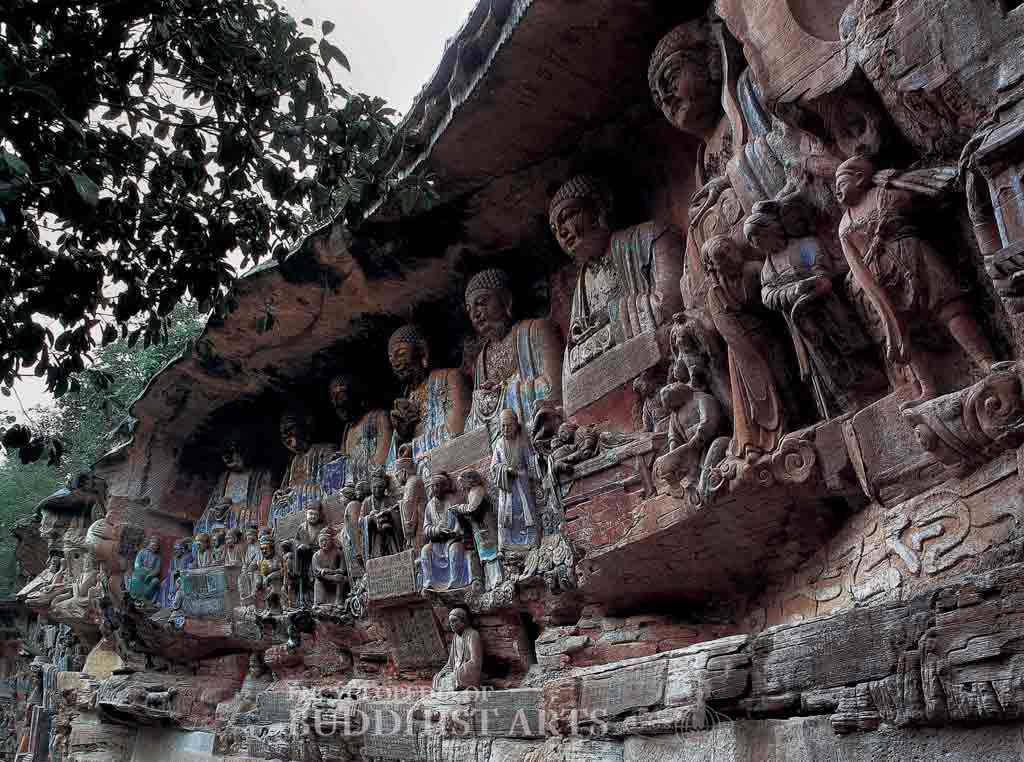
Dazu Rock Carvings Baodingshan Great Buddha Bay Niche 15: Illustration of the Sutra on the Profound Kindness of Parents
Dazu Rock Carvings Baodingshan Great Buddha Bay Niche 15: Illustration of the Sutra on the Profound Kindness of Parents
CHINA, Chongqing, Dazu; Southern Song dynasty
Situated in the north cliff, this niche faces south and measures 14.5 m wide and 6.9 m high. The carved statues are divided into three tiers: the upper tier contains statues of the Seven Buddhas of the Past; the middle tier is based on the Sutra on the Profound Kindness of Parents; and the lower tier illustrates the Avici Hell. There are also seven inscriptions on the cliff wall relating to various sutras.
The Seven Buddhas of the Past and Present wear monastic robes and have round nimbuses. They all have a similar appearance, though their hands form different mudras. From right to left, they are Vipasyin, Sikhin, Visvabhu, Krakucchanda, Kanakamuni, Kasyapa, and Sakyamuni. According to the Sutra of the Seven Buddhas, the first three Buddhas are the final three Buddhas in the past vyuha kalpa, and the last four Buddhas are the first four Buddhas of the current bhadra kalpa.
Eleven scenes from the Sutra on the Profound Kindness of Parents are carved in the middle tier. The central scene is from the “Introductory Chapter” of the sutra, depicting a couple holding an incense burner and praying to the Buddha for a son. Carvings and inscriptions of the ten favors bestowed by parents on their children are depicted on either side of the couple. The left side shows the first favor of providing protection during pregnancy, the third favor of forgetting all of the pain of childbirth once the child has been born, the fifth favor of keeping the child in a dry place, the seventh favor of washing away the filth, and the ninth favor of deep caring and sacrifice. On the right side are the second favor of bearing suffering during childbirth, the fourth favor of eating something bitter so the child may have something sweet, the sixth favor of nourishing the child with the mother’s milk, the eighth favor of being concerned and worried when the child is far away, and the tenth favor of ultimate love and sympathy. These carvings offer insight into family life during the Song dynasty (960–1279). Scenes of beings suffering in the Avici Hell are carved in the lower tier.
For more details, go to the Encyclopedia of Buddhist Arts: Caves A-E, page 247.
Cite this article:
author = Hsingyun and Youheng and Johnson, Peter and Mankuang and Huntington, Susan and Edson, Gary and Neather, Robert,
booktitle = {Encyclopedia of Buddhist Arts: Caves A-E},
pages = 247,
title = {{Dazu Rock Carvings Baodingshan Great Buddha Bay Niche 15: Illustration of the Sutra on the Profound Kindness of Parents}},
volume = 5,
year = {2016}}