
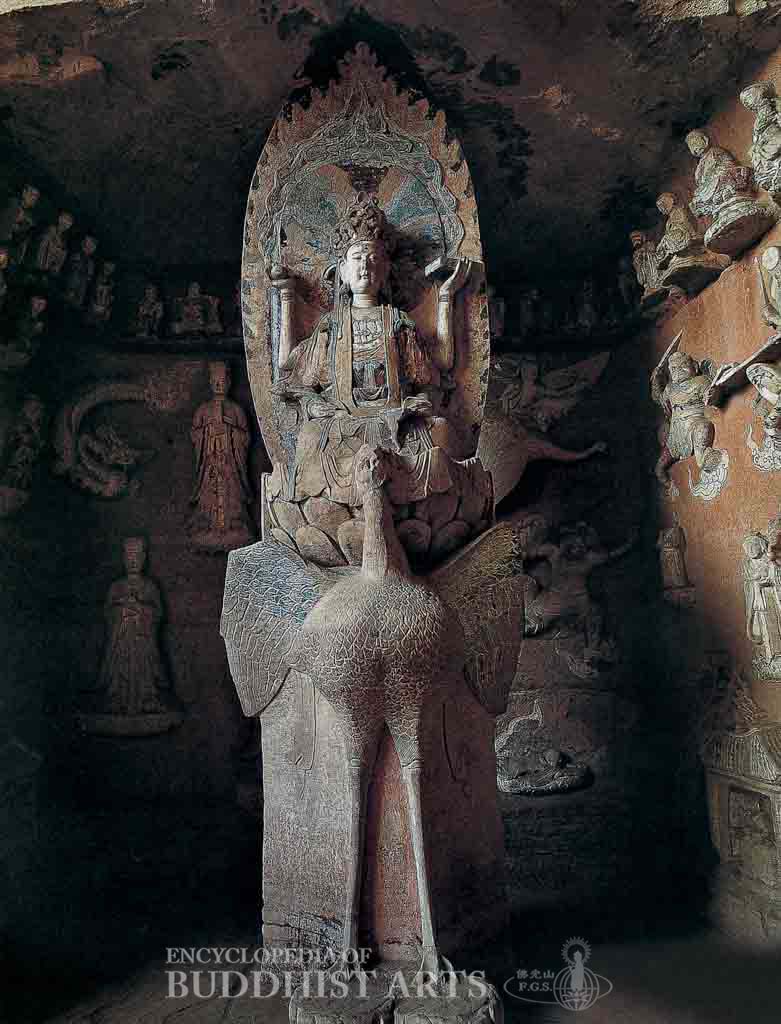
Dazu Rock Carvings Shimenshan Cave 8: Mahamayuri; H: 1.1 m
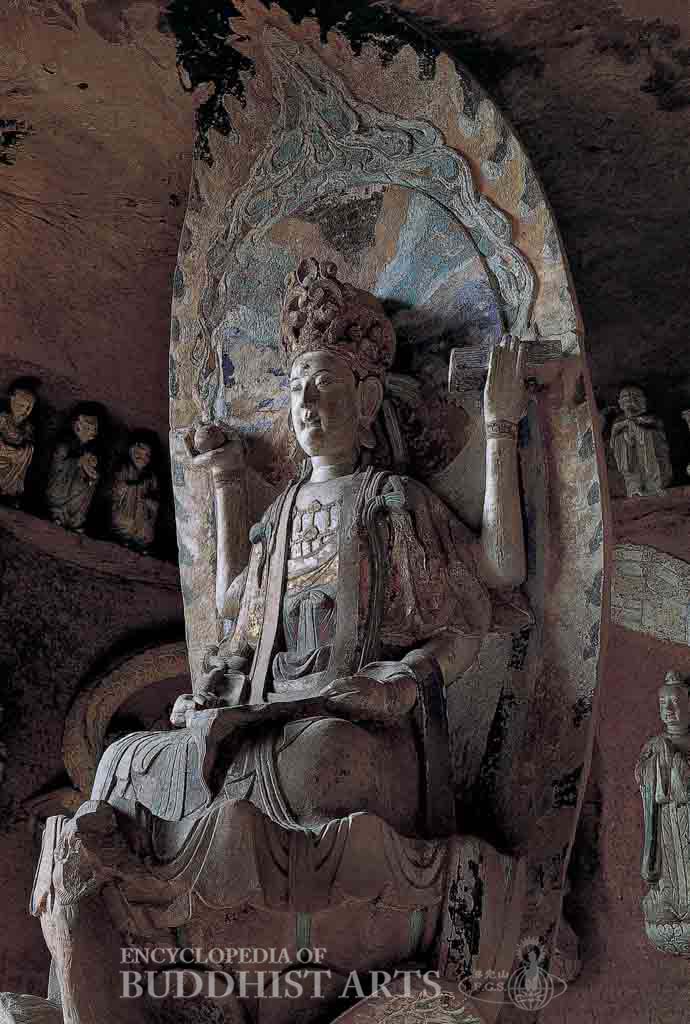
Dazu Rock Carvings Shimenshan Cave 8: Mahamayuri (detail)
Dazu Rock Carvings Shimenshan Cave 8
CHINA, Chongqing, Dazu
Cave 8, also known as Mahamayuri Bodhisattva Cave, dates from the Southern Song dynasty (1127–1279). It has a width of 3.12 m, a height of 3.18 m, and a depth of 2.31 m. A statue of Mahamayuri seated in full lotus position on a lotus throne is found in the center of the cave. The lotus throne rests on the back of a peacock, which in turn stands upon two lotuses. The peacock’s tail flares upwards behind Mahamayuri, forming a mandorla around the Bodhisattva and reaching up to the ceiling to serve as the support pillar for the cave.
Mahamayuri wears a tall headdress, long earrings, a robe, and chest ornaments. The statue has four arms: the upper hands hold a sutra and a wish-fulfilling jewel, while the lower hands hold a fan and a lotus. There is a nimbus surrounded by flames behind the head.
Sculptures carved in several registers are located on the walls of the cave. Of particular interest is the back wall, which contains an illustration from the Mahamayuri Vidyarajni Sutra. The sutra tells the story of a monk named Svati, who was out chopping wood when he was bitten by a poisonous snake. On seeing his condition, the disciple Ananda immediately reported this incident to the Buddha. The Buddha disclosed the Mahamayuri Dharani, which is capable of eliminating all poisons. This carving shows Ananda shouting at a monk lying on the ground near a withered tree with a snake crawling out of it. Another interesting carving is located in the middle register on the right wall. It depicts the battle between the asura king and Sakra of Trayastrimsa Heaven as described in the Dhvajagrakeyura Dharani Sutra. The sutra states that Sakra was defeated by the asura king, prompting the Buddha to disclose the dharani to Sakra to teach him how to overcome his enemy.
For more details, go to the Encyclopedia of Buddhist Arts: Caves A-E, page 299.
Cite this article:
author = Hsingyun and Youheng and Johnson, Peter and Mankuang and Huntington, Susan and Edson, Gary and Neather, Robert,
booktitle = {Encyclopedia of Buddhist Arts: Caves A-E},
pages = 299,
title = {{Dazu Rock Carvings Shimenshan Cave 8}},
volume = 5,
year = {2016}}