
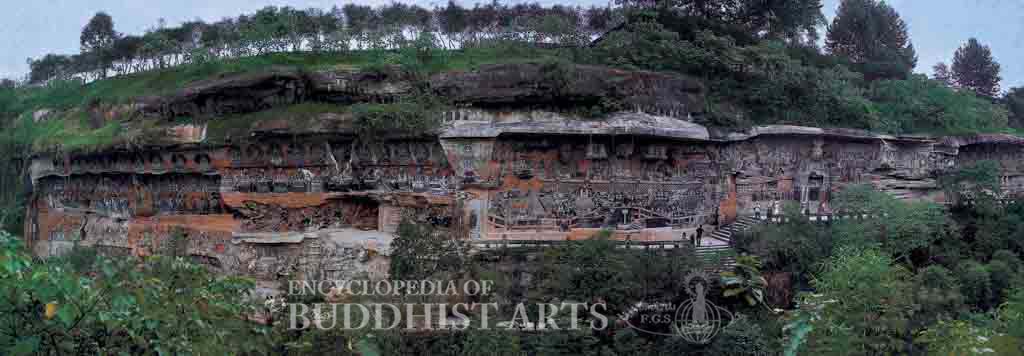
Dazu Rock Carvings: Baodingshan Great Buddha Bay - North Cliff
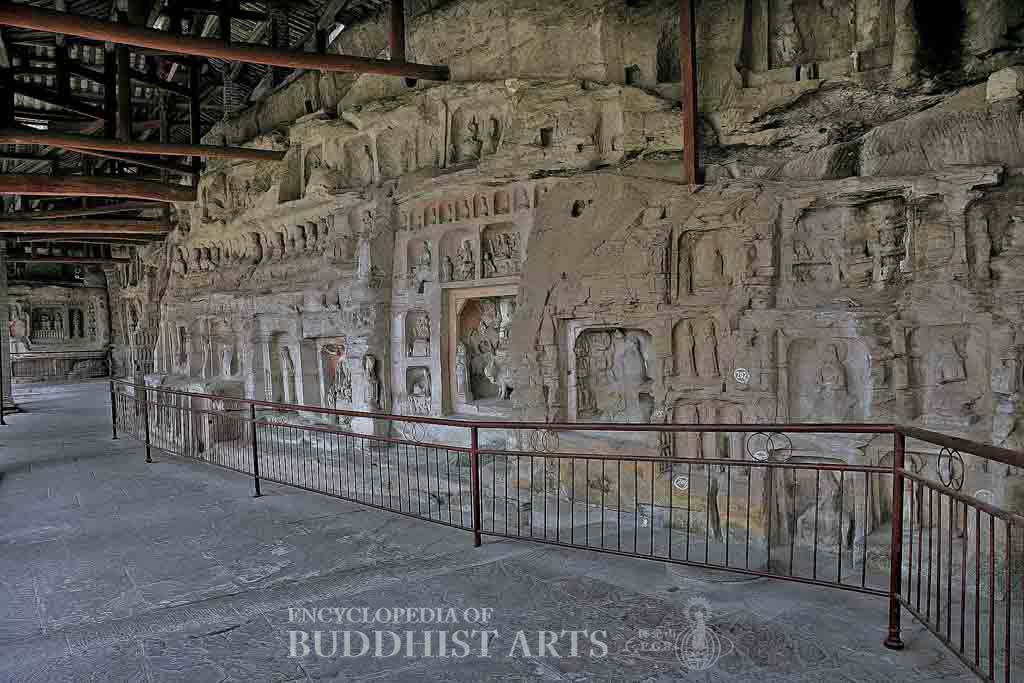
Dazu Rock Carvings: Beishan
Dazu Rock Carvings
CHINA, Chongqing, Dazu
These carvings are located in the mountains southwest, northwest, and northeast of Dazu, Chongqing. In total, the site encompasses 74 numbered cave clusters, more than 60,000 sculptures and carvings, and over 150,000 Chinese characters of sutra engravings, inscriptions, chronicles, and praises. The sculptures at Dazu best represent the Chinese culture among cave arts. The cave clusters at the site are distributed among Beishan (North Mountain), Baodingshan (Treasure Peak Mountain), Nanshan (South Mountain), Shizhuanshan (Stone Seal Mountain), Shimenshan (Stone Gate Mountain), Miaogaoshan (Wonderful Heights Mountain), and Shuchengyan. Beishan and Baodingshan are the most representative, reflecting the development of cave art during the Late Tang period (846–907), the Five Dynasties (907–960), and the Song dynasty (960–1279). The Dazu Rock Carvings were listed as a UNESCO World Heritage Site in 1999.
Beishan is 2.5 km northwest of Dazu. Sculptures are scattered around the Buddha Bay, Avalokitesvara Slope, the Cliff of Buddha Ears, and Yingpan Slope. The Buddha Bay is the oldest cave cluster at Dazu, with construction beginning in the year 892. The period from the Five Dynasties through the Southern Song dynasty was the most productive. In addition to Buddhist caves and niches housing statues and reliefs, there are also carvings of sutra pillars, stupas, and memorial statues of officials. There are 290 numbered caves and niches running from south to north, with a total of over 4,360 sculptures. The sculptures depict Sakyamuni Buddha, Amitabha Buddha, the Medicine Buddha, Ksitigarbha Bodhisattva, Avalokitesvara Bodhisattva, Samantabhadra Bodhisattva, and Manjusri Bodhisattva. The southern and northern sculptures primarily date from the Late Tang period and the Five Dynasties, while the carvings in the central area date to the Song dynasty.
Baodingshan is 17.5 km northeast of Dazu. The 18 sculpture groups cluster around the Great Buddha Bay in the valley northwest of Shengshou Temple, and the Small Buddha Bay east of the temple. The Great Buddha Bay is a deep, horseshoe-shaped valley with a length of approximately 500 m. There are no repeated themes among the carvings, suggesting a high level of cohesion, advanced planning, and organization. The surface of the cliffs has inscriptions describing the content of the sculptures, together with related sutras, praises, and verses. The sculptures were carved as described in the inscriptions, and their themes and content include the principles of Buddhism and its most important sutras.
The Small Buddha Bay consists of the ruins of Benzun Hall of Shengshou Temple, thought to have been constructed by Zhao Zhifeng prior to the carving of the Great Buddha Bay. The main structure is a large, cave-like altar chamber, constructed entirely of stone. It contains over 1,200 sculptures and carvings. The statues and inscriptions at Small Buddha Bay all relate to Vajrayana Buddhism. It was a place for meditation, Vajrayana initiation, taking precepts, and cultivation. The Great Buddha Bay is an enlarged and more complete version of the Small Buddha Bay. The themes of the sculptures there include both Mahayana and Vajrayana teachings, and their methods of practice.
Shimenshan is located 20 km southeast of Dazu. The sculptures and carvings at this site are scattered around Shimenshan and Chenjiayan (Chen Family Cliff). They depict themes from both Buddhism and Daoism. The Buddhist sculptures portray figures such as the Medicine Buddha, Sakyamuni Buddha, Avalokitesvara, Mahamayuri, and Hariti.
Shizhuanshan is located 22.5 km southwest of Dazu. The sculptures are distributed on Shizhuanshan itself and the nearby Thousand Buddha Cliff. The carvings at these sites illustrate Buddhist, Confucian, and Daoist themes.
Miaogaoshan is 37.5 km southwest of Dazu. With the exception of the second niche, which has a combination of Buddhist, Confucian, and Daoist themes, all the other niches house Buddhist statues, including Avatamsaka Triad, Avalokitesvara, Ksitigarbha, and Arhats.
The Dazu Rock Carvings make a vital contribution to Chinese cave art. In total, Buddhist themes make up approximately 80 percent of the works, with the others being Confucian and Daoist. Some sculptures focus on one of the three religions, some combine two, and some even combine all three. This is a unique feature of Dazu rarely seen anywhere else in China. Among the Buddhist sculptures, the themes and forms reflect the fact that many branches of Buddhism were popular in the region. The integration of themes from everyday life into the carvings enlivens the works and presumably made them more accessible to the common people living in the region. It is clear that the intricate compositions, especially seen in the caves in Baodingshan, were carefully planned and precisely executed. The many statues are distributed in an orderly manner, fully displaying the development of Buddhist sculpture in the Sichuan area during the period between the Tang and Song dynasties.
For more details, go to the Encyclopedia of Buddhist Arts: Caves A-E, page 231.
Cite this article:
author = Hsingyun and Youheng and Johnson, Peter and Mankuang and Huntington, Susan and Edson, Gary and Neather, Robert,
booktitle = {Encyclopedia of Buddhist Arts: Caves A-E},
pages = 231,
title = {{Dazu Rock Carvings}},
volume = 5,
year = {2016}}