
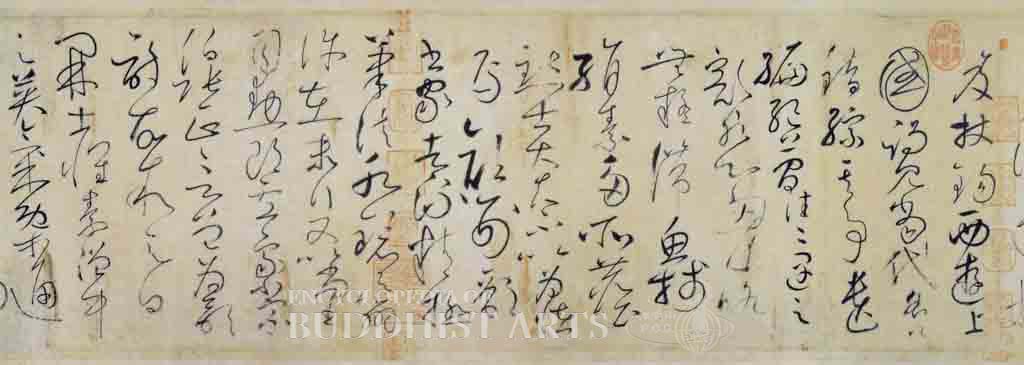
Autobiography of Huaisu by Huaisu (detail); Tang dynasty, dated 777
Ink on paper
Huaisu
CHINA, Hunan, Changsha; Tang dynasty
Huaisu was a monk and calligrapher who had an original surname of Qian and an alias of Cangzhen. He enjoyed reading Buddhist texts since he was young, in addition to calligraphy. Since his family was too poor to purchase paper, it is said that Huaisu planted a large amount of banana trees and used the leaves to practice his calligraphy upon; thus his former residence is now called the Green Heaven Hut. Originally modeling his calligraphy after masters such as Ouyang Xun and Zhang Xu, he later traveled to Chang’an (present day Xi’an, Shaanxi), and paid a tribute to contemporary calligraphy masters such as Wu Tong and Yan Zhenqing. This experience allowed for his exposure to various ancient books and rare calligraphic works.
Having a free and indulgent character, Huaisu was not restricted by small details in behavior, which was expressed through his famed wild cursive script. He motioned his brushstrokes as if heavy rain and swirling wind storms, which changed unpredictably yet remained meticulous. Huaisu’s later works were of a more ordinary style and self-claimed that he deeply obtained the Samadhi of a cursive script saint. His wild cursive script style followed that of Zhang Xu, and together, the two were often referred to as Crazy Zhang, Drunk Su.
Huaisu is considered to be the most notorious calligrapher among Chinese Buddhist monks. His calligraphic works continue to circulate still and today are regarded as rare treasures that are highly influential. His extant works include Autobiography of Huaisu and Thousand Character Classic in cursive script, both of which are kept at the National Palace Museum in Taipei, Taiwan. In addition, Bitter Bamboo Shoot Note is kept at the Shanghai Museum, and Treatise on Calligraphy is kept at the Liaoning Provincial Museum in Shenyang.
For more details, go to the Encyclopedia of Buddhist Arts: People, page 99.
Cite this article:
author = Hsingyun and Youheng and Youlu and Pokorski, Stefanie and Yichao and Mankuang and Miaohsi,
booktitle = {Encyclopedia of Buddhist Arts: People },
pages = 99,
title = {{Huaisu}},
volume = 19,
year = {2016}}