
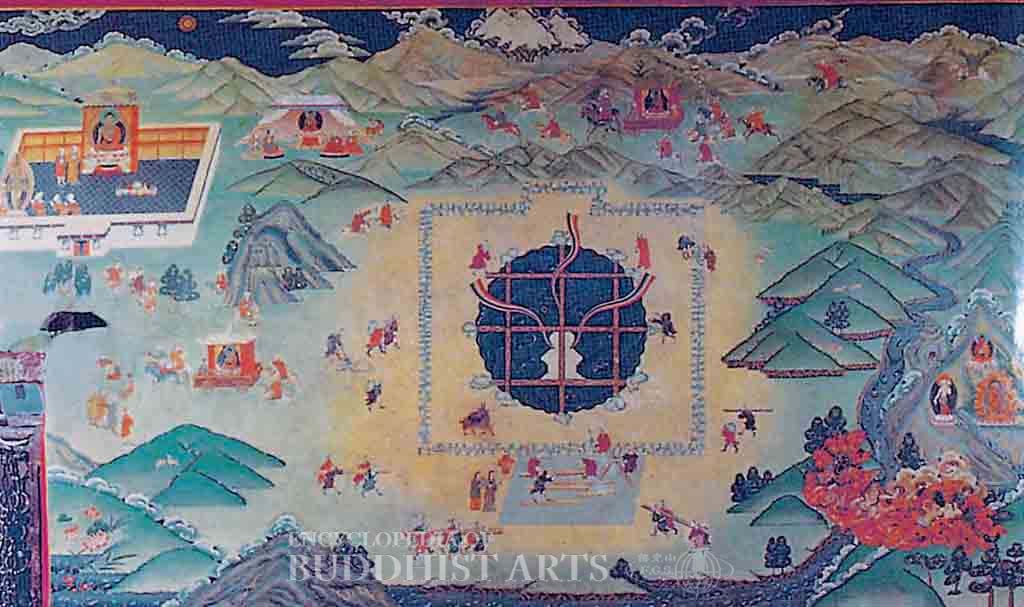
Jokhang Temple Murals: Circumambulation Path - Construction of Jokhang Temple and Princess Wencheng’s Journey
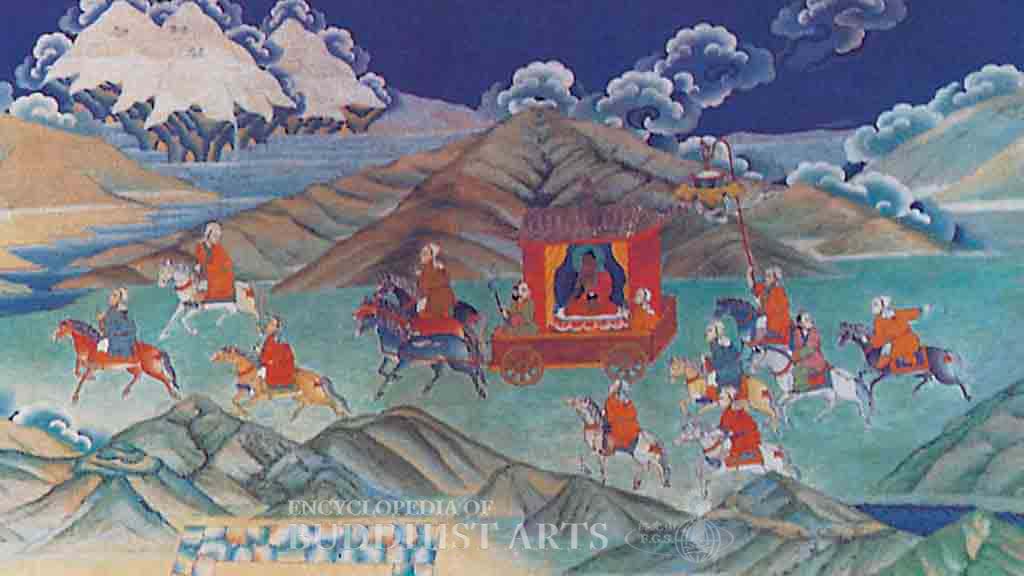
Jokhang Temple Murals: Circumambulation Path - Princess Wencheng’s Journey - Traveling to Tibet
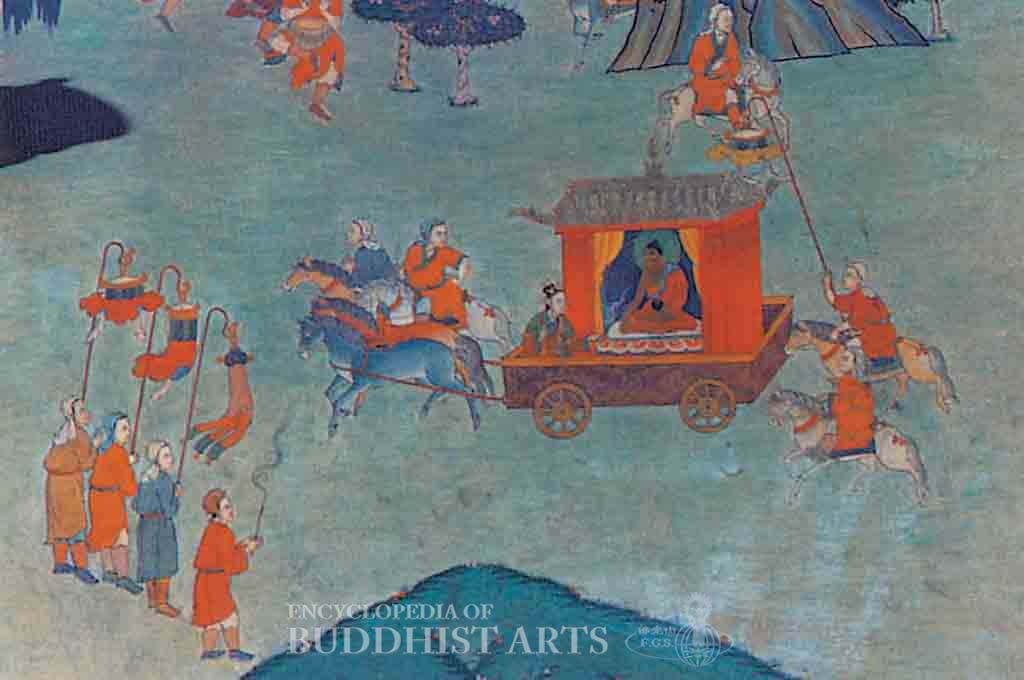
Jokhang Temple Murals: Circumambulation Path - Princess Wencheng’s Journey - Arriving at Tibet
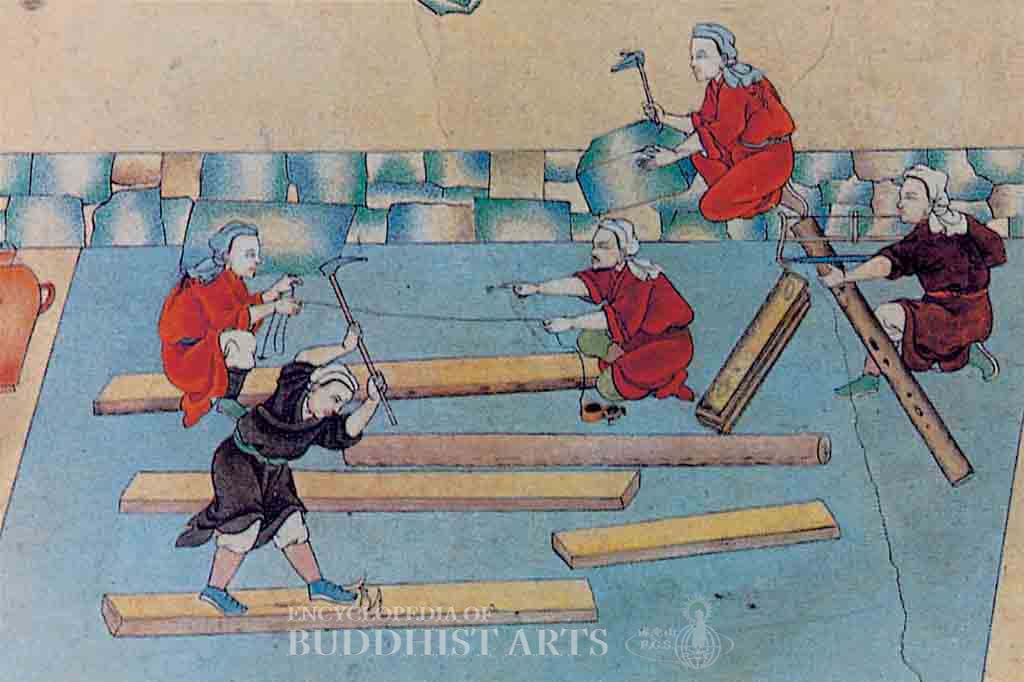
Jokhang Temple Murals: Circumambulation Path - Construction of the Jokhang Temple - Sawing Timber
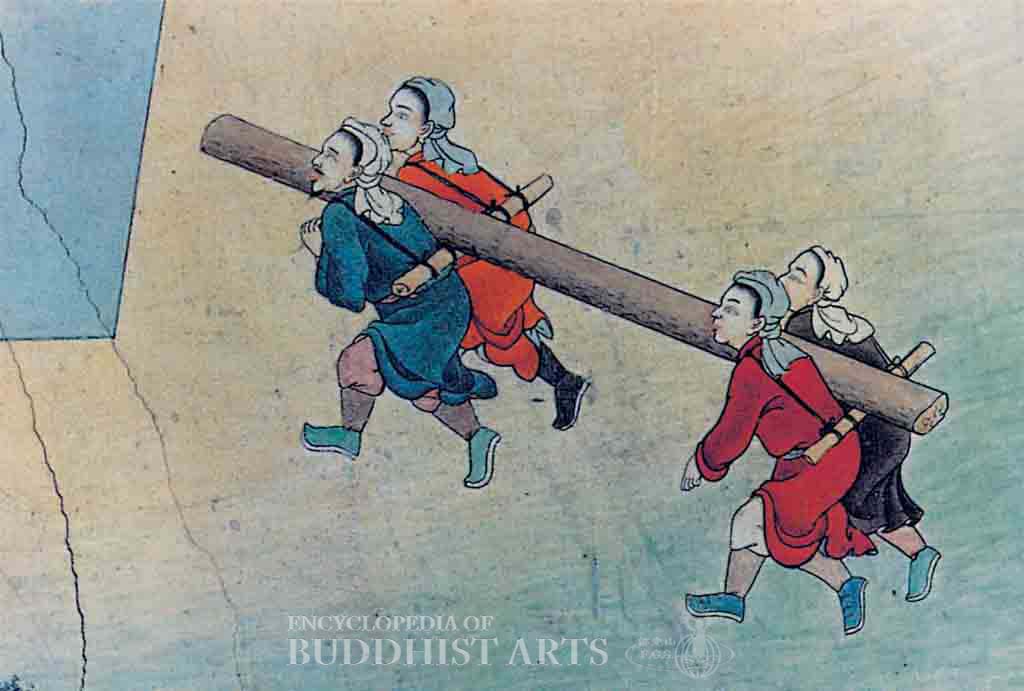
Jokhang Temple Murals: Circumambulation Path - Construction of the Jokhang Temple - Transporting Logs
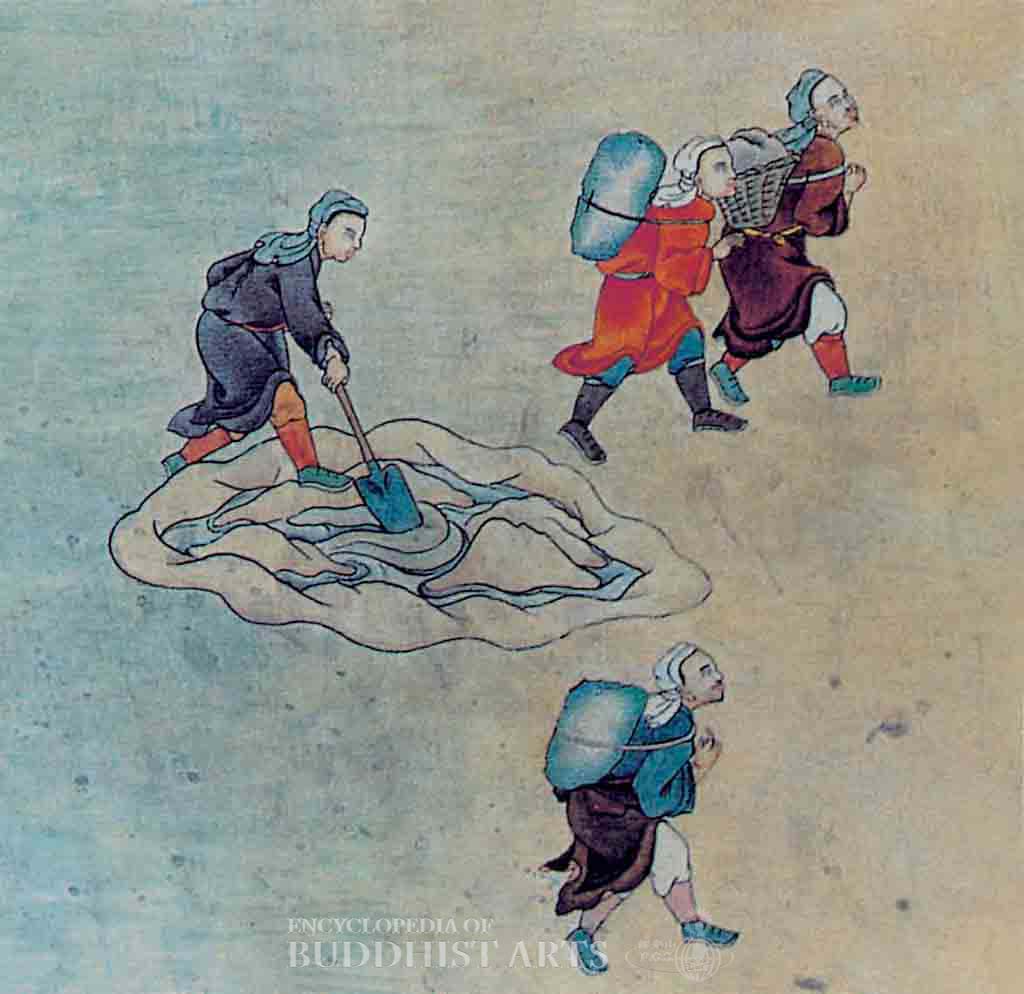
Jokhang Temple Murals: Circumambulation Path - Construction of the Jokhang Temple - Transporting Sand

Jokhang Temple Murals: Central Hall - Buddha Pentad
Jokhang Temple Murals
CHINA, Tibet, Lhasa
Jokhang Temple was built in the mid-7th century by Songtsan Gampo (reigned 629–650) and his wives, the Nepali Princess Bhrkuti and the Chinese Princess Wencheng. The temple was expanded repeatedly by succeeding dynasties. In the mid-17th century, the Fifth Dalai Lama carried out a large expansion and renovation that forms the present-day structure.
The central hall is a traditional Tibetan-style building with a circumambulation path. The walls along the path are painted with murals illustrating Buddhist stories, the lives of important Tibetan figures, and Vajrayana mandalas. Among these murals there are images of Princess Wencheng’s Journey and the Construction of Jokhang Temple. There are also 108 scenes from the Life of the Buddha that are based on descriptions in the History of the Desirable Precious Tree.
The murals of Princess Wencheng’s Journey begin with Traveling to Tibet, in which the princess is shown riding on a carriage down a road that runs between rocky mountains. The princess sits on the outside of the carriage, while inside, beneath the canopy, there is an image of Sakyamuni Buddha. The carriage is drawn by three horses and accompanied by a group of riders. In the next image, the princess’ carriage is welcomed by figures holding banners and playing instruments. Another series of murals depicts the construction of Jokhang Temple, including rare portrayals of workers cutting timber, transporting logs, and moving sand.
Inside the central hall, a few precious images from the time of the Tibetan Empire (circa 7th–9th century) still remain, although many of the details have worn away. Among them is a mural of a Buddha Pentad. The Buddha wears a three-leaf crown and has a petal-shaped nimbus. He sits in full lotus position on a lotus throne and forms a mudra. Four Bodhisattvas with similar crowns and nimbuses flank the Buddha. Below the lotus throne there are two small lions.
For more details, go to the Encyclopedia of Buddhist Arts: Painting I-O, page 394.
Cite this article:
author = Hsingyun and Youheng and Youlu and Wilson, Graham and Manho and Mankuang and Huntington, Susan,
booktitle = {Encyclopedia of Buddhist Arts: Painting I-O},
pages = 394,
title = {{Jokhang Temple Murals}},
volume = 15,
year = {2016}}