
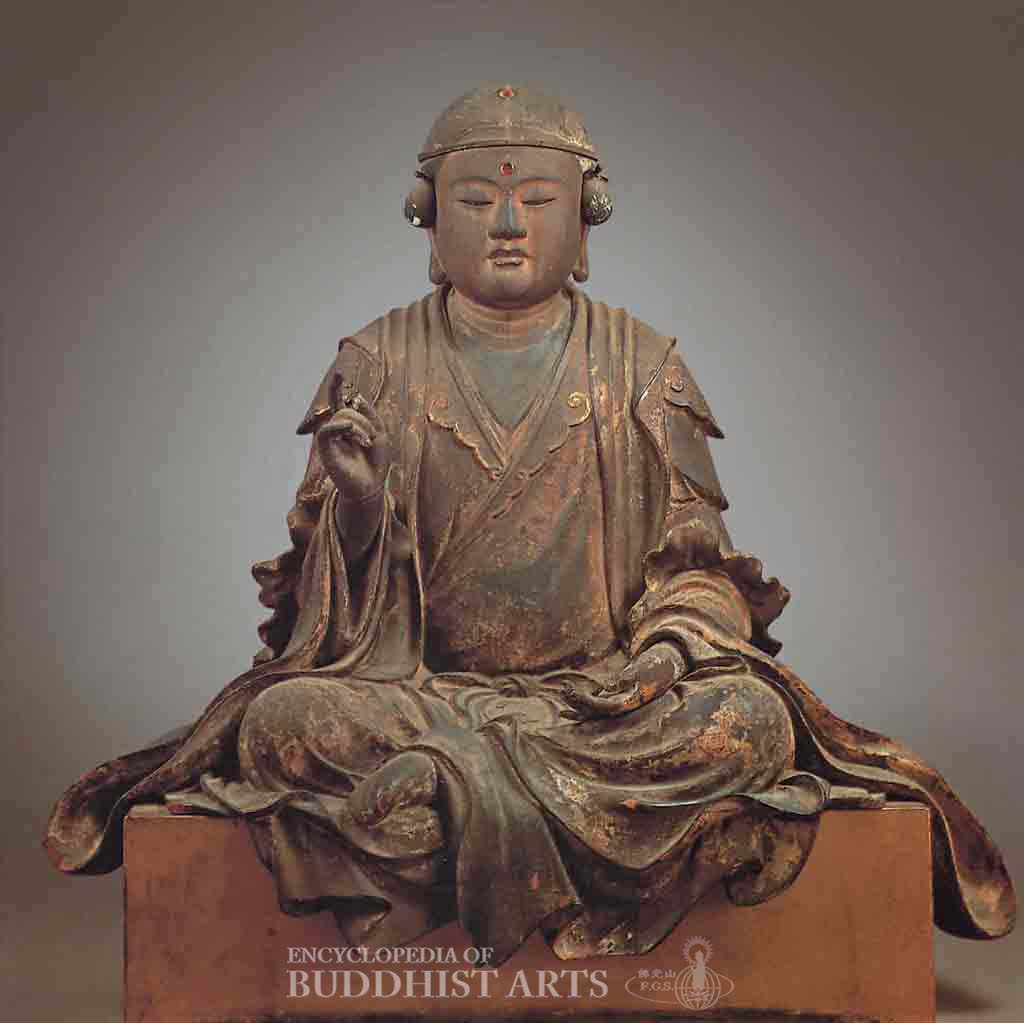
Ninnaji Temple: Prince Siddhartha
Wood
Ninnaji Temple: Prince Siddhartha
JAPAN, Kyoto; Kamakura period
This sculpture is a work of Master Inchi from the mid-13th century according to an inscription found in the statue. The figure was assembled from several pieces of wood with details molded in clay later. The statue is said to depict Prince Siddhartha before renouncing royal life, a very rare subject in Japan. An alternative interpretation is that this is a cult image of Prince Shotoku. The sculpture was listed as an Important Cultural Property in 1918.
The adolescent figure is fashionably dressed as a Japanese prince and sits with legs crossed and eyes serenely lowered. The long hair is kept in place by a fillet and wound in the youth’s style on either side of the head. The stone that formed the urna, one of the signs of a future Buddha, is now missing from the forehead. The left hand is lowered in the lap and the index finger of the right hand is raised, perhaps conveying some doctrinal point. The figure also shares many features with images of Prince Shotoku. The refined facial appearance and decorative garment is characteristic of the Inpa school.
For more details, go to the Encyclopedia of Buddhist Arts: Sculpture N-Sr, page 764.
Cite this article:
author = Hsingyun and Youheng and Lovelock, Yann and Chou, Yuan and Huntington, Susan and Edson, Gary and Neather, Robert,
booktitle = {Encyclopedia of Buddhist Arts: Sculpture N-Sr},
pages = 764,
title = {{Ninnaji Temple: Prince Siddhartha}},
volume = 12,
year = {2016}}