
Amaravati: Prince Visvantara Jataka
Limestone
Amaravati: Prince Visvantara Jataka
INDIA, Andhra Pradesh, Amaravati; Satavahana period
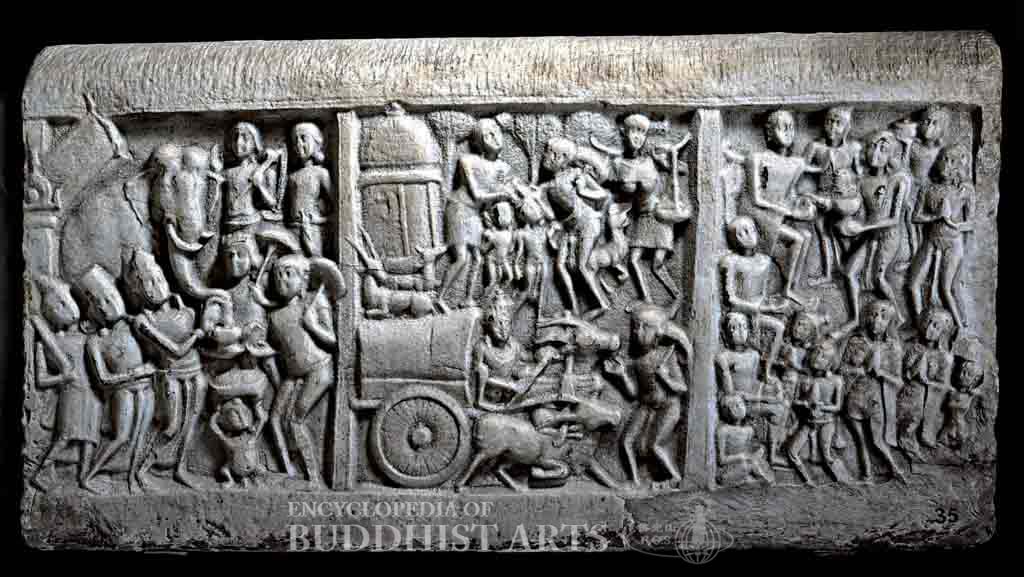
These reliefs were on a section of the railings from Amaravati. The artwork is divided into three sections illustrating episodes from the Prince Visvantara Jataka. The work blends a composite narrative approach in individual sections with a sequential progression, thus allowing the depiction of more incidents from the story. The carving is the product of Amaravati’s middle period, and figures are portrayed with the slender arms and legs typical of its sculptural style.
Three brahmins, in the left section, are asking for the white elephant, which the generous crown prince allows. He holds a vase, which conventionally signifies permission. The upper register follows the prince’s expulsion by the king for having given away this national treasure. The lower register of the central section depicts the prince donating his cart to a brahmin while traveling. He is shown again above with his family that are settled in the forest.
The final section shows Prince Visvantara eventually giving away his wife and children to the brahmin who was Sakra in disguise. The heavenly being, moved by this final test of his generosity, blesses the prince, who is then welcomed back to the palace after his virtuous deeds are recognized.
For more details, go to the Encyclopedia of Buddhist Arts: Sculpture A-F, page 25.
Cite this article:
author = Hsingyun and Youheng and Lovelock, Yann and Chou, Yuan and Huntington, Susan and Edson, Gary and Neather, Robert,
booktitle = {Encyclopedia of Buddhist Arts: Sculpture A-F},
pages = 25,
title = {{Amaravati: Prince Visvantara Jataka}},
volume = 10,
year = {2016}}