
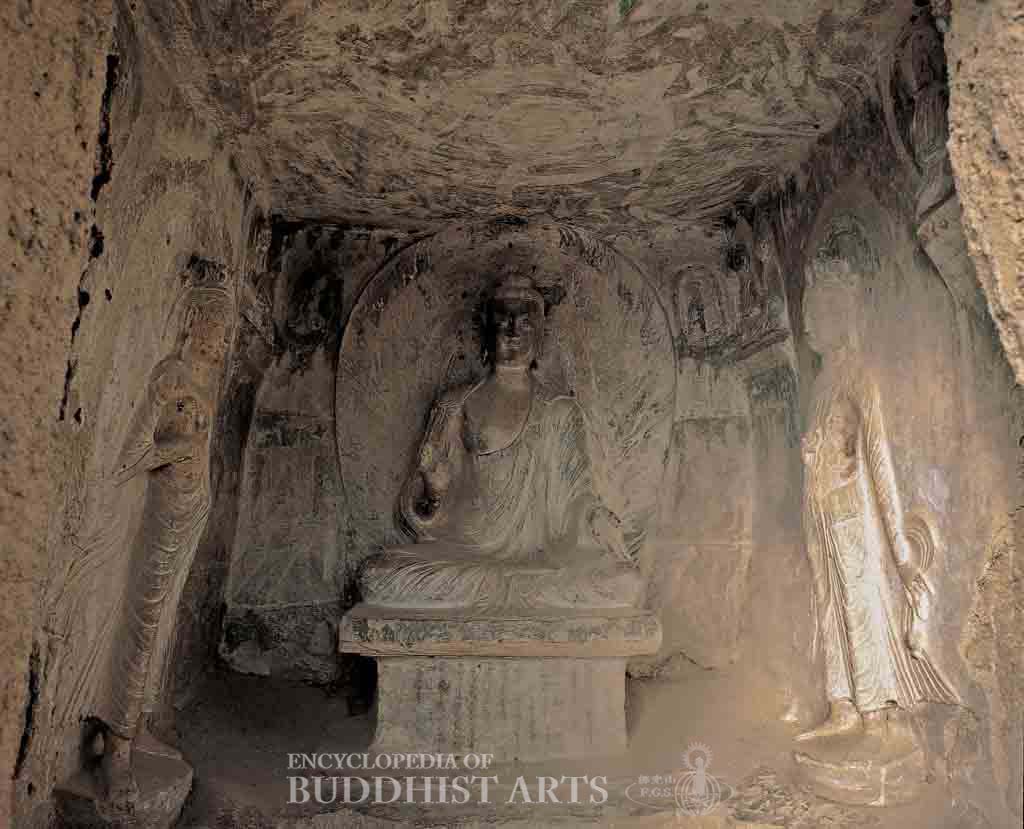
Maijishan Grotto 115
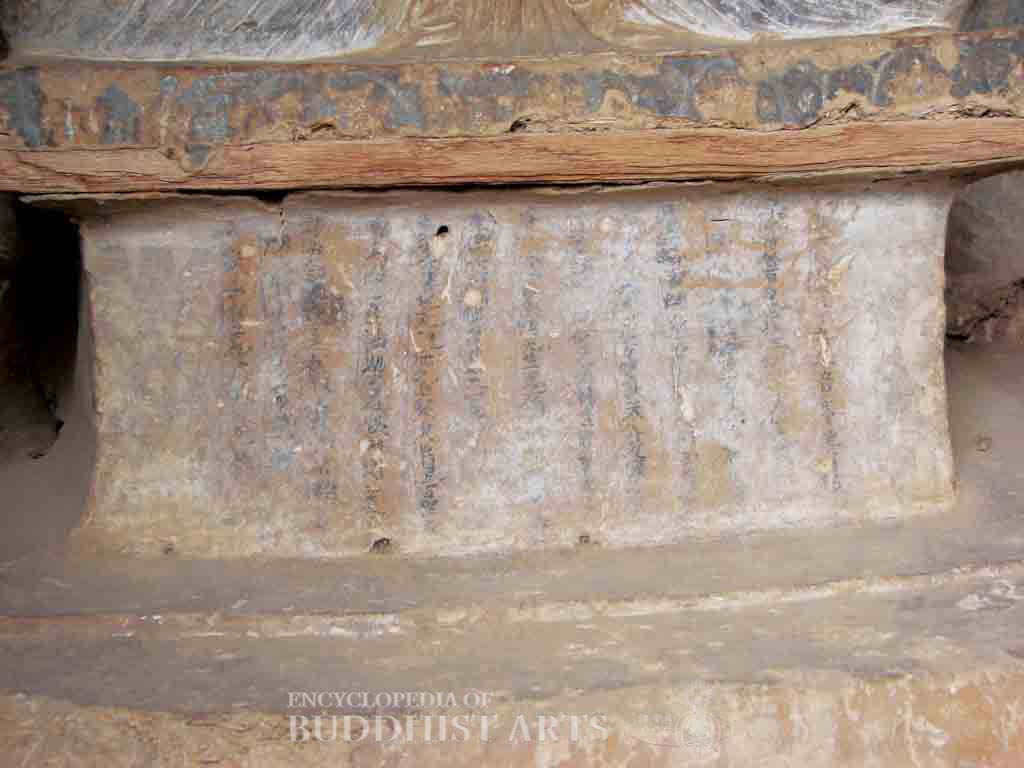
Maijishan Grotto 115: Inscription (back wall, front of throne)
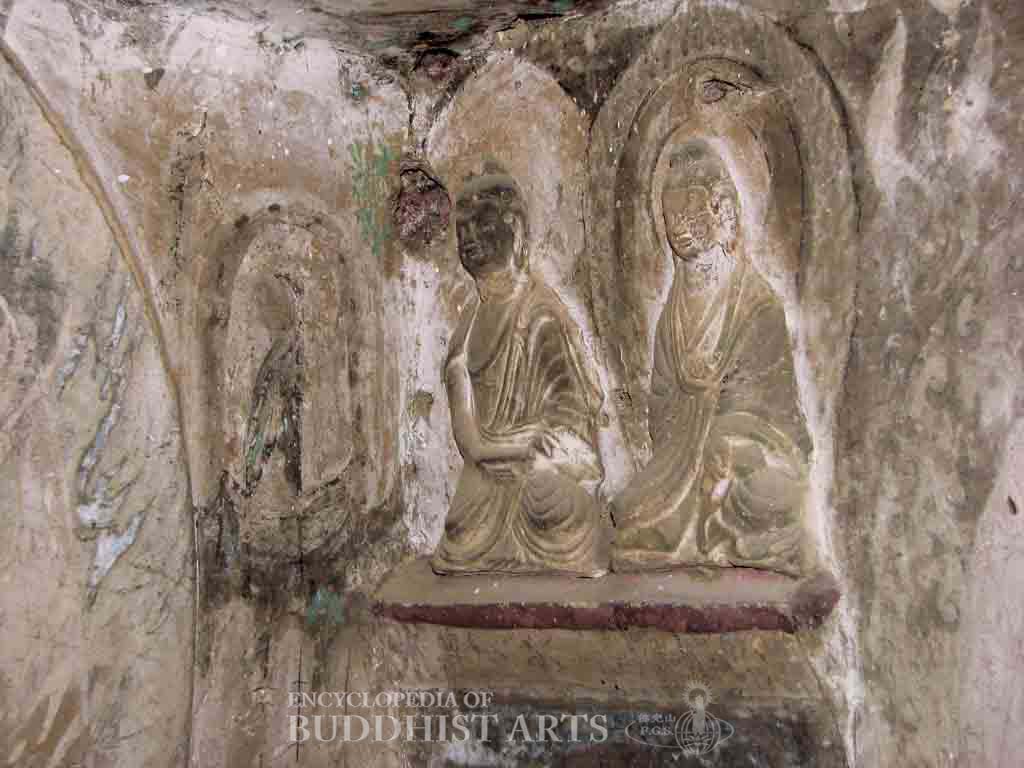
Maijishan Grotto 115: Small Seated Buddhas (right wall, upper section)
Maijishan Grotto 115
CHINA, Gansu, Tianshui
Excavated in the Northern Wei dynasty (386-534), this small grotto is located in the upper tier of the west cliff. It is 95 cm in width, 93 cm in height, and 90 cm in depth, and houses one Buddha and two Bodhisattvas. The main Buddha, seated in full lotus position on a rectangular throne, is 86 cm in height. The right hand forms the abhaya (fearlessness) mudra and the left hand displays the varada (wish-granting) mudra. Behind the Buddha, there is a mandorla with a flame pattern, and two monks are found on either side of the mandorla. On each side wall is an attendant Bodhisattva, 76 cm in height, who stands on a semicircular pedestal. The Bodhisattvas are adorned with jewelry and wear stoles and dhotis. Their left hands hold vases and their right hands hold flowers at their chests. There is a mandorla with a flame pattern on the wall behind each Bodhisattva. Two small seated Buddha are carved between each Bodhisattva and the main Buddha.
The paintings on the back and side walls portray karma stories, apsaras, monks making offerings, and coiling dragons. One mural portrays the winged demonic king called Kalmasapada, who captures King Sutasoma while he was bathing in a forest. The mural features a castle, brahmins, birds, a winged figure, forests, the teaching of the Dharma under a tree, and yaksas. These depictions match the descriptions in Buddhist scriptures such as the Sutra of the Wise and the Foolish. The mural is in the style of the Southern Dynasties (420–589).
This small grotto is the only one in the Maijishan Grottoes that preserves an inscription from the Northern Wei dynasty. This inscription found on the front of the Buddha’s throne consists of 13 rows and 190 characters. The inscription has been a useful reference point for dating the contents of the Maijishan Grottoes.
For more details, go to the Encyclopedia of Buddhist Arts: Caves M-Mo, page 761.
Cite this article:
author = Hsingyun and Youheng and Johnson, Peter and Mankuang and Huntington, Susan and Edson, Gary and Neather, Robert,
booktitle = {Encyclopedia of Buddhist Arts: Caves M-Mo},
pages = 761,
title = {{Maijishan Grotto 115}},
volume = 7,
year = {2016}}